The market is about to receive three payroll reports in the space of a few weeks, and almost all of the attention will land on the wrong number. The headline count of jobs gained or lost is a lagging, heavily revised figure that tells you where the labor market was, not where it is turning. The information that actually prices recession risk is buried one layer down: the cumulative trajectory of the cyclical sectors, and whether the two reliable counter-cyclical cushions are still absorbing losses or have begun to crack.
That distinction matters more than usual right now because the data through August already showed a marked deceleration in job growth, and the alternative series released during the shutdown pointed to that weakness persisting through September and October. When three delayed reports arrive in rapid succession, the temptation is to average the top lines and move on. The sharper read comes from watching the composition change across those three prints, because composition is where every historical downturn announced itself before the aggregate number confirmed it.
Why the Headline Is the Wrong Anchor
The structure of the American labor force has shifted so far since 1950 that the sectors which drove past recessions no longer employ enough people to drive the aggregate on their own. Manufacturing was nearly a third of all payrolls in the 1950s. Today it is roughly 8 percent. Construction has held steady at about 5 percent across the entire post-war period. Together, the two most rate-sensitive, most cyclically violent sectors of the economy now account for only about 13 percent of employment.
That is the trap in the headline number. The five largest sectors, Retail and Transportation, Education and Health Services, Government, Professional and Business Services, and Leisure and Hospitality, hold roughly three-quarters of all jobs. When you average a soft cyclical print against a still-expanding health services print, the aggregate can look benign while the leading edge of the labor market is already contracting. The composition shift means the recession signal has migrated away from the number everyone quotes.
The Sectors That Actually Turn First
In the recessions of the 1970s and 1980s, manufacturing and construction did nearly all the work. When those two sectors rolled over, total employment rolled over with them, and the correlation was tight enough that a single-sector read was almost sufficient. That is no longer true.
Across 1990, 2001, and 2008, the job losses spread. Manufacturing and construction still contributed, but retail and transportation, professional and business services, and leisure and hospitality became significant sources of the decline. This is the mechanism that connects composition to market consequence: a modern recession does not arrive as a manufacturing collapse that the aggregate absorbs. It arrives as a broadening, where sector after sector crosses from expansion into contraction. The signal is not the depth of any one line; it is the count of how many cyclical lines have turned negative at the same time.
So the discipline for reading the three coming reports is to track the cumulative change in each of the eight largest sectors from its own recent peak, not the month-over-month aggregate. If manufacturing and construction weaken alone, that is the old, contained pattern the aggregate can withstand. If professional and business services and leisure and hospitality begin to join them, that is the broadening that has preceded every recession since 1990, and it is the configuration the equity market is not currently pricing.
Where the Cushion Lives
Two sectors have historically expanded straight through downturns and offset the cyclical bleed: government employment and education and health services. In prior recessions these two counter-cyclical lines kept rising while manufacturing and construction fell, and their steady growth is a large part of why aggregate payrolls have looked less alarming than the cyclical detail underneath.
This is the load-bearing observation for the coming reports. The recession risk is not fully expressed until the cushion stops cushioning. As long as health services and government keep adding jobs at their trend pace, the aggregate can decline gently even as the cyclical sectors deteriorate, and the market can keep telling itself the slowdown is orderly. The dangerous configuration is the one where the counter-cyclical sectors flatten or turn while the cyclical sectors are already falling, because that removes the statistical support that has been holding the headline together.
There is a complication worth naming on the government line specifically. The record-length shutdown distorts federal payroll counts directly through furloughs and their reversal, so the government series in these particular reports will carry noise that has nothing to do with the underlying labor cycle. Read state and local government, and read education and health services, as the cleaner tests of whether the cushion is intact.
What Would Break This Reading
The strongest counterargument is that a composition-based recession signal fires early and often, and that broadening in the cyclical sectors has appeared before in this cycle without a downturn following. That is fair. A soft patch in professional and business services or a hiring pause in leisure and hospitality is not, by itself, a recession. The 2022 and 2023 slowdowns in various sectors did not resolve into a contraction, because the cushion held and the cyclical weakness never broadened far enough at once.
The reading breaks, in other words, if the coming reports show the cyclical softness staying narrow, confined to manufacturing and construction, while health services and government continue their steady climb. In that case the deceleration through August is a mid-cycle cooling, the aggregate keeps drifting rather than falling, and an expensive equity market gets to keep its benefit of the doubt.
The complication that cuts the other way is that three reports compressed into a few weeks will be exceptionally noisy. Shutdown-affected months carry survey collection problems and reference-period distortions on top of the usual revisions. A single print showing broadening could be an artifact. The signal has to appear across the sequence, in the same cyclical sectors, with the cushion visibly weakening, before it deserves to be traded rather than watched.
The Condition That Prices the Risk
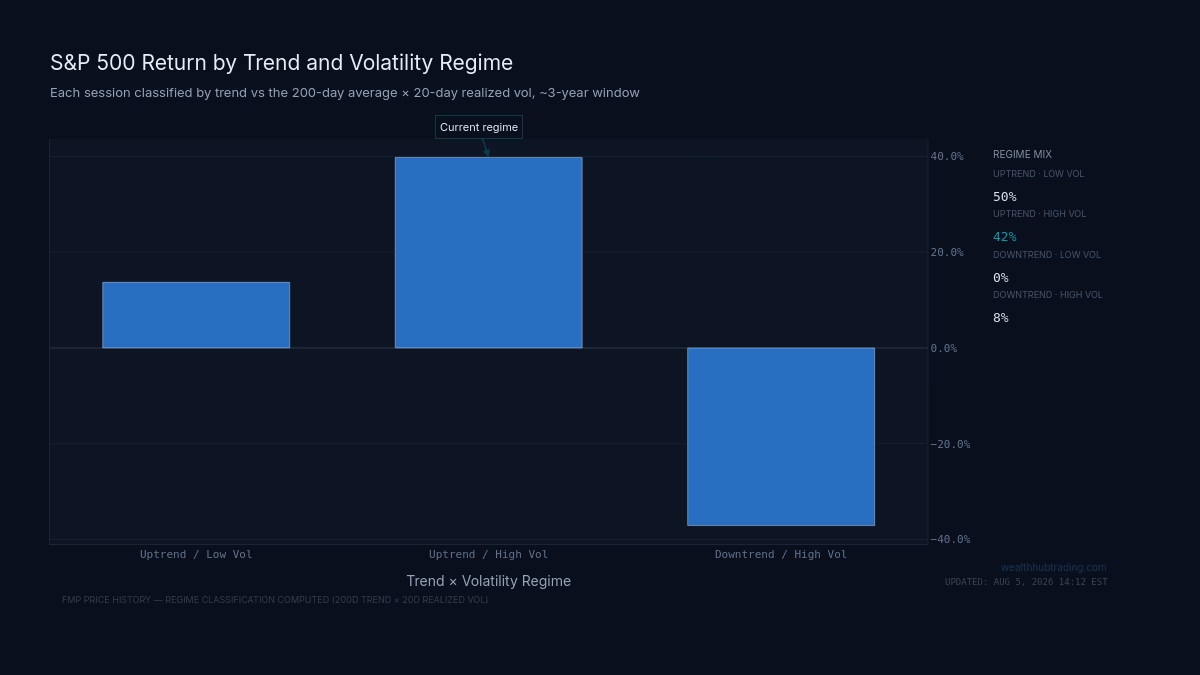
The equity valuation backdrop is what makes this labor read consequential rather than academic. A richly valued market prices a soft landing by construction; it has little cushion of its own for a rise in recession odds. The transmission runs through the discount the market applies to forward earnings, and that discount widens fastest not when the headline payroll number disappoints once, but when the composition confirms that the slowdown has become general.
The observable condition to watch across the three reports is therefore specific and testable. Recession odds move materially higher, and the equity market's soft-landing premium becomes hard to defend, when broadening in the cyclical sectors coincides with a stall in education and health services. Cyclical weakness alone, with the cushion intact, is the benign reading the aggregate supports. Cyclical weakness plus a fading cushion is the configuration that has preceded downturns, and it is the one the current market is least positioned to absorb. Until the health-services line flattens, the cleaner interpretation is a cooling labor market rather than a cracking one.