The interesting number in the agentic story is not the token spend Jensen Huang wants his engineers to consume. It is the moment a "theoretical" disruption risk becomes a line item a management team has to explain on an earnings call. That transition happened faster than most equity models assumed it could, and the reason is a single technical fix that looks trivial on paper: an agent that remembers what it did five minutes ago.
This article walks through the mechanism in four steps: (1) why the old chatbot model could not disrupt anything, (2) the specific fix that turned a chatbot into an agent, (3) how that fix converts a theoretical business risk into a disclosed one, and (4) what a reader can actually monitor in filings to catch the transition early. The goal is to give you a way to read the agentic era through documents rather than through hype.
Why the call-and-response model could not disrupt a business
Start with the concept plainly. A large language model (LLM) is a system that predicts the next chunk of text given the text before it. Until late 2025, nearly every commercial AI product wrapped that prediction in a call-and-response loop: you type a prompt, the model returns an answer, and the interaction ends. Nothing persists.
The constraint that made this loop weak is the context window, which is the fixed amount of text the model can hold in working memory during a single run. Think of it as a whiteboard of a fixed size. Everything the model "knows" about your task in the moment has to fit on that whiteboard. When the board fills up, older content gets erased to make room. The model does not forget gracefully; it forgets the way a whiteboard forgets, by having something wiped off.
This is why the first two years of AI SaaS products felt impressive in a demo and useless on a real job. A task with any real complexity, say reconciling a month of invoices or refactoring a codebase, requires holding hundreds of intermediate facts in memory: what you already tried, what failed, what the third file depends on. The whiteboard was too small. Each new call started closer to a blank slate than the last, so the product plateaued at "helpful autocomplete."
Here is the causal chain that matters. No persistent memory means no multi-step task; no multi-step task means the AI cannot actually replace a workflow; and if it cannot replace a workflow, it cannot take revenue away from the company that owns that workflow. The disruption stayed theoretical because the technology could not finish a job.
What this means for you as a reader of company filings: for two years, "AI risk" in a risk-factors section was boilerplate. Legal teams inserted it because everyone did. It described a future, not a present. You were correct to discount it.
The fix that turned a chatbot into an agent
The concept in one sentence: an AI agent is an LLM given a memory it controls and the ability to act on the world without being prompted at each step.
The technical breakthrough behind the November 2025 inflection is almost embarrassingly simple, which is exactly why it spread so fast. The tool that became the poster child, released open-source and self-hosted, solved the memory problem not with a bigger whiteboard but with a filing cabinet. It stored the running context in a large text file on disk, then looped through fresh model calls, reading the relevant part of that file back in on each pass. The whiteboard stays small, but nothing is ever truly erased, because it all lives in the cabinet.
Walk through why that changes the behavior. On each loop the agent reads its own history, decides the next action, executes it (running a command, editing a file, sending a message), writes the result back to the file, and loops again. It no longer needs you to prompt each step. It runs until the task is done or it hits a wall. Early users left these agents running overnight and woke up to finished work. That is the difference between a tool you operate and a worker you delegate to.
Two secondary effects amplified the shift. First, an ecosystem of skills and plugins grew around the open-source core, which is a network effect: each new plugin makes the platform more useful, which attracts more users, which attracts more plugin authors. Second, the whole thing could run for roughly the cost of a Mac Mini and be directed from an iMessage. The hardware craze is a red herring; most of the computation happens in the cloud. The Mac Mini is a mascot, not a requirement. What actually spread was the memory pattern.
An honest note on the naming: this class of tools went through a rapid rebrand under legal pressure early in its life, which tells you how quickly commercial stakes attached to something that started as a hobbyist library. Treat the specific product names as fast-moving. The mechanism, persistent context plus an action loop, is the durable part.
What this means for you: when you evaluate an "AI product," the question is no longer "how good is the model?" It is "does this thing hold state across steps and take actions on its own?" A stateless demo is still a toy. A stateful loop is a competitor.
How the fix converts a theoretical risk into a disclosed one
This is the step the market prices slowly, and it is where the equity read lives.
A disruption risk exists in three stages, and each stage lives in a different part of a company's disclosures. In stage one the risk is theoretical, and it sits in the generic risk-factors boilerplate. In stage two the risk becomes operational, and it starts to shape the guidance language management uses on calls, hedges about "evolving competitive dynamics," softer outlook statements, a new emphasis on "efficiency." In stage three the risk becomes financial, and it shows up in the actual numbers: revenue growth decelerating, margins compressing as the company cuts price to defend share, headcount actions.
The consensus error is to keep treating the risk as stage one long after the technology has pushed it into stage two. Investors anchor to the reported headline number, which is backward-looking, and to the guided narrative, which management controls. The gap you want to read is between the guidance language and what the filings actually disclose. Management will describe a soft quarter as "timing" while the risk-factors section quietly gains two paragraphs about competition from automation. The prose and the numbers begin to disagree, and the prose is usually the leading indicator.
Watch how the agentic fix accelerates this. Once agents can finish multi-step tasks, the businesses most exposed are those whose product is itself a multi-step knowledge task sold as a service: routine consulting, basic IT services, standardized back-office processing, entry-level coding contracted out. These are exactly the "AI loser" profiles that traded as theoretical shorts for two years with a lot of noise, then began to move once the technology crossed from demo to delegated worker late in 2025. The tape did not lead the fundamentals; the capability crossing a threshold did.
Consider the specialty business-services segment as a live illustration, using a name in that category. Information Services Group ($III), an advisory and research firm in the IT-services space, reported FY2025 revenue of $244.7M and operating income of $17.8M, an operating margin of 7.3%. Set that against a peer in the same broad services universe: BK Technologies ($BKTI) posted FY2025 revenue of $86.1M at an 18.6% operating margin. The contrast is instructive. A 7.3% operating margin is thin enough that a modest revenue decline, the kind agentic substitution produces first, flows almost directly to the bottom line, because fixed costs do not fall as fast as the revenue does. The company with an 18.6% margin has more cushion to absorb the same percentage revenue hit before it turns operating income negative.
You can see how quickly thin margins turn ugly at the edges of this peer set. Two comparators in the same data pull, Chowbus ($CHOW) and Conduent ($CNDT), were already running negative operating margins in FY2025, at -9.4% and -1.9% respectively, and both burned free cash flow (-$67.7M and -$154.0M). Those are not agentic-disruption casualties per se, and the read on their specific causes is not something these figures alone establish. But they anchor the general point: in a low-margin services business, there is very little distance between "revenue decelerates a few points" and "operating income goes negative." The agent that can finish a client's task is the thing that removes those few points of revenue.
What this means for you: the transition from stage one to stage two is legible in documents before it is legible in the stock price. When a low-margin services company's guidance language turns defensive while its risk factors expand, you are watching a theoretical risk become an operational one in real time.
What to monitor, and where the mechanism breaks
Here is the practical routine. When you suspect a company sits in the agentic blast radius, do three reads in order.
First, read the risk-factors section of the two most recent annual filings side by side. You are looking for expansion and specificity. Boilerplate AI risk is one recycled paragraph. A risk that has moved to stage two reads differently: it names the specific workflow under threat, references competitors by category, and grows in length. Length and specificity are the tell.
Second, read the guidance language against the numbers. Pull the operating margin and revenue growth trend, then read what management says about them. Divergence is the signal, when the narrative is calmer than the arithmetic. A 7.3% operating margin described with new emphasis on "cost discipline" is a company preparing you for compression it will not yet name.
Third, size the margin cushion. Compute how many points of revenue the company can lose before operating income turns negative. A firm at a 7.3% operating margin with mostly fixed costs has far less room than one at 18.6%. The thinner the cushion, the faster a stage-two risk becomes a stage-three event.
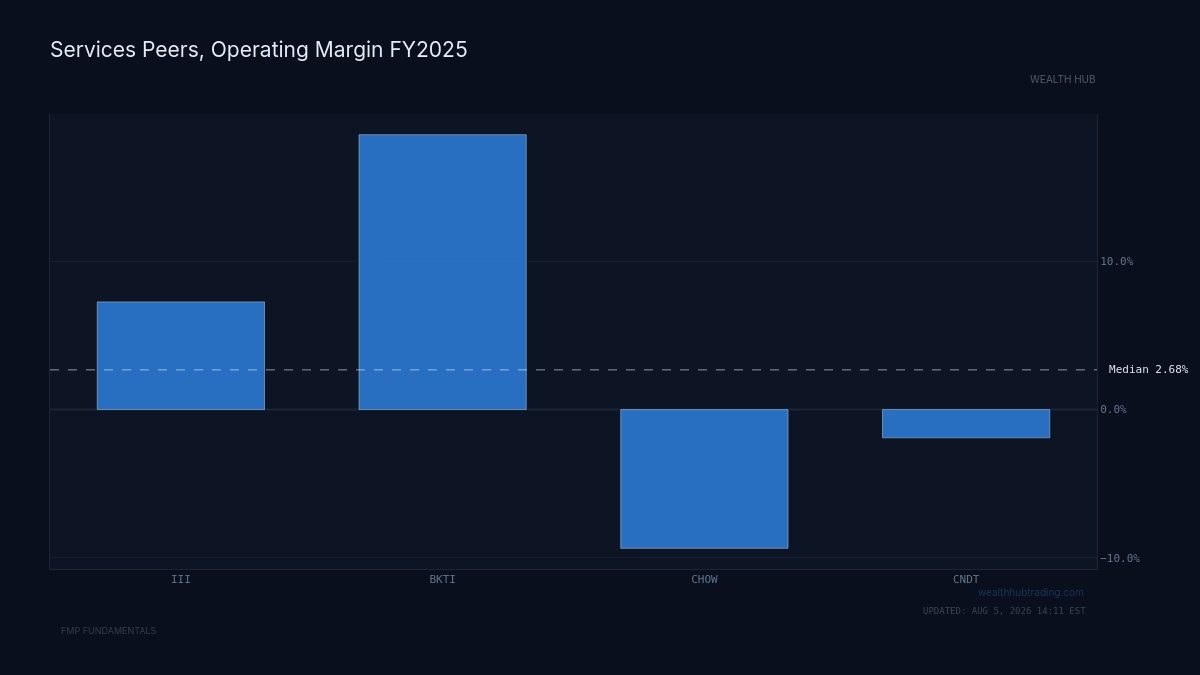
Operating Margin compared across III + 3 peer(s). Median across the set: 2.68%.
Now the failure modes, because a mechanism you cannot break is a mechanism you do not understand.
The mechanism breaks in the obvious direction when the agent cannot actually do the job. Persistent memory plus an action loop finishes structured multi-step tasks. It does not finish tasks that hinge on accountability, relationships, regulatory sign-off, or physical presence. A services firm whose real product is a trusted human signature on a compliance opinion is far more insulated than one whose product is routine data transformation, even if both file under the same industry code. Do not short a business-services ticker on the code alone; read what the service actually is.
It also breaks in the other direction, and this is the subtler error. A company can adopt agents faster than it is disrupted by them, converting a revenue threat into a margin tailwind. The history here rhymes with earlier platform shifts: the incumbents that survived disruption were often the ones that absorbed the disrupting technology into their own operations. This does not happen every time, and the timing is genuinely hard to call, but it happens often enough that "exposed to agents" and "hurt by agents" are not the same statement. The read on any single name has to distinguish which side of that line it lands on, and the filings, again, are where you look: capex and hiring patterns tell you whether a firm is building agentic capacity or getting run over by it.
Finally, the mechanism breaks as a trade even when it holds as a fact. The "AI losers" basket described above worked over two years but with, in the operator's own words, a good deal of choppiness. A correct structural read can be early by quarters, and a low-margin name can rally hard on a single "efficiency" narrative before the compression arrives. The mechanism tells you the direction and the destination. It does not time the path.
The one-sentence version: an AI agent became a real competitor the moment it could remember its own work and act without prompting, and the way you catch that competition reaching a specific company is to watch its guidance language and its risk factors diverge from its reported margin before the market marks the stock. Read the documents, size the cushion, and separate the businesses that will absorb the agents from the ones the agents will absorb.