The most repeated claim about artificial intelligence and the economy is that it will be disinflationary. That claim is not wrong so much as premature. It assumes the conclusion of a race whose first lap is running the other way. The question that actually determines whether AI pushes prices down is not whether it raises productivity, but whether it raises productivity faster than it raises the cost of adopting it. Right now, on the evidence available, the cost side is winning.
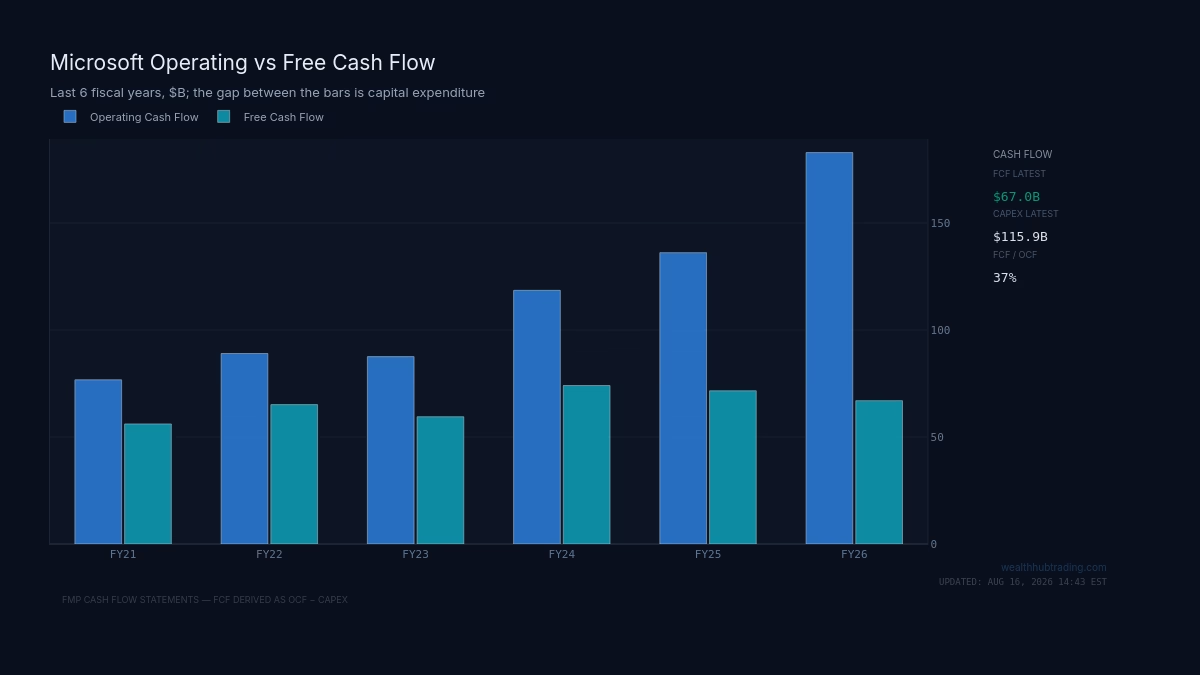
The starkest data point arrived in the third quarter of 2025, when America's largest technology firms spent more on capital investment than they earned from operations. That is a first, and it inverts the usual picture of these companies as cash machines. For a moment, the most profitable businesses in the country became net consumers of resources rather than net generators of them. The reason to care is not corporate finance. It is that the same spending that shows up as capex on a handful of balance sheets shows up as demand in the markets for chips, power, and specialized labor, and demand in constrained input markets is a price story before it is ever a productivity story.
The Step the Disinflation Story Skips
The mechanism worth understanding is the productivity J-curve. When a general-purpose technology arrives, firms do not simply plug it in and get more output per hour. They reorganize workflows, build data infrastructure, retrain people, and rewire processes. During that phase, measured productivity can actually fall, because the resources poured into adoption are real costs today while the payoff is deferred. Output per worker dips before it climbs. Brynjolfsson, Rock, and Syverson formalized this pattern: the gains are real, but they lag the investment, sometimes by years.
Apply that to inflation and the received wisdom flips. A technology that will eventually lower unit costs can raise them during the transition, because the economy is paying the adoption bill before it collects the productivity dividend. The disinflation thesis is not false. It is describing the far end of the curve while the economy is standing at the near end.
Where the Costs Are Already Visible
The near end is not hypothetical. Across 2025, the major AI developers, including Google, OpenAI, Anthropic, Meta, Amazon, and Oracle, committed on the order of $300 billion to capital investment spanning semiconductor supply chains, power grids, and the narrow pool of engineers who can build these systems. That spending did not slow into the first quarter of 2026; it accelerated, and current projections have it rising further.
Concentrated demand of that size against inelastic short-run supply does what concentrated demand always does. Memory chip prices are up substantially. Energy consumption and, in some markets, energy prices are being pulled higher by data-center load. And the pass-through has begun to reach consumer electronics, where the input cost of memory and compute is no longer absorbed silently. This is the part of the story that is measurable now, and it runs in the opposite direction to the disinflation forecast.
The honest framing is that AI is currently an inflationary impulse operating through input markets, and a potential disinflationary force operating through productivity, with the two separated in time. Which one dominates in any given quarter depends on where the economy sits on the J-curve.
A Level Shift or a New Growth Rate
The longer-run question changes the stakes entirely, and it is genuinely unresolved. AI could deliver a one-time increase in the level of potential output: a step up in what the economy can produce, after which growth returns to its old trend. Or it could raise the growth rate itself, most plausibly if AI accelerates the process of innovation rather than merely automating existing tasks.
The distinction is not academic. A level shift raises the natural rate of interest temporarily, during the transition, and then lets it drift back. A sustained acceleration in growth raises the natural rate permanently. For anyone trying to read where neutral policy settles over the next decade, that is the fork in the road, and current estimates of AI's productivity impact straddle both branches, from a few percentage points of GDP over a decade to considerably more if the innovation-augmenting case holds.
Two countervailing forces widen the uncertainty rather than narrow it. The first is concentration. AI adoption skews toward large firms, so if the returns accrue to a small set of incumbents, the investment boom that lifts the neutral rate may be narrower than the aggregate capex figures imply, and winner-take-all dynamics can thin out the diversity of research that sustains long-run growth in the first place. The second is the household side. Workers whose tasks are displaced cut consumption; workers whose tasks are complemented gain, but if the winners save a higher share of their income, aggregate demand can soften even as measured productivity rises. Both forces argue for humility about how cleanly the productivity gain translates into the growth-rate story.
The Financial-Stability Tail
There is a third channel that the input-price and growth-rate debates tend to crowd out, and it is the one where the Q3 2025 data point earns its weight. When the most cash-generative firms in the economy spend beyond their operating cash flow, the marginal dollar of AI buildout is increasingly funded rather than self-financed. That is fine while expected returns stay above the cost of capital. It becomes fragile if the productivity payoff arrives later or smaller than the capex assumed.
The exposure is not evenly spread. It concentrates in the same handful of names driving the spending, and in the suppliers, from chipmakers to power providers, whose order books now depend on that spending continuing. A capex cycle built on the expectation of a specific productivity dividend is only as stable as that expectation. The channel to watch is not a single company's balance sheet but the correlation across the cluster: they are financing the same bet with the same assumptions at the same time.
What Would Change the Read
The strongest counterargument is straightforward and deserves to be stated plainly. If the productivity payoff arrives faster than the skeptics expect, the J-curve is shallow, the input-price pressure is a brief transition cost, and the disinflation thesis is simply early rather than wrong. That outcome is entirely possible, and the wide range of credible productivity estimates means it cannot be dismissed.
The read here does not require betting against it. It requires sequencing it. The disinflationary case is a claim about the destination; the inflationary pressure is a fact about the road. Both can be true.
The observable condition that would resolve the tension is the relationship between two series that are currently moving apart: measured productivity growth and AI-related input costs. As long as capex keeps rising while economy-wide productivity growth stays flat, the economy is paying the adoption bill without yet collecting the dividend, and the net effect on prices is upward. The turn comes when productivity growth begins to accelerate while capex intensity plateaus. That crossover, not the arrival of the technology itself, is the moment the disinflation thesis stops being a forecast and starts being a fact. Until it appears in the data, the cleaner reading is that AI is an inflationary force wearing a disinflationary reputation.