The most important word in Marc Ganzi's weekend interview was not "top." It was "signed." The DigitalBridge chief executive, who has just sold his company to SoftBank, told the Financial Times that about half of the data centre leases signed this year will never be built, blocked by hostile local zoning, reluctant utility regulators and tighter financing. Taken at face value, that sentence does more damage than his valuation call. The data centre trade has been priced on signed-lease backlog as if a lease were a revenue stream. The best-connected seller in the industry says it is closer to an option, and one that expires worthless half the time.
Herb Greenberg flagged the quote on Monday with the right instinct: when the man who sold at the last two tops says this is another one, the burden of proof shifts. The sharper point is that Ganzi supplied both halves of the bear case himself. The multiple is coming down, and the denominator that justified it is softer than the headline backlog suggests.
What Ganzi Actually Said
The quotes are specific enough to take literally. Asked whether the SoftBank sale was timed at a market peak, Ganzi said: "It is a top. I think the top's already happened... The days of data centres trading at 40 times [EBITDA] are over."
His record is the reason the line landed. The FT notes this is his third major exit in three decades. He sold Apex Site Management to SpectraSite in 2000, at the top of the telecoms bubble, and Global Tower Partners to American Tower for $4.8bn in 2013. At DigitalBridge he turned Colony Capital, a struggling real estate investor, into a $108bn digital infrastructure manager in six years. SpectraSite, the buyer in 2000, went through a Chapter 11 restructuring within roughly two years. That is the precedent the market is now pattern-matching against.
Then came the reassurance. Ganzi said he is not worried about frothy valuations in the face of delays, challenges and cancellations, because of the velocity of coming demand.
Those three statements cannot all carry equal weight. If demand velocity were strong enough to make a 50% failure rate on signed leases irrelevant, there would be little reason to call a top in multiples, and less reason to sell. The action is the most informative data point in the interview. Words about demand are cheap; a sale to SoftBank at what the seller calls peak pricing is not.
Why a Signed Lease Is Not Revenue
The mechanism matters more than the mood. A hyperscale data centre lease is typically signed well before the building exists. Between signature and commencement sit land control, zoning approval, an interconnection agreement with the local utility, transformer and switchgear delivery, construction financing, and construction itself. Revenue starts at commencement, not signature.
Throughout this cycle, the signature has been the headline. Developers and operators report leasing in megawatts signed, the press counts gigawatts of announced campuses, and private capital has priced platforms partly on that pipeline. A 40x EBITDA multiple only makes sense if investors are paying for EBITDA that does not yet exist, and much of that future EBITDA sits in signed-but-not-commenced backlog.
Ganzi's 50% figure attacks precisely that layer. Zoning and utility regulation are not demand problems; they are permission problems. Financing is a capital-cost problem. None of the three is solved by a hyperscaler's willingness to sign. A tenant can want 300 megawatts and still not receive them if the county board votes no or the utility will not commit power on the needed timeline.
This is where the equity-fundamental gap sits. Guidance language talks about record leasing and backlog. Filings, read carefully, separate leases signed from leases commenced, and show construction in progress on the balance sheet alongside the cash required to finish it. The question the market has mostly skipped is the conversion rate from the first number to the second. Ganzi has now put a figure on it, and it is far worse than a backlog headline implies.
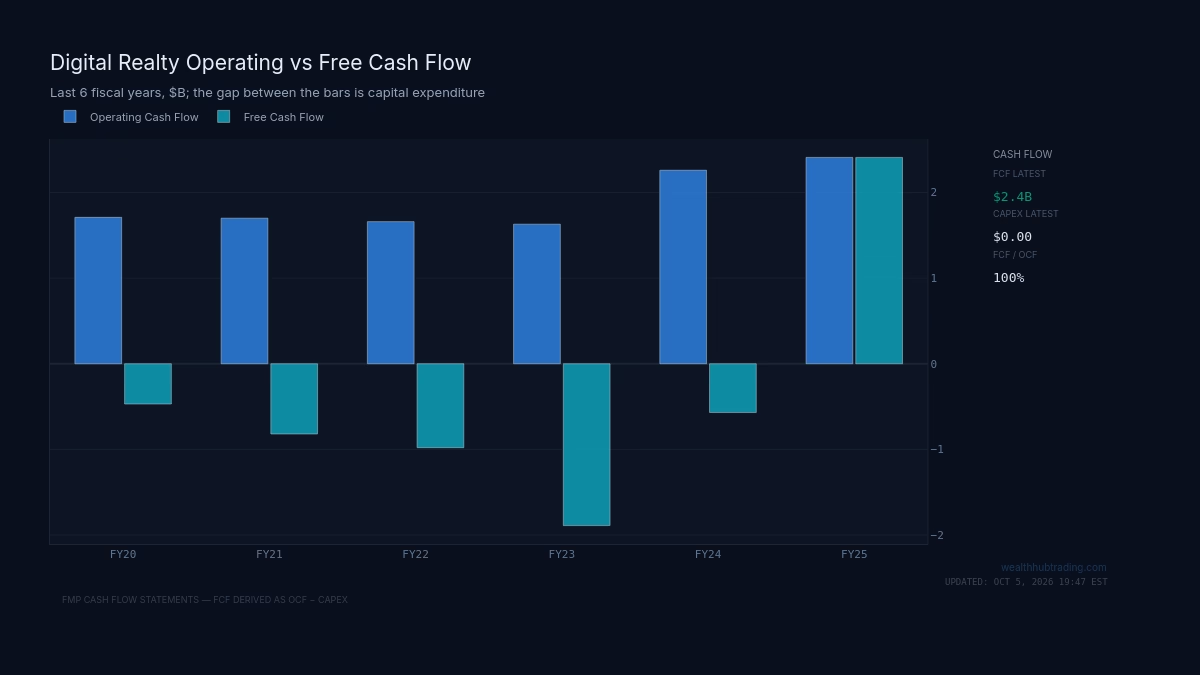
The capital intensity is why conversion matters so much. Development spending at a large public operator like Digital Realty consumes most or all of its operating cash flow, with the remainder funded by debt, equity or joint-venture partners. Every megawatt that is signed but stalled still carries land, pre-development and sometimes equipment costs. If half the pipeline stalls, the operator holds capital that is earning nothing while the tenant keeps its options open.
Where the Value Migrates
The useful implication is not "data centres are a bubble." It is that the binding constraint has moved, and the value is moving with it.
When capital was the constraint, the platform that could raise money fastest won, and capital raisers like DigitalBridge earned premium multiples. Ganzi is describing a world where power, permits and local politics are the constraint. In that world, the scarce asset is the energized, entitled site, not the lease and not the fund. Owners of capacity that is already powered and zoned should hold pricing power, because the tenant whose lease dies in one county still needs megawatts somewhere. Owners of paper pipeline lose, because their backlog was priced as if it would convert.
This also explains why a financial sponsor would sell now even while believing in demand. A sponsor's edge is raising and deploying capital. If deployment is gated by regulators and utilities rather than money, more capital does not buy faster growth; it buys a longer queue. The return on the sponsor's core skill falls. Selling to a buyer with a longer horizon and a strategic agenda, which describes SoftBank, is a rational response.
There is a second-order read for the utilities that Ganzi called reluctant. Their reluctance is a pricing signal. A utility asked to build substations and transmission for a campus that might never fully load is being asked to take stranded-asset risk on behalf of tenants who signed leases they may not honour. Regulators pushing back on that risk allocation look less like obstruction and more like a correction to it. That inference is ours, not Ganzi's, and it depends on jurisdiction, but it is consistent with his list of obstacles.
The Case That Demand Overwhelms the Friction
The strongest counterargument is Ganzi's own: demand velocity. It deserves a fair hearing.
First, a 50% failure rate on this year's signings does not mean a 50% shortfall in capacity. If signings ran far ahead of what the grid can deliver, half of them may still exceed what gets built in the near term. Tenants who over-signed across multiple sites to secure any power at all would be expected to drop the duplicates. In that reading, the cancellations are hedges unwinding, not demand disappearing.
Second, failed leases do not destroy demand; they relocate it. A hyperscaler blocked in one market signs in another. Aggregate data centre absorption could stay strong while individual developers' backlogs disappoint. That is bad for anyone valued on its own pipeline and fine for the asset class as a whole.
Third, multiple compression from 40x is not a crash. Ganzi said the days of 40x are over, not that the assets are impaired. An industry can grow earnings while its multiple falls, and long-term holders of energized assets may do well despite a lower exit multiple.
These are real points, and they narrow the thesis rather than kill it. They argue against a blanket short on digital infrastructure. They do not rescue a valuation built on signed backlog, because every one of them concedes that individual backlogs overstate what will be built. The counterargument actually sharpens the split between energized capacity and paper pipeline.
What would break the read: if operators begin reporting signed-to-commenced conversion at rates far above 50%, with commencement dates holding rather than slipping, then Ganzi's figure was either exaggerated or specific to the projects he saw. Seller incentives cut both ways here. A seller has some reason to talk down the price the next buyer pays, but no obvious reason to talk down the business he just sold, which makes the quote more credible rather than less.
The Disclosures That Settle It
The decision variable for this trade is conversion, and it can be tracked rather than guessed.
The first item is the gap between leases signed and leases commenced in operator filings, and whether that gap widens quarter over quarter. A growing signed-not-commenced balance alongside slipping commencement dates would confirm Ganzi's figure within public companies.
The second is construction in progress relative to development spend. If capital keeps flowing into projects while commencement lags, money is being parked in assets that are not yet earning.
The third is how operators describe power. Language that shifts from "secured" to "anticipated" or "subject to utility approval" is the guidance-versus-filing gap in miniature.
The fourth is private-market transaction pricing. Ganzi's 40x reference is a private-deal benchmark. The next large platform sale will show whether buyers pay for pipeline or only for energized megawatts.
Ganzi has sold near the top before, and his buyers did not always enjoy what came next. This time he told everyone the price and the flaw in the same interview. The thesis holds as long as signed backlog keeps converting at something close to his 50% figure. If conversion comes in well above that, the demand-velocity argument wins and the multiple has room. Until filings show that, the market should treat a signed data centre lease as what the most experienced seller in the business says it is: half a building.