The number the Gemini 3 rally is not pricing sits in Alphabet's FY2025 cash flow statement: capital expenditure of $91.4B, or 55.5% of operating cash flow. The market has spent the last several months re-rating Alphabet from "AI loser bleeding search" to the hyperscaler that trains frontier models on its own silicon. That re-rating is correct on the technology and premature on the economics. The bullish TPU narrative and the balance-sheet reality are the same fact viewed from two ends, and only one end is in the multiple.
The Story the Market Bought, and the One It Skipped
Alphabet is the only company that has shipped a mass-produced accelerator competitive with Nvidia's core offering across meaningful metrics, and it has spent roughly a decade optimizing its research, training, and inference pipelines around that chip. Gemini 3 was the public demonstration: a frontier model trained on TPUs, delivered on Alphabet's own terms rather than rented from an Nvidia allocation queue. Reports that Anthropic and Meta intend to run TPUs, with Meta reportedly wanting them for training and not merely inference, extended the point. The CUDA moat is not infinite, and Alphabet is the clearest proof.
The market treated this as a revelation. It was not. The vertical integration case for Alphabet, low customer acquisition cost, best-in-class first-party data, and cheaper training on owned silicon, was legible well before Gemini 3. What changed was sentiment, not information. Perception flipped somewhere around the point the legal overhang lessened, and Gemini 3 supplied the emotional confirmation that let a slow structural story clear all at once.
That is exactly the setup where the consensus stops reading. Everyone is now anchored to the guided narrative, frontier models on cheaper chips, and almost no one is anchored to what the same integration costs in the cash flow statement.
What the Filings Actually Disclose
Per Alphabet's FY2025 cash flow statement, the company generated $164.7B in operating cash and spent $91.4B on capital expenditure, leaving free cash flow of $73.3B. Capex ran 22.7% of the $403.0B in FY2025 revenue and, more tellingly, 55.5% of operating cash flow. More than half of every operating dollar Alphabet produced went back into the ground as infrastructure.
The vertical integration that lets Alphabet train on TPUs is not free optionality. It is a capital program. TPUs, the datacenters that house them, and the networking that connects them are the physical form of "cheaper training," and they consume cash at a scale the operating margin, a healthy 32.1% on $129.2B of operating income, hides completely. The income statement still looks like the old Alphabet. The cash flow statement is the one that changed.
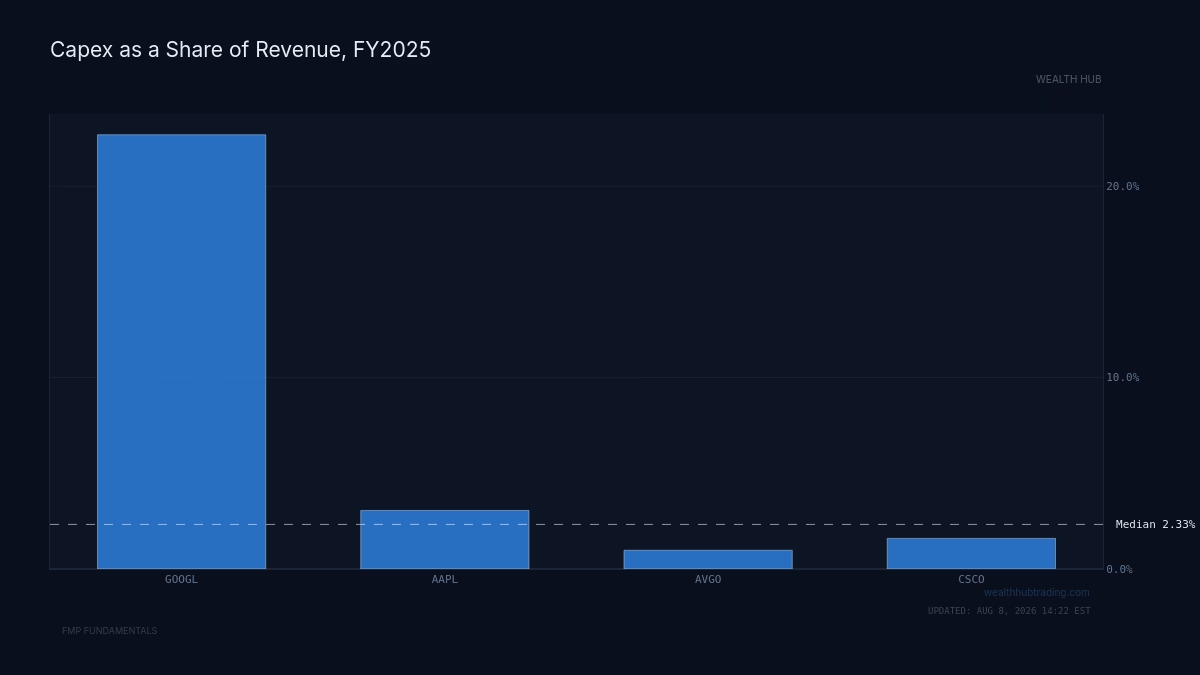
Set Alphabet against companies that are also enormously profitable but do not own their compute. Per FY2025 filings, Apple spent $12.7B of capex against $416.2B of revenue, 3.1%, and converted that into $98.8B of free cash flow, more than Alphabet, on comparable revenue. Broadcom, at $63.9B of revenue and a 39.9% operating margin, spent $623M in capex, roughly 1.0% of revenue, and produced $26.9B of free cash. Cisco spent $905M, 1.6% of revenue. Alphabet's 22.7% is not a rounding difference. It is a different business model wearing the same margin.
This is the disclosure the rally is not pricing. Alphabet's FY2025 free cash flow of $73.3B is lower than Apple's $98.8B despite $13B more capex and comparable top-line scale. The market is celebrating the strategic advantage of owning the stack while ignoring that owning the stack is precisely what is suppressing the cash the strategy is supposed to generate.
Why Owning the Chip Cuts Both Ways
There is a real advantage buried in the cost. If TPU-based training is genuinely cheaper per unit of capability than renting Nvidia capacity, Alphabet's high capex buys a lower marginal cost of intelligence than a lab without its own silicon can achieve. The $91.4B is the price of not standing in an allocation queue and not paying Nvidia's gross margin on every training run. For a company that intends to run frontier models at planetary scale through Search, Cloud, and its own products, structural cost control on compute is worth a great deal.
The question the filings force is one of timing. The capex is being spent now, in cash, at 55.5% of operating cash flow. The return, cheaper inference across a decade of AI-native products, is a future stream the market is discounting on the strength of one model release. That is a legitimate bet. It is not a free advantage, and the free-cash-flow gap versus Apple is the receipt.
The TPU trade, extended outward, gets more interesting than Alphabet alone. If Anthropic and Meta genuinely scale TPU deployment, the beneficiaries include the merchant silicon designer that co-develops Alphabet's chips and the broader custom-accelerator supply chain, not only Alphabet's own P&L. But that is an inferred second-order chain, not a disclosed fact, and it should be held loosely. What the filings support is narrower and firmer: Alphabet is spending like an infrastructure company and being valued, newly, like a software winner.
The Case Against This Read
The strongest counterargument is that capex intensity of this kind is the correct signal, not a warning. High infrastructure spend by a company with a 32.1% operating margin and $164.7B of operating cash is a company investing from strength, not straining a balance sheet, and total debt of $59.3B against $595.3B of total assets confirms there is no leverage problem. If TPUs compound into durable cost advantage, today's 55.5% cash-flow reinvestment rate is a bargain, and the market re-rating is early rather than late.
There is also the demand-side reading the market is clearly leaning on. A breakthrough model may be broadly bullish for compute regardless of who wins the chip war, because switching costs across AI accelerator ecosystems are high and labs locked into one architecture tend to buy more of the next generation rather than migrate. On that logic Gemini 3 raises total compute demand and Alphabet's capex is simply the leading edge of a spend cycle that lifts the whole complex.
Both of these can be true. Neither changes the disclosed fact that Alphabet's free cash flow is being held down, right now, by the very integration the rally is celebrating, and that recency bias is doing a lot of the work in a stock that reversed from AI loser to consensus winner in a matter of months. Oracle's move from a 40% gap up to credit-default-swap scrutiny in weeks is the reminder of how fast a compute-capex story can turn when sentiment overshoots the cash.
What Would Settle It
The read resolves on free-cash-flow conversion, not on the next model. Watch whether capex as a share of operating cash flow stabilizes or keeps climbing above the FY2025 55.5% mark in subsequent filings. If the reinvestment rate plateaus while Cloud and AI-product revenue accelerate, the vertical-integration bet is converting, and the current multiple is defensible or cheap. If capex intensity keeps rising while free cash flow stays flat or compresses, the market has paid a software multiple for an infrastructure cash profile, and the gap will close the uncomfortable way.
The technology thesis is settled: Alphabet can train frontier models on its own chips. The economic thesis is not. Until the cash flow statement shows the TPU advantage arriving as free cash rather than only as capital expenditure, the cleaner reading is that the market re-rated the story and skipped the receipt.