The $2 billion Fervo Energy raised in its May IPO was supposed to buy time. For a company whose plan is to build more than 1 gigawatt of enhanced geothermal capacity by 2030, the public listing has done the opposite. It turned the share price into an input cost. Every daily swing in the stock now feeds directly into what the buildout will cost to finance. A stock that closed nearly 70% below its offering price last week is not just an embarrassment for the underwriters. It is a higher cost of capital for wells that have not yet been drilled.
That is the mechanism the roller-coaster headlines miss. The debate has centered on two questions. Did the short seller get it right? Did Monday's third-quarter report, which sent the shares up more than 25% from Friday's close, vindicate management? Both questions matter less than a structural one. Fervo traded a patient, milestone-based capital provider for a market that reprices reservoir risk every few seconds. It did so while its first grid-scale plant in Beaver County, Utah, had only just begun commercial operations.
A Reservoir Experiment on a Trading Screen
Enhanced geothermal is a slow-revealing technology. Drillers fracture hot, dry rock, circulate fluid through it, and bring heat to the surface. The two numbers that decide whether this works commercially take years to resolve. The first is how much the per-well drilling cost falls as the program scales. The second is how well each reservoir holds its temperature and flow rates over time. A single quarter of production data says little about thermal decline over a 20- or 30-year asset life.
Private venture capital is built to hold that kind of uncertainty. Investors mark positions on milestones: a successful flow test, a financing close, a plant energized. In the meantime they absorb ambiguity quietly. When Doomberg first covered Fervo in 2025, the company was in exactly that position. It had blue-chip backers and what it described as a sold-out book of business, and its main remaining task was execution.
Public equity handles that same ambiguity very differently. It prices every unanswered question continuously, and it reacts most strongly when someone claims to have the answer. Morpheus Research published a scathing short report in early October, and the stock's slide to roughly 70% below the IPO price followed. The specific allegations sit behind the excerpt available here and are not repeated in this article. The sequence is the point. Within five months of listing, one outside party was able to reprice years of unresolved engineering risk, and the market had no operating track record against which to test the claims.
The broader IPO data that Doomberg cites makes the same point from another direction. The widely referenced University of Florida work on technology IPOs documents a long decline in the share of issuers that are profitable at listing. Abundant private money has removed the traditional reason to go public. That makes a pre-revenue-scale listing a choice, not a necessity, and choices are judged by what they cost.
Why a Sold-Out Book Concentrates the Risk
The intuitive reading is that contracted demand protects the company. If the output is already sold, what can go wrong? For the equity holder, this is where intuition gets it backwards.
Long-term offtake agreements fix the price at which power is sold. They pass price risk to the buyer and leave execution risk entirely with the developer. If drilling costs come in above plan, the contracts do not reprice. If a reservoir underdelivers on flow or temperature, the contracted megawatt-hours still have to be supplied, or the shortfall becomes a penalty, a renegotiation, or a reputational cost. The ceiling on revenue is fixed. The floor on cost is not.
So a sold-out book turns the equity into a leveraged bet on two operating variables: cost per well and reservoir longevity. That is a defensible bet for a private holder with a ten-year horizon and the ability to inject more capital at a negotiated price. It is a harsher bet for a public holder, because the company's ability to fund the next tranche of drilling depends partly on where the stock trades when the money is needed.
The arithmetic shows why the 70% drawdown matters beyond mark-to-market losses. Suppose Fervo needs to issue equity again before the 1 GW target is in sight. Neither its cash burn nor its capex per megawatt is disclosed in the material reviewed here, so the timing cannot be pinned down. Any issuance near current levels would dilute holders at a fraction of the IPO price. Higher dilution raises the hurdle each new project must clear to create value per share. A weaker share price weakens the equity cushion that project lenders look at. Higher financing costs squeeze margins on contracts whose prices cannot move. The loop runs in one direction until operating data breaks it.
The Incumbent Benchmark
One way to see what the market is being asked to underwrite is to look at what mature, conventional geothermal actually earns. Ormat Technologies is the listed incumbent. It runs hydrothermal plants that tap naturally occurring reservoirs, not the engineered systems Fervo is pioneering, so it is a benchmark, not a proxy. Its revenue and margin history shows what a scaled geothermal fleet looks like once the exploration drama is over: a utility-like business, not a hypergrowth story.
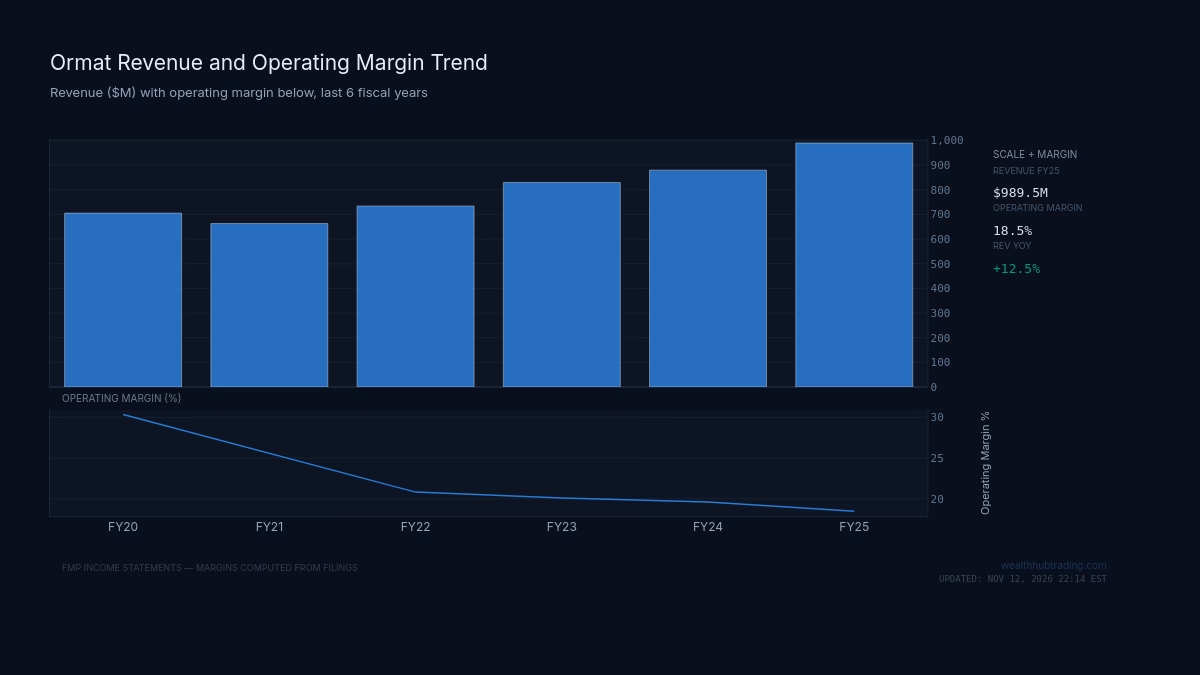
Fervo's valuation case, at the IPO price and arguably even after the collapse, assumes something the incumbent's history does not show. It assumes that engineered reservoirs can scale faster and more cheaply than nature-dependent ones, enough to justify a growth multiple on a power-generation business. That assumption may be right. Enhanced geothermal's appeal is that it frees developers from the narrow geography of natural hydrothermal resources. But the equity is priced as if the drilling cost curve has already been proven. One commercially operating site cannot prove it.
The Case Against the Premature-IPO Read
The strongest counterargument deserves a fair hearing, and it is not weak.
First, $2 billion is a very large cash position for a company at this stage. A listing that raised it at peak enthusiasm may look wise in hindsight. On this view, management sold expensive equity when buyers were willing to pay for it, and that cash now funds the drilling program however the stock trades. The 70% drawdown is then a problem for IPO buyers, not for the company's balance sheet. That holds if the $2 billion covers the path to self-funding project debt.
Second, the 25% jump on third-quarter results suggests the operating data contained something the market found reassuring. The details of the release are not in the material reviewed here. The reaction itself is informative. A stock that falls hard after a short report and then rallies sharply on a fundamental disclosure is being repriced on evidence, which is how the public process is supposed to work. Part of the move may be short covering. Positioning data is not available here, so how much is covering and how much is a genuine rerating cannot be separated.
Third, public status may lower long-run financing costs for the whole category. Project lenders and utilities often prefer counterparties with audited, public disclosure. If Fervo survives its first year as a listed company, its transparency becomes an asset.
All three points have merit. None of them breaks the core mechanism. The cash cushion buys time but does not fix the dilution loop if a second raise is needed. The earnings rally shows the market can be reassured, which also confirms that it now sets the price of reassurance every quarter. The disclosure benefit arrives only if the operating data cooperates.
What the Stock Now Means for Enhanced Geothermal
There is a second-order consequence that reaches beyond one ticker, and it is the part of the story that most affects the wider alternative energy world. Fervo is the first enhanced geothermal developer with a visible, daily market price. Every private peer, every project lender weighing an EGS loan, and every utility deciding whether to sign the next firm clean-power contract now has a public reference point. When that reference point traded 70% below issue, it signaled to the whole category that engineered geothermal carries execution risk the market will not overlook.
This spillover is an inference, not an observed fact. No financing terms for private EGS developers were reviewed for this article. But category-defining IPOs often set the cost of capital for the private companies behind them, in both directions. A Fervo that recovers on hard operating data could pull the sector's financing costs down. A Fervo that bleeds through a dilutive raise could do the reverse for companies that never chose to list. That cat-scratch fever in one share price is how a single company's listing decision becomes a sector's problem.
The Data That Decides It
Short reports, rallies, and IPO-quality debates are all noise around one signal: sustained production at the Beaver County plant. Specifically, the decisive figures are flow rates and temperatures holding over successive quarters, and per-well drilling costs falling as more wells are completed. If Fervo reports stable output and a falling cost curve over the next several releases, the dilution loop reverses. A rising stock lowers the cost of the next tranche, and the 2030 gigawatt target becomes a financing question instead of a credibility question.
The read breaks in Fervo's favor if the company reaches its next major capacity addition on existing cash plus project-level debt, with no new equity issued. It breaks against the company if a follow-on equity raise arrives while the stock sits anywhere near last week's lows. Until one of those two outcomes appears, the share price is not a verdict on whether enhanced geothermal works. It is the price of having asked public markets to answer that question years early.