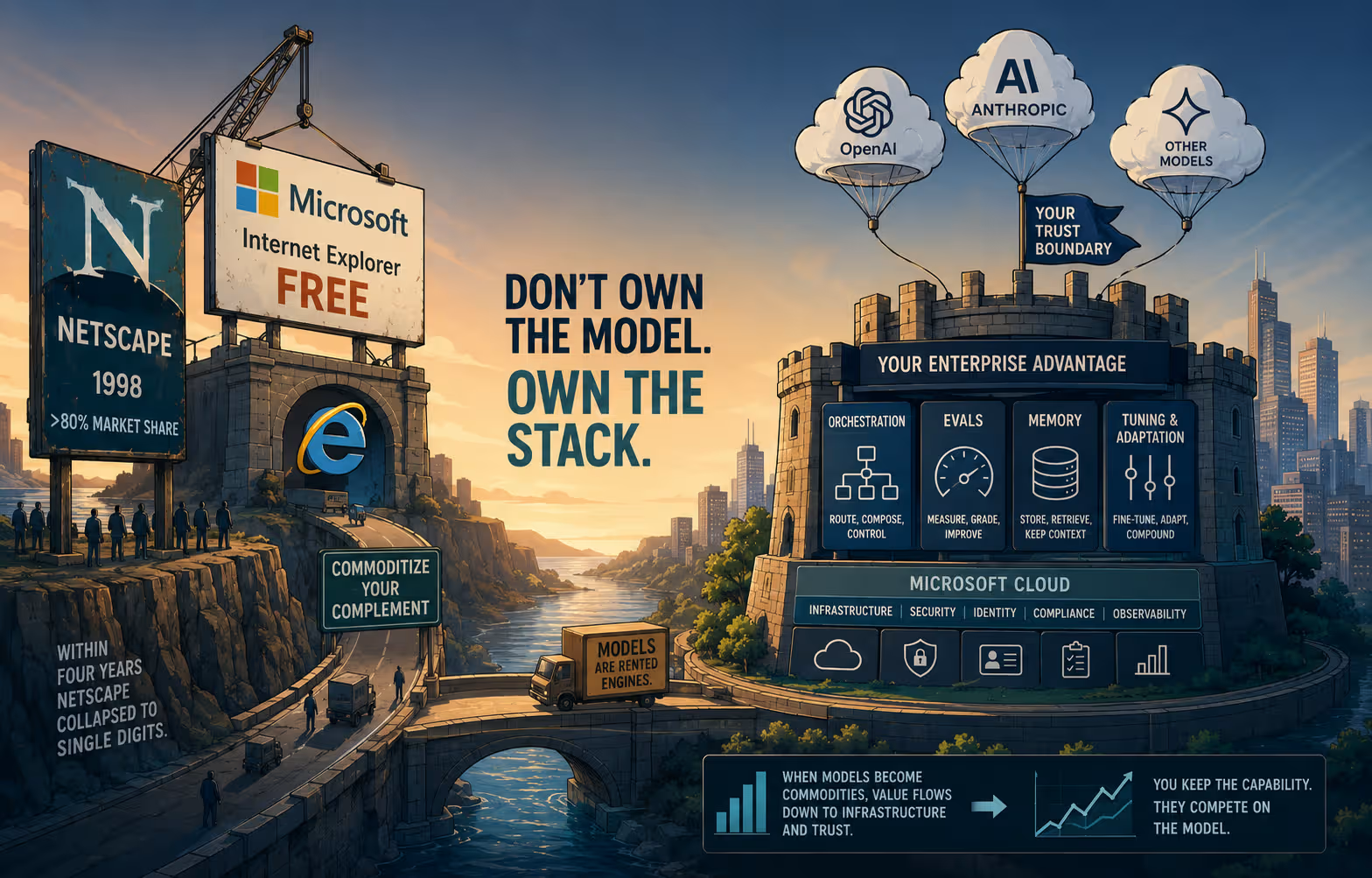
In 1998, Netscape's browser was the most valuable piece of software most people touched. Microsoft gave away Internet Explorer for free, bundled it into Windows, and within four years Netscape's market share collapsed from over 80% to single digits. Microsoft did not build a better browser to win. It made the browser worthless as a standalone product, because the browser was a complement to the thing Microsoft actually sold: the operating system underneath.
That episode is the key to reading what Satya Nadella has been writing on X. His two recent essays, "A frontier without an ecosystem is not stable" and "The Reverse Information Paradox," are not neutral commentary on the AI industry. They are a strategic prescription, and the prescription follows a playbook nearly as old as the company itself.
This piece walks through the mechanism in four steps: (1) the strategy Nadella is deploying, called commoditize-your-complement, (2) how the specific defense he prescribes actually works inside an enterprise, (3) the one place intuition misreads his motive, and (4) when the strategy fails.
What "commoditize your complement" actually means
A complement is a product that becomes more valuable when the price of a related product falls. Cars and gasoline are complements; cheaper gas sells more cars. In software, the operating system and the applications running on it are complements.
The strategic move is this: if you sell product A, you want product B (its complement) to be cheap, abundant, and interchangeable, because every dollar that drains out of B is a dollar that can flow into A.
Nadella sells cloud infrastructure and enterprise software. In the AI stack, the frontier model, meaning the large general-purpose systems built by OpenAI and Anthropic, is the complement to that infrastructure. If frontier models become expensive, proprietary, and irreplaceable, value pools at the model layer. If they become swappable commodities, value drains downward into the infrastructure that runs them and the trust layer that surrounds them, which is precisely what Microsoft sells.
The practical implication for a reader parsing any platform CEO's public writing: read it as a map of what they want commoditized, not as disinterested analysis.
How the defense actually works
Nadella's prescription is concrete, and it is worth tracing as a mechanism rather than a slogan. The goal is to keep an enterprise's accumulated capability from leaking to the model provider. The defense has four moving parts:
Here is the asymmetry Nadella is attacking, in his own framing: model providers claim fair-use rights to train on public data, then impose restrictive terms on distillation and reserve the right to learn from customer interactions. Learning flows one direction. If that holds, economic value converges toward the owners of the learning infrastructure rather than the creators of the knowledge.
The mechanism that breaks the asymmetry: when your orchestration, evals, memory, and tuning all live behind your own trust boundary, the "veteran" capability your firm accumulates stays home even if a vendor pulls its "generalist" model tomorrow. You keep the compounding asset. The model becomes a rented engine.
For an enterprise leader, the actionable read is direct: the data-retention policies of frontier labs, justified on safety grounds, are the exact channel through which your proprietary knowledge trains your future competitor's product.
Where intuition misreads the motive
The obvious objection is that Nadella is talking his book. Microsoft is OpenAI's largest outside partner and runs one of the largest AI infrastructure businesses on earth. A world where every firm treats frontier models as commodities is a world where pricing power drains from OpenAI and Anthropic and pools in Microsoft's layers.
All true. But here is where intuition gets it wrong: a self-interested argument is not thereby a false one. The test of Nadella's claim is not his motive; it is whether the underlying mechanism holds for you. If you run a large enterprise, the one-directional flow of learning is a real risk to your intellectual property regardless of who points it out. The correct response to "he's talking his book" is not to dismiss the argument but to ask whether your book and his happen to align on this specific point. Often they do.
When the strategy fails
Commoditize-your-complement fails when the complement is too good to substitute away from. If one frontier model is dramatically better at the tasks you care about, model-agnostic orchestration is a fiction; you will route everything to the best model and pay whatever it charges. The strategy only works when the models are genuinely close enough to be interchangeable.
There is a leading indicator worth understanding here, with an important caveat about what it can and cannot tell you. Exponential View's analysis of OpenRouter token data shows the three frontier providers falling from roughly 72% of weekly token share a year ago to about 33% today, with open-weight models absorbing nearly all the difference.
The caveat is structural: OpenRouter users are self-selecting model-routers, so this sample is not representative of the broad enterprise market. It over-samples exactly the cost-sensitive, model-agnostic buyers Nadella is trying to create. That is why it functions as a leading indicator of the most price-elastic workloads rather than a measure of the whole market. If the mechanism generalizes, the token market bifurcates: cheap open-weight models for routine work, expensive frontier models reserved for the hardest tasks.
The mechanism in one sentence: a platform owner defends its position by making the layer above it cheap and interchangeable, and Nadella's four-part enterprise defense is that strategy handed to his customers as advice. Why it matters for you: the trust boundary he describes is a genuine hedge against IP leakage whether or not you ever run it on Microsoft's cloud, so evaluate the mechanism on its merits and decide separately who you rent the infrastructure from.