Most investors watching the Situational Awareness blowup believe they are seeing a story about hubris: a mid-twenties trader with no experience, a leveraged AI bet, and a spectacular crash. That story is true, and it is also the least useful thing to take from it.
The misconception is that the fund's collapse is a morality tale. It is actually a mechanics tale. The same leverage that produced a reported 500% first-half return is the mechanism that forced the drawdown of roughly 85-90% from peak in a matter of weeks. Understanding the pipe that runs both directions is more valuable than the schadenfreude.
This piece walks through the mechanism in four steps: (1) how leverage manufactures a forced seller, (2) why forced selling creates the best entry points in markets, (3) why those entry points are almost impossible to capture, and (4) what the Korean margin-call wave tells you about scale.
Why the misconception persists
The hubris framing persists because it is emotionally satisfying and requires no financial literacy. A young person got rich too fast and lost it the arc writes itself. What the framing hides is that the rate of the gain and the rate of the loss are the same physical phenomenon viewed from opposite ends.
Leverage is borrowed capital used to increase the size of a position beyond what your own cash could fund. If you put up $1 and borrow $4, you control $5 of exposure. A 20% gain on that $5 position doubles your $1. The reporting on a near-500% half-year return is consistent with heavy leverage stacked on a position that ran hard. The problem is that the arithmetic is symmetric. A 20% adverse move on the same $5 position wipes your $1 entirely.
How leverage manufactures a forced seller
A forced seller is a market participant who must sell at whatever price is available, on someone else's timeline, not their own. Leverage creates them through a margin call the demand from a lender for additional collateral when the position moves against the borrower.
The sequence runs: (1) the leveraged position falls in value, (2) the collateral backing the loan shrinks below the lender's required threshold, (3) the lender demands cash or liquidates the position directly. Step three is not a choice. The trader sells because the broker will sell for them otherwise.
This is why a 30% year-to-date loss implies an 85-90% drawdown from peak. The gains sat on borrowed money; when the underlying names (reportedly SNDK, BE, NBIS) rolled over, the leverage amplified the loss and the margin desk did the rest.
Why forced selling is the best opportunity in markets
Here is the part intuition gets right. The value of buying from a forced seller is written into the name. A forced seller sells at any price to whoever provides liquidity right now. They are not optimizing for value. They are optimizing for survival.
When Situational's crowded names bounced hard on the unwind news, that snap-back was the market re-pricing away the forced-seller discount. The stocks were not suddenly worth more on fundamentals. The mechanical pressure had simply cleared.
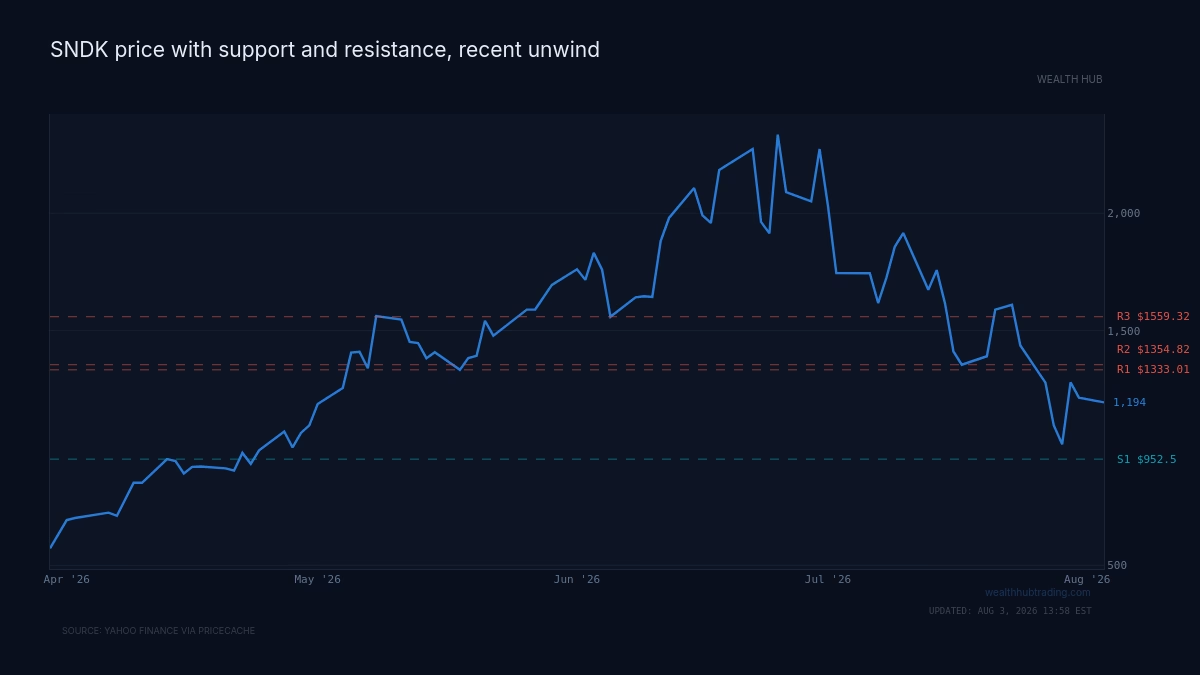
Computed support/resistance levels from 126-day price history. R1/R2/R3 nearest resistance above current price. S1/S2/S3 nearest support below.
Why you almost never capture it
Here is the part intuition gets wrong. Forced sellers are nearly impossible to find in time. Sellers know that revealing distress guarantees a worse price, so they hide it. They do not email the market announcing they will take any bid.
The only reliable tell is a large fund being margin-called publicly. Situational kept its liquidity problems private; its chunkier positions moved in lockstep and popped together, but no single name showed the clean dislocation you could confidently trade. Archegos in 2021 offered a rare exception, when its forced unwind visibly took down a cluster of media and Chinese internet names over a few days. Those setups are exceptional precisely because the distress became legible before it fully cleared.
Korean margin calls
The one fund is not the whole story. A Goldman note reportedly estimated 1.2 million margin calls in South Korea over the past month roughly 3% of the adult population, and plausibly north of 10% of the young-male demographic that dominates margin trading.
That is not one blown-up fund. That is a sector-wide leverage unwind. Many of these AI and momentum names sit down 30-40% over the past month even after the bounce. When margin calls hit a population rather than a single desk, the forced selling compounds: each liquidation pushes prices lower, which triggers the next margin call, which forces the next liquidation. The cascade is the mechanism, and it does not care about the fundamental case for any individual stock.
What a reader who understands the mechanism does differently
The failure mode of this framework is obvious once named: buying into a cascade before it finishes is how you become the next forced seller. The margin-call chain has to exhaust before the discount is real. Buying on day one of a public unwind is not contrarian courage; it is standing in front of the remaining liquidations.
The practical implication is this. Do not read the Situational Awareness story as a warning about ambition. Read it as a map of a two-way pipe. Leverage manufactures forced sellers, forced sellers manufacture opportunity, and the opportunity is only capturable after the last margin call clears which is exactly the moment it stops looking like an opportunity and starts looking like an obvious buy everyone else already sees.
The single sentence to keep: the same leverage that produces the legendary return produces the forced sale, and the discount it creates is only safe to buy once the mechanism that created it has run out of fuel.