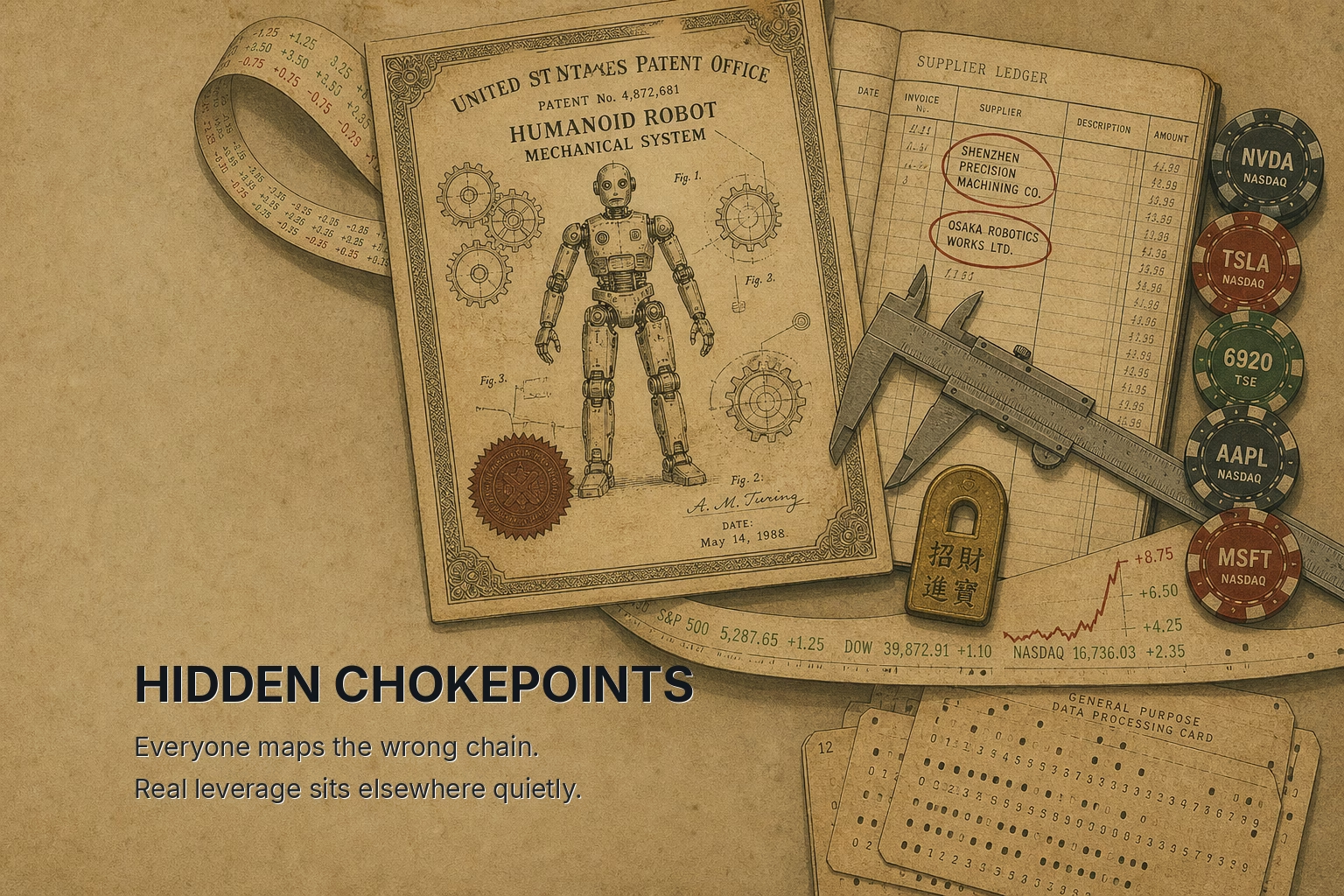
The most exposed link in the humanoid robot is not the chip. It is a high-precision gear made by a company most American investors have never heard of, and the entire Western robotics ambition rests on whether a machinist in Nagano can be replaced. Consensus is buying the picks-and-shovels story with NVIDIA and Supermicro. The picks and shovels are being forged in Japan and China.
And once again the narrative arrives dressed as a semiconductor trade. The map circulating this week from Barclays and Bernstein carries the same architecture the market applied to generative AI: find the enabling silicon, buy the enabler, ride the deployment ramp. Its name this time is humanoid robotics. The trouble is that the enabling component is not silicon. It is torque density, and torque density is a metallurgy and gearing problem that Silicon Valley does not own.
What Is Consensus Actually Buying?
Consensus is buying a forecast. The humanoid market today is roughly $2-3 billion in revenue. The projections run to $10-25 billion by 2030 and, in the excited version, to $200 billion by 2035. William Thompson at Barclays laid the range out plainly in his Thursday note, and the range itself is the tell. When the low forecast and the high forecast for the same decade differ by an order of magnitude, the analyst is not modeling a business. He is modeling a hope and bracketing his embarrassment.
The instruments the market reaches for are NVIDIA, Supermicro, AMD, Microsoft. The soft-landing crowd is long risk and long the AI-deployment narrative, and humanoids slot neatly into that story as the next incremental demand pull for compute. 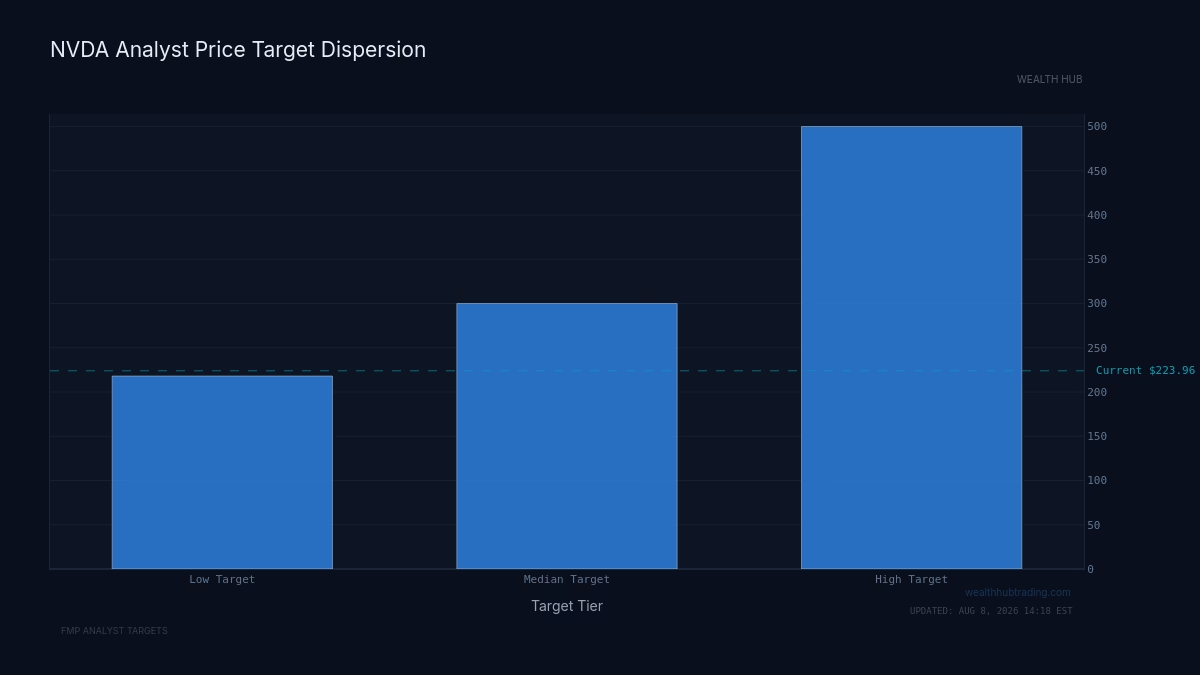
Here is the part consensus misses. Read the same Barclays note past the headline forecast and you arrive at the material bill. A humanoid may require 40 to 70 actuators, and those actuators represent roughly 30% to 50% of the material cost of the machine. The single largest hardware prize in the entire humanoid is not the inference chip. It is the actuator. And inside the actuator, the barrier to entry is the reducer, the high-precision gearing system that converts fast motor rotation into the slow, forceful, controlled motion a robot arm needs.
The market is pricing the brain. The scarce part is the joint.
Where Does the Money Actually Concentrate?
It concentrates in two places, and neither of them is in the tickers the note recommends as longs.
The first is Japan. Reducers have been, in Barclays' own framing, high barriers to entry, and they are led by Harmonic Drive Systems and Nabtesco. This is not an accident of the current cycle. Harmonic Drive has spent decades on strain-wave gearing; the tolerances involved are the kind that take a generation of manufacturing culture to accumulate and cannot be capitalized into existence in a quarter. If actuators are 30% to 50% of the bill and the reducer is the gating component inside the actuator, then a meaningful fraction of every dollar spent on a Western humanoid flows, today, to a machinist in Japan.
The second place is China, and here the concentration is not skill but chemistry. Rare-earth magnets are what give a high-performance motor its torque density, and Bernstein's Dien Wang put the number on it: a humanoid robot can consume more than twice as much magnetic material as an EV motor. Twice the magnet load, in a supply chain where rare-earth processing and magnet production are heavily concentrated in China. Wang called China's dominance troubling in an increasingly multipolar world, which is analyst-speak for a chokepoint that Beijing controls the valve on.
So the value chain the market is mapping runs through a Japanese gearing duopoly and a Chinese magnet monopoly. The named US longs, NVIDIA and Supermicro and AMD and Microsoft, touch the compute layer and the training stack. They do not make reducers. They do not process rare earths. They do not wind high-torque motors. The gap between the guided narrative, physical AI as an American compute story, and the disclosed anatomy, physical AI as a Japanese-Chinese hardware story, is the entire trade.
Why Hasn't the Market Priced the Chokepoint?
Because the market has learned exactly one lesson from the last AI cycle, and it is applying that lesson to the wrong layer.
In generative AI, the scarce input really was silicon, and the company that made the silicon captured the economics. First-level thinking says: robots are physical AI, physical AI is the next AI, therefore buy the AI names. Second-level thinking asks a different question. In this build-out, what is the equivalent of the H100? What is the part that is genuinely hard to make, concentrated in few hands, and consumed in enormous quantity per unit shipped?
The answer is not a chip. It is a strain-wave reducer and a sintered neodymium magnet. The market has not repriced the Japanese and Chinese owners of those parts because doing so requires abandoning the framework that worked last time and admitting that the profit pool sits with unglamorous mechanical suppliers on the other side of the Pacific rather than with the Nvidia-shaped hole every AI thesis is built to fill.
There is a geopolitical layer stacked on top of the industrial one. Both notes converge on the same warning: the humanoid supply chain is dangerously exposed to China. If Beijing moves on Taiwan, the loss is not only advanced chips. It is the motion-control components and the magnet feedstock needed to build humanoids at scale. Western supply chains may regionalize over time, with parallel hardware and manufacturing ecosystems emerging, but regionalization is a decade-long capital program, not a repricing event. The macro regime here is slow-moving until it is not. The base case is a grinding, gradual bifurcation of the supply chain; the tail case is an abrupt severance that no amount of Nvidia stock hedges.
Edward Chancellor observed in "Devil Take the Hindmost" that speculative manias reliably misidentify where the durable value in a new technology will settle, crowding the visible symbol while the real economics accrue elsewhere. The visible symbol here is the humanoid demo and the compute behind it. The real economics, on the evidence of the material bill, accrue to gears and magnets.
What Would Have to Be True for Consensus to Be Right?
For the long-NVIDIA-into-humanoids trade to work as framed, the actuator and its reducer would have to commoditize fast enough that the hardware bill collapses toward the compute-and-software layer, letting the American names capture the value. That is possible. Chinese motor and actuator makers are already driving cost down aggressively, and commoditization of the mechanical layer is a real force.
But notice what that scenario actually implies. If actuators commoditize, the winners are the low-cost Chinese actuator manufacturers, not the US compute names. And if actuators do not commoditize, because strain-wave gearing tolerance resists cheap replication, the winners are Harmonic Drive and Nabtesco. Both branches of the fork lead away from the recommended longs. The only path where NVIDIA and Supermicro capture the humanoid value chain is one where robots ship in volume, consume the projected compute, and the entire mechanical stack quietly becomes someone else's low-margin problem. That is the bull case, and it is one outcome among several, and not the most likely one.
The bear case is quieter and closer to a coin flip than the excitement suggests: the humanoid ramp simply arrives late. The forecasts that stretch to $200 billion by 2035 assume a deployment curve that has never once, in the history of complex electromechanical hardware, arrived on the optimistic schedule. The market today is $2-3 billion. The gap between $3 billion and $200 billion is being underwritten by demonstration videos of Chinese robots doing backflips, and a backflip is not a bill of materials.
I do not know when the market will separate the compute story from the mechanical story. These reframings hide in plain sight for several reporting cycles before price notices. What I do know is that the disclosed anatomy of the machine and the recommended list of longs describe two different businesses.
The scarce thing in a humanoid is not thought. It is torque, and torque is made in Japan and magnetized in China.