Terry Duffy suing the CFTC the same week he handed over the CEO title tells you something no earnings call would: the CME does not believe its liquidity moat alone can stop what Kalshi is doing. It believes the regulatory perimeter can. That is the mechanism worth understanding, and it is the place most observers get the story backwards.
The reflexive read is incumbent-fears-disruptor, and the CFTC chairman handed everyone that framing on a plate: "Incumbents are always going to fear the future, right?" It is a tidy narrative and it is wrong about where the contest actually sits. The CME's dominance in short-term rate and equity index derivatives was never primarily a technology story. It was a network-liquidity story sitting inside a regulatory container. Duffy is not litigating to slow down a better mousetrap. He is litigating because a rival is being allowed to build a functionally similar mousetrap under a different set of rules, and the rulebook is the asset he actually controls least.
The Moat Was Never the Matching Engine
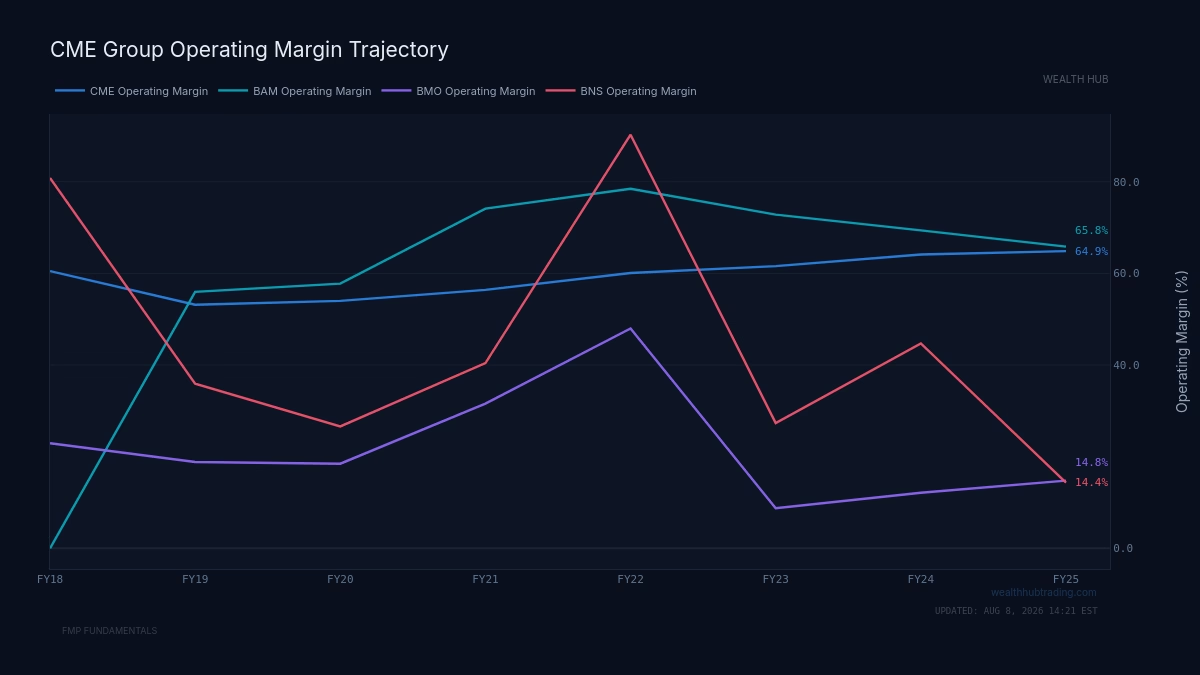
Look at what the CME became under Duffy and the source of the margin is unambiguous. Daily volume rose from 2.2 million contracts in 2002 to 28.1 million, at roughly $0.65 a contract, and operating margin expanded from 34% to 66%, among the highest in the S&P 500. Those are not the economics of a firm that wins on speed. They are the economics of a firm that owns the pool everyone else has to trade into.
The mechanism is liquidity concentration. In a listed derivatives market, the exchange with the deepest book wins almost automatically, because the next trader routes to wherever the tightest spread and largest resting size already are. Liquidity begets liquidity. That is why the E-mini and Micro S&P contracts are effectively uncontested, and why the near-monopoly in SOFR-based short-term rate futures held even as the underlying benchmark migrated from LIBOR. Competitors could copy the contract specification. They could not copy the open interest.
Here is where intuition fails. If the moat is liquidity, a new entrant with a thinner book should be no threat, and Duffy could ignore Kalshi entirely. He is not ignoring it. The lawsuit reveals that the CME's leadership sees the liquidity moat as necessary but not sufficient, because there is a second wall behind it that is quieter and, until now, load-bearing: the product-approval process. A rival cannot bootstrap liquidity in a contract it is not permitted to list. The permission is upstream of the network effect.
What Perpetual Futures Actually Threaten
Kalshi's pitch, a "next-generation CME for the 21st century," reads as marketing. The specific product at issue in the suit is not marketing. Perpetual futures, contracts with no expiry that hold their peg to the underlying through a periodic funding payment between longs and shorts, are the dominant form of leveraged speculation in crypto for a reason. They collapse the roll. A trader in a quarterly CME contract must periodically close and reopen a position as expiry approaches, and that roll is friction, cost, and a recurring reason to re-examine where the liquidity is. A perpetual has no roll. The position simply persists.
Strip out the roll and you have removed one of the recurring moments where an incumbent's liquidity advantage gets re-tested and reaffirmed. You have also created a product the CME does not offer in its core franchise. If a regulated venue can list perpetual equity-index or rate exposure while the CME's franchise is built on expiring contracts, the competitive question is no longer "who has the deeper book today." It becomes "which product structure do leveraged traders actually prefer, given a regulated venue for each." That is a different fight, and it is one where incumbency counts for less.
This is why the timing is not incidental. Duffy announced his move to executive chairman and filed the suit in the same week. The succession is the end of an operator's tenure; the lawsuit is the opening of a defense that will outlast it. The two events read as one decision: hand off the running of the business, and personally take ownership of the existential regulatory question before stepping back.
Where the Contest Is Really Decided
The honest way to frame this is as a claim about jurisdiction and product parity, not about who innovates. If the CFTC can grant a newer entrant permission to list a product structure the incumbent is not itself offering, regulatory approval stops being a neutral gate and becomes a competitive variable. Duffy's suit is, in effect, an argument that the regulator changed the rules of the container his moat sits inside.
That reframes what a CME shareholder should watch. The reflex is to track Kalshi's volumes and treat rising share as the threat. The volumes are a lagging indicator. The leading indicator is the scope of what the CFTC permits and on what terms, because product permission is the input that precedes any liquidity migration. A favorable ruling for the CME does not restore a technological edge, because there was never a decisive one. It restores the integrity of the regulatory wall behind the liquidity wall.
The Case Against This Read
The strongest counterargument is that this is a category error, and Kalshi is not a CME competitor at all. Kalshi built its business in event and sports prediction markets. Its expertise is in binary, resolvable-outcome contracts and a retail-facing distribution machine, not in the deep institutional order books that clear billions in notional rate and index risk. Institutions do not manage duration or hedge equity beta on a prediction platform. On this view, perpetual futures on Kalshi are a retail-speculation product that never touches the CME's institutional franchise, and Duffy is swatting a fly with a federal lawsuit because he is a fighter by temperament: "I'm always up for a good battle."
There is real weight here. The CME's franchise is overwhelmingly institutional, and prediction-market liquidity has been event-driven and shallow relative to listed derivatives. If perpetuals on a retail venue stay in a retail lane, the two businesses may barely intersect.
But that is precisely the migration path a moat-holder cannot afford to assume away. Retail speculation is where product structures get normalized before they move upmarket; the perpetual itself was born in crypto retail and now dominates leveraged trading across that asset class. A structure that wins the retail funnel and earns regulatory legitimacy does not need to be institutional on day one. It needs a regulated venue and time. Duffy filing suit rather than waiting is the tell that the CME reads the retail-stays-retail assumption as the risky bet, not the safe one.
The Condition That Settles It
This read is confirmed or broken on one observable: the scope and durability of the CFTC's permission for perpetual futures, and whether that permission survives the litigation intact. If Kalshi's authorization to list perpetuals is upheld and broadened, the regulatory wall behind the CME's liquidity has been breached regardless of how thin Kalshi's book is today, and the correct thing to track is product parity, not volume share. If the suit narrows or reverses that permission, the moat is intact and the episode was, as Selig implies, an incumbent flinching at a shadow.
Either way, the lawsuit has already revealed the thing the margin structure obscured. The CME's 66% operating margin was never purely the reward for the deepest book. It was the reward for the deepest book inside a container the incumbent could count on. Duffy's last dance is a fight over the container, and that he chose to have it in court rather than on the trading floor is the most precise statement anyone has made about where the CME's moat actually lives.