
A company raised its full-year revenue growth guide from 30% to 39% over three quarters and the stock fell. That is the puzzle worth sitting with, because the market that supposedly worships acceleration just punished it.
The consensus reflex says accelerating revenue is a buy signal. It usually is. The reflex misses that acceleration is a level statement and the market prices the derivative of the level, not the level itself. Figma's numbers went up. The rate at which they were going up, quarter over quarter, went down. Those are different objects, and the second one is what moved the stock.
Let me walk through where intuition breaks, because the break is instructive far beyond this one name.
Why did a raised guide sink the stock?
In February, management guided to roughly 30% revenue growth for 2026, against a sell-side consensus sitting near 24%. In May they raised to 35%. Last week they raised again, to 39%. Three consecutive raises, each one blowing past the prior number and past the Street. On the crude scoreboard investors claim to keep, this is a rout in the company's favor.
The stock fell anyway.
The reason is buried one layer below the annual number. The third-quarter guide implies sequential revenue growth of roughly 1% quarter over quarter. That is the object that spooked people. A 39% annual print is a comfortable story to tell over twelve months; a ~1% sequential step is the raw acceleration data arriving in real time, and it arrived flat. The annual guide is a summary of the past three quarters plus a modest forward assumption. The sequential guide is the forward assumption standing alone, stripped of the flattering base effects. Investors read the sequential number and correctly understood that the annual figure was being carried by quarters already banked.
The part consensus misses is that "accelerating revenue" as a slogan describes a trailing comparison, while a stock is a claim on the forward derivative. Those coincide when a business is genuinely inflecting. They diverge, violently, when the trailing acceleration was a base-effect artifact and the forward path is decelerating. Figma just showed the market the divergence.
What is the difference between the annual number and the derivative?
Think of a car whose speedometer reads 39 miles per hour, up from 30 a few minutes ago. The passenger cheers the higher reading. The driver, watching the accelerator, notices his foot is easing off. The speedometer is the year-over-year growth rate. The accelerator position is the sequential growth. One is where you are; the other is where you are going. The market does not pay for the speedometer. It pays for the accelerator.
Year-over-year revenue growth for a software company mixes together every quarter of the trailing four against the same quarters a year prior. When a company laps two weak quarters, the comparison flatters the current period even if nothing has changed sequentially. Figma's re-acceleration over the last three quarters is real in the sense that the year-over-year prints genuinely rose. But part of that rise is the arithmetic of easy comparisons rolling off, not a business reaccelerating from its own current base.
The sequential number strips the comparison out. It asks one question: how much bigger was this quarter than the quarter immediately before it? A ~1% answer, guided forward, tells you the current-base momentum is thin regardless of how the annual figure reads. This is why a company can post rising year-over-year growth and a falling stock in the same week without any contradiction. The two series are measuring different things, and only one of them is forward-looking.
The intuition trap is treating "revenue growth accelerated" as a single fact. It is two facts wearing one coat. The trailing fact accelerated. The forward fact, as guided, did not.
Are the extra revenue dollars worth anything?
Here is the second knife, and it cuts deeper than the sequential print. Figma raised its full-year revenue outlook by about $40 million. It held the non-GAAP operating income guide flat, at $125 to $135 million.
Read that again. Forty million dollars of incremental revenue dropped in, and not one incremental dollar of guided operating profit came out the other side. The entire revenue raise is being consumed before it reaches the operating line. Investors have a phrase for revenue that arrives without margin: empty calories. The body takes in the intake and stores none of it as usable energy.
There are innocent explanations. A company investing hard into a genuine growth window will spend ahead of revenue by design, and the flat operating guide may be management choosing to plow the raise into sales capacity, into AI features, into the land-grab. That is the charitable read, and it is not wrong on its face. Amazon spent a third of every revenue dollar for years and the patient were rewarded.
The uncharitable read is that the marginal revenue dollar at Figma simply does not carry the margin the base business carries, because it is being bought rather than earned. When the incremental customer costs as much to acquire and serve as the revenue they bring, growth is a treadmill. The flat operating guide against a rising revenue guide cannot, by itself, distinguish the investment case from the treadmill case. What it can do is tell you the market was handed a revenue raise with no profit attached and was asked to pay up for it. The market declined.
I do not know which read is correct. The published guidance shows the revenue raise and the flat operating line; the question of whether that spend is a land-grab or a treadmill would require the segment-level economics, and those are not something I will assert from the outside. What I know is that the market priced the ambiguity as a negative, and given the setup, that is the disciplined thing to have done.
What about the AI story everyone is really arguing about?
Behind all of this sits the terminal-value question, and it deserves an honest naming: the AI risk to a design-software company is definitionally unfalsifiable in the near term. No quarter, good or bad, resolves it. If generative tools collapse the cost of producing interface design toward zero, Figma's moat is a function of workflow lock-in and collaboration surface, not of any single quarter's growth rate. If they do not, the terminal value is intact and the current price is a bargain. Neither branch can be proven by the print in front of us.
This is why the stock "flails," to use the operator's own word. The bull and the bear are not arguing about the last three quarters. They are arguing about a state of the world five years out that no current data point can adjudicate. The near-term re-acceleration and the long-term durability question are running on separate clocks. The re-acceleration is measurable and, as we have seen, thinner beneath the surface than the headline suggests. The durability question is unmeasurable and therefore permanently available as a discount the market can apply or remove at will, according to mood.
Howard Marks has argued, in his memos on knowing what you cannot know, that the intelligent posture toward the unknowable future is not prediction but preparation for a range of outcomes. That posture applies with unusual force here. The AI branch is a genuine unknowable, not a solvable analytical problem. Pretending the next earnings call will settle it is the error. It will not.
So the sober frame is this: separate what the quarter actually told you from what the quarter cannot tell you. The quarter told you the sequential momentum is soft and the revenue raise carries no incremental profit. The quarter told you nothing about whether AI erodes or entrenches the franchise. Conflating the two, in either direction, is how investors talk themselves into paying for a speedometer while the accelerator eases off.
What is the actual read?
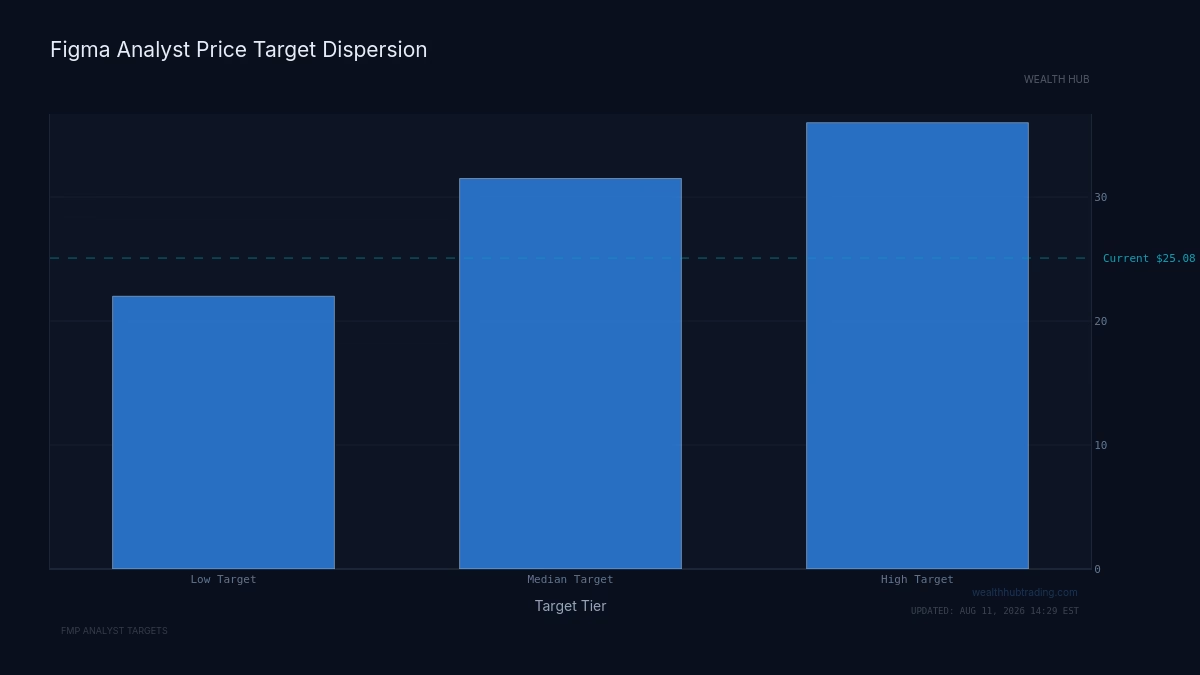
The stock did not fall because acceleration is bad. It fell because two specific things sat inside a headline that looked, at a glance, like unambiguous good news. The sequential guide of ~1% said the forward derivative is flattening. The flat operating guide against a $40 million revenue raise said the incremental dollar may not carry margin. Both are legitimate reasons for a forward-looking asset to reprice lower on a nominally strong annual print.
The bull case, that this is a company spending through a real growth window with durable lock-in, is one outcome among several, and not obviously the most likely given what the guide disclosed. The market weighing the ambiguity toward caution is not a mispricing to fade on reflex. It is the market pricing the derivative instead of the level, which is what markets are supposed to do.
Revenue that arrives without profit and momentum that flattens beneath a rising headline is not acceleration. It is arithmetic wearing acceleration's coat.