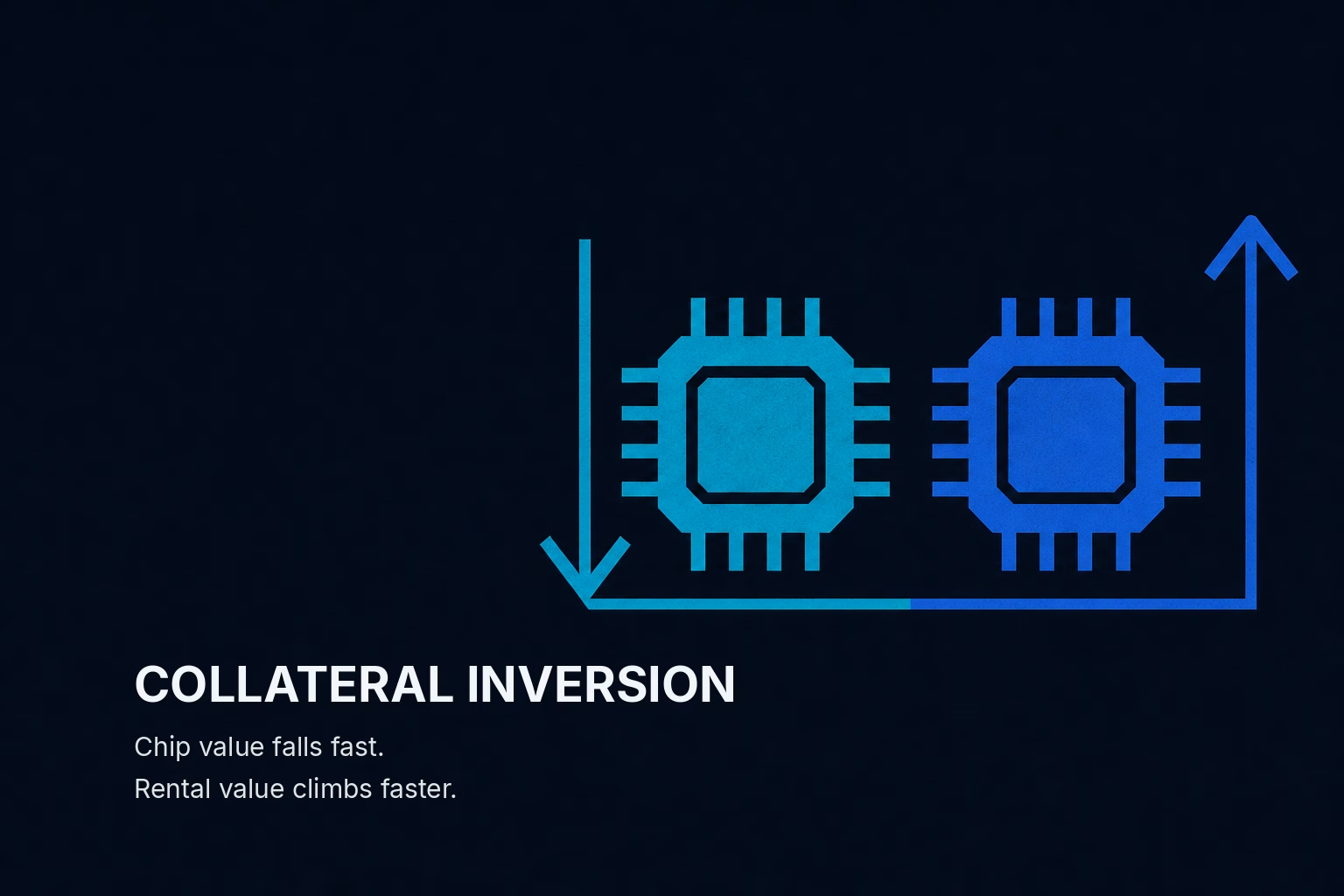
The surprising fact underneath the $500 billion capital deal is not that Wall Street wants exposure to AI. It is that used Nvidia GPUs are behaving like the opposite of the asset everyone modeled. Silicon is supposed to depreciate. A five-year-old chip is supposed to be worth a fraction of its list price, undercut by every faster successor. Instead the rental price of a 2020-vintage A100 is high enough that CoreWeave just signed a lease running to 2029 at what it called an attractive rate, while remaining sold out of prior generations. That inversion, an obsolete component that gains value on the secondary market, is the mechanism that makes the whole financing structure work. Get the mechanism wrong and you misprice the risk.
Why an Old Chip Rents Higher
Start with the observed prices, because they are the load-bearing evidence. Renting an Nvidia H100 for an hour has moved to $2.71, up from $1.96 at the end of November, per Silicon Data. Baseten disclosed that its B200 rental rate jumps from $2.63 to $5.10 an hour when its contract renews in October, roughly a doubling on renewal. The forward rates curve upward into 2027 and 2028. None of that is how a maturing technology component is supposed to price.
The intuitive model says compute is a commodity: newer nodes are cheaper per unit of work, so the marginal buyer always rotates to the latest silicon, and last generation's chips collapse toward salvage. That model would be right if the binding constraint were performance per dollar. It is not. The binding constraint right now is delivered compute per unit of time, and there is not enough of it. When aggregate demand for training and inference outruns installed capacity, every functional chip that can do useful work clears at a scarcity price, regardless of vintage. An A100 is slower than a Blackwell, but a slower chip that exists and is powered and networked beats a faster chip that has not been built yet. Scarcity, not spec sheet, sets the rent.
The second half of the mechanism is why the old chips stay useful long enough to matter. Jensen Huang's framing, stripped of the promotional gloss, is the actual engineering claim: CUDA lets Nvidia and outside developers keep upgrading Ampere, Hopper and Blackwell across their lives on a common platform. That software continuity is what makes a 2020 chip mission-capable in 2027. Versatility keeps utilization high; high utilization is what turns a depreciating box of transistors into a productive asset that throws off predictable cash. A durable, high-utilization, cash-generating asset is, by definition, financeable.
The Mortgage-Backed Analogy, Read Carefully
This is the point Jon Gray was making at the launch of the deal to mobilize over $500 billion of third-party capital, alongside Apollo, BlackRock, Blackstone, Brookfield, Goldman Sachs and KKR. His analogy is precise and worth taking literally. A bank underwrites the borrower and the house. An airline is underwritten on its own credit and on the plane. Until now, GPU financing has been underwritten almost entirely on the borrower, meaning investors sized their exposure to a specific hyperscaler or a specific model company and stopped there. What resilient rental pricing does is introduce the second leg: the collateral itself has a market value that persists independent of who is renting it.
That is the whole unlock. If a chip retains value across tenants and across years, a lender can lend against the chip, not only against the counterparty. The pool of capital willing to fund the buildout widens from equity investors betting on individual AI winners to credit investors underwriting an asset with an observable, term-structured price. Larry Fink reached back to the birth of the mortgage-backed securities market in the 1970s to describe the moment. The comparison is apt in structure: MBS worked because housing collateral could be valued, pooled, and financed apart from any single homeowner's credit. The claim here is that compute can be treated the same way.
Note what actually made this deal possible. It was not a forecast. It was the price action. Gray and Fink are responding to the fact that GPU rents held up and then rose. The financing follows the collateral value; the collateral value is not conjured by the financing.
The Forward Curve Is the Tell, and the Risk
The most important detail is the one that sounds like a footnote: Silicon Data is compiling forward rates, and CoreWeave is signing multi-year leases against them. A forward curve is what separates a spot commodity from a financeable asset class. It is the instrument that lets a lender model cash flows years out, discount them, and set a loan-to-value. The existence of an upward-sloping H100 forward curve into 2027 and 2028 is the market building the term structure that credit underwriting requires. That is the machinery of an asset class assembling itself in real time.
It is also exactly where the thesis is most exposed. A forward curve is a set of expectations, not a guarantee. It slopes upward because today's participants expect scarcity to persist. Underwrite a 2029 lease against that curve and you have taken a multi-year position on the supply-demand balance of compute staying tight. The collateral value that makes the loan safe is the same scarcity that a wave of new supply is designed to destroy.
What Would Break This
The thesis breaks on supply, and the mechanism that inverts intuition today is the mechanism that would reverse it. Scarcity is holding old-chip prices up. Scarcity is not a permanent condition; it is the gap between demand and an installed base that is being expanded as fast as fabs, power, and data center shells allow. Every hyperscaler capex dollar and every one of these financed buildouts adds capacity. The moment aggregate compute supply catches aggregate demand, the intuitive commodity model reasserts itself: the marginal buyer rotates to newer silicon, older vintages lose their scarcity premium, and the forward curve that looked like collateral becomes a mark-to-market loss.
There is a subtler failure mode. The financing structure assumes the second leg, collateral value independent of the tenant, is real and durable. If GPU rents fall, the two legs correlate: the borrowers most likely to default are AI companies whose economics deteriorate precisely when compute gets cheap and abundant, which is the same event that guts the resale value of the collateral securing their leases. That is the correlated-collapse risk every asset-backed market rediscovers eventually, and the 1970s MBS comparison should be a warning as much as an aspiration. Housing collateral and borrower credit turned out to be far more correlated in a downturn than the early structures assumed.
There is also a hardware-specific wrinkle. Chips do not just depreciate on price; they consume power. A 2020 A100 does less work per watt than current silicon. In a world where the binding constraint shifts from chip availability to power availability, an old chip can be scarce and simultaneously uneconomic to run, and its rental value falls even if no successor floods the market. Power cost is the variable that could sever utilization from vintage.
The Condition to Watch
The single observable that confirms or invalidates this asset class is the slope and level of the GPU forward curve as new capacity comes online. As long as forward rents into 2027 and 2028 hold their upward slope while the buildout accelerates, the market is telling you demand is outrunning even a supply surge, and the collateral thesis holds. The first sustained flattening or inversion of that curve, especially in older vintages like the A100, is the signal that scarcity is clearing and that leases underwritten against yesterday's prices are about to be marked down.
Watch the renewal rates most closely. Baseten's B200 renewal at nearly double the prior rate is the bull case in a single data point. The first widely reported renewal that resets lower, rather than higher, is the moment the second leg of the underwriting starts to wobble. Until that happens, resilient and rising rents remain the cleaner reading, and the $500 billion in mobilized capital is a rational response to a genuinely new, genuinely collateralizable asset, rather than the top-tick it will look like in hindsight if the forward curve is wrong.