Two outsiders from Berkeley turned a small $110,000 account into millions by spotting what Wall Street missed that markets often misprice uncertainty.
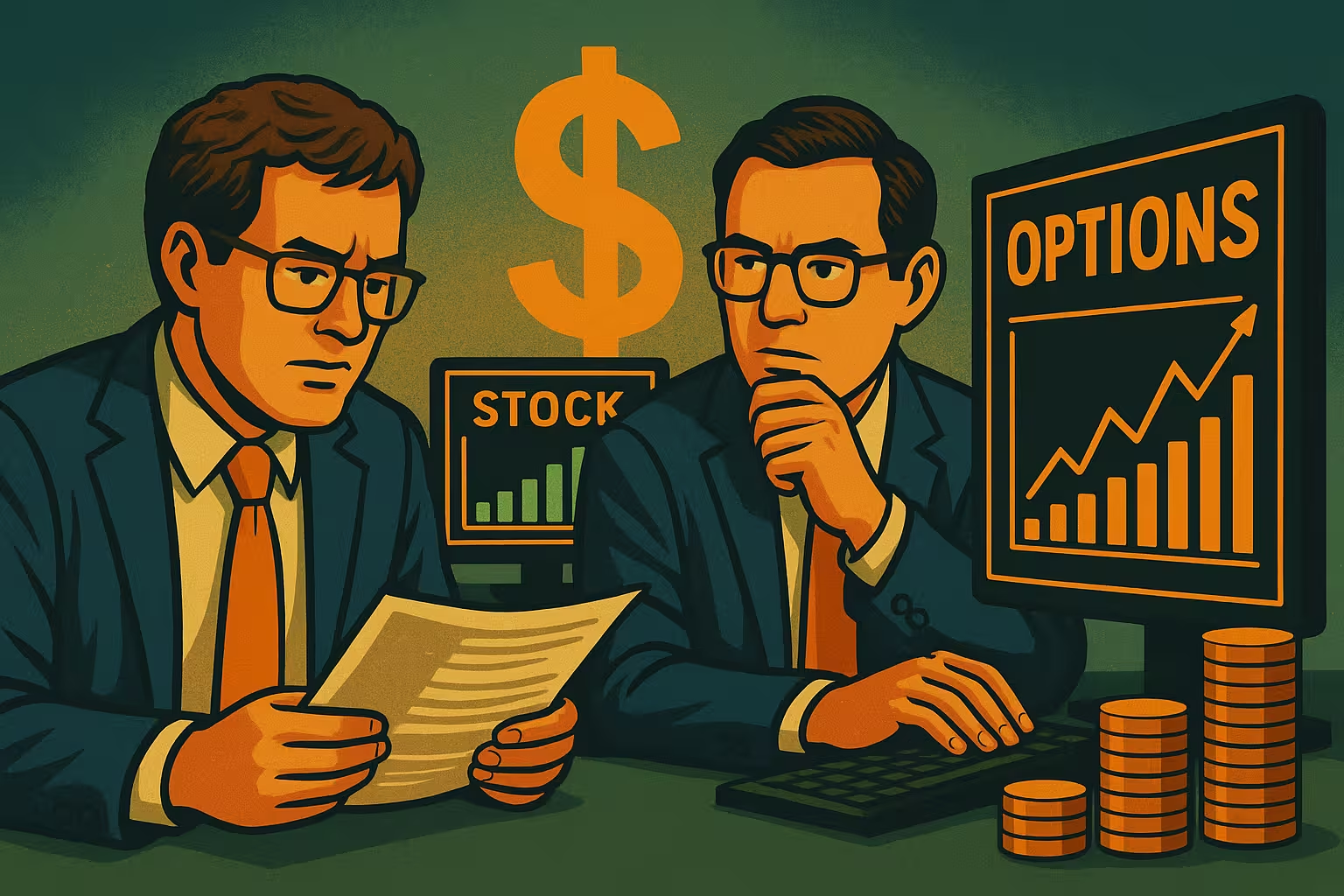
When two young investors, Charlie Ledley and Jamie Mai, started trading out of a garage in Berkeley, California, they had just $110,000 in a Schwab account and little more than curiosity, spreadsheets, and conviction. They weren’t Wall Street insiders, nor CFA-certified analysts. They were outsiders intellectually restless and obsessed with probability. But that outsider’s perspective became their greatest advantage.
They founded Cornwall Capital with a radical idea: the market often prices certainty into uncertain situations, leaving vast opportunity for those willing to embrace ambiguity. Their strategy was simple but profound seek highly asymmetric bets, situations where you risk $1 to make $10, $20, or even $100.
Within a few years, their garage-born experiment would grow into a hedge fund featured in Michael Lewis’s The Big Short, earning them tens of millions. But their ascent began not with subprime mortgages rather, with a contrarian leap of faith on a little-known credit card company: Capital One Financial.
The Capital One Gamble: Betting on Integrity Over Panic
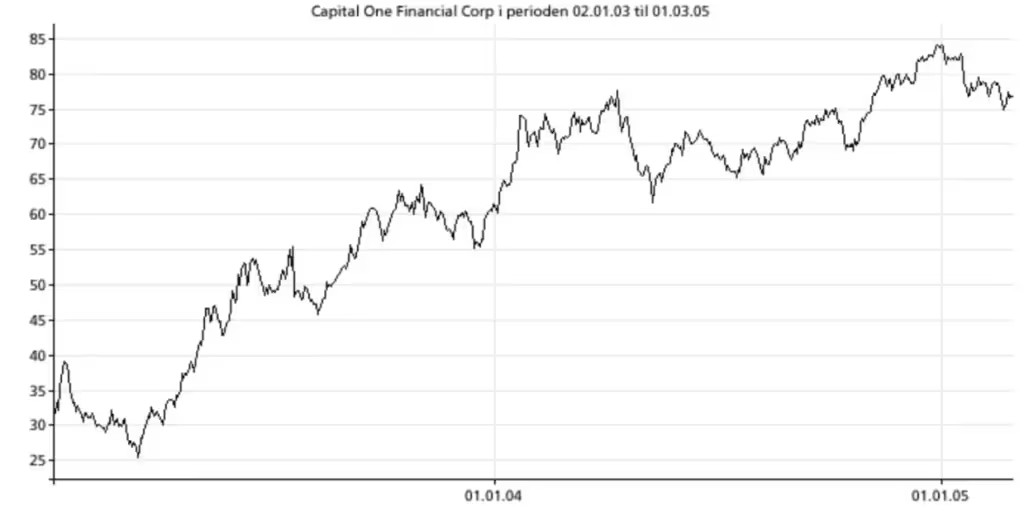
In 2002, Cornwall Capital stumbled upon Capital One when the company was under siege. The stock had plunged nearly 60% in two days after rumors of fraud among top executives and the launch of an SEC investigation.
While most investors fled, Charlie and Jamie saw something different. Capital One’s fundamentals were still exceptional strong loan performance, expanding customer base, and consistent profitability. The panic, they realized, stemmed not from the numbers but from perception.
They set out to answer a binary question: Was Capital One run by crooks, or was it simply misunderstood?
They didn’t rely on analyst reports or Wall Street whispers. They did their own research combing through financial statements, talking to former employees, and even reaching out to people who had gone to college with the CEO to assess his character.
Their conclusion was stark: the company wasn’t crooked, and the market was wrong.
Instead of buying the stock, they looked for maximum asymmetry. The stock traded around $30, but they bought two-year LEAPS call options at a $40 strike for just $3 per contract, investing $26,000, about 23% of their total capital.
If Capital One recovered, the payoff would be immense. If it collapsed, they’d lose the premium but nothing more.
As months passed, Capital One’s fundamentals held firm. When the SEC cleared the company of wrongdoing, the stock rebounded sharply. Those out-of-the-money LEAPS exploded in value. The $26,000 stake became $526,000 a 2,000% return.
The lesson was life-changing: markets overprice fear and underprice integrity. In other words, when the crowd panics over uncertainty, pricing models break down and that’s when asymmetry emerges.
Scaling the Model: Asymmetry as a System
Cornwall’s first windfall wasn’t luck it was proof of concept. Ledley and Mai had uncovered a recurring inefficiency in market psychology: investors’ obsession with precision blinds them to fat-tailed outcomes.
Their next trades followed the same principle high uncertainty, low probability of loss, and massive upside.
They invested in United Pan European Cable (UPC), a distressed telecom company trading at a fraction of its potential value. Instead of buying shares, they bought long-dated call options worth $500,000. When the company rallied, that position turned into $5.5 million.
Another bet on a small firm that delivered oxygen tanks to patients’ homes yielded even more. A $20,000 investment ballooned to $3 million.
The common thread wasn’t the industry or timing it was structure. They built option valuation models, testing every assumption in Black-Scholes, tweaking volatility, correlation, and probability inputs to expose where the market’s assumptions diverged from reality.
They realized that financial markets often confuse “known” with “certain.” Prices reflected an illusion of stability not true probability.
“What struck us most,” Mai said later, “was how easily one could identify situations where the market mispriced potential outcomes. Markets were too certain about inherently uncertain things.”
The Philosophy of Asymmetry
Cornwall’s insight wasn’t new in theory it was a practical form of behavioral finance before the term became popular.
Where others sought “edge” through prediction, they sought it through distribution of outcomes.
They looked for bimodal payoffs: outcomes that were likely to end in one of two extreme ways disaster or triumph. In these cases, the market often priced assets as if they would muddle along in the middle.
That’s where the opportunity was.
“It’s easy to frame the questions in special situations,” Mai explained. “The market has already identified the problem and applied a discount. The issue is that while the market can estimate the magnitude of a risk, it’s often terrible at evaluating its probability.”
Examples included lawsuits, regulatory actions, accounting scandals, or any event that cast doubt on a company’s viability. In those moments, the market’s uncertainty discount created price dislocation.
Cornwall sought to quantify that dislocation and structure bets that turned mispriced volatility into exponential upside.
The Art of the Exotic Bet
As they grew, Cornwall expanded their playbook. They weren’t just trading vanilla calls and puts anymore they began designing exotic options that expressed their macro views at minimal cost.
After the 2008 crisis, they noticed something odd: the Australian dollar and the Swiss franc had developed an extremely inverse correlation due to “risk-on/risk-off” market behavior. When global risk appetite surged, the Aussie rallied and the franc fell. When fear returned, the franc soared while the Aussie plunged.
They wanted a cheap way to get short the euro, but euro put options were too expensive. So they structured a “worst-of” option a derivative whose payoff depends on whichever of two currency pairs performs worse.
They bought a basket option tied to EUR/AUD and EUR/CHF crosses. If the euro dropped sharply against either currency, the payout could be massive and if one of the two didn’t move, the premium would still be minimal.
Because these pairs were negatively correlated, the market assumed the likelihood of both moving together was low, and priced the correlation accordingly. Cornwall disagreed. They believed a euro debt crisis could break that correlation entirely.
While vanilla euro puts cost about 4.5% of notional, the worst-of basket trade cost them less than one-tenth of that.
When the euro collapsed in 2009, it fell against both the Swiss franc and the Australian dollar exactly the scenario the market had dismissed. Cornwall’s trade returned six times their invested capital.
That trade epitomized their genius: using structural mispricing in this case, correlation assumptions to find cheap convexity.
The Big Short: From Asymmetric Bets to Systemic Insight
Their ultimate success came in the mid-2000s, when they applied the same philosophy to credit markets. They noticed that the booming subprime mortgage market had created a web of complex instruments mortgage-backed securities (MBS) and collateralized debt obligations (CDOs) that everyone treated as virtually risk-free.
Cornwall didn’t have the expertise to analyze subprime mortgages in detail. So they hired a former BlackRock analyst who specialized in mortgage credit to evaluate the quality of collateral loan-to-value ratios, FICO scores, and the seasoning of nonperforming loans.
The analyst identified the worst subprime pools in the market. Cornwall then searched for CDOs that contained those same underlying assets effectively constructing a list of “toxic twins.”
They bought credit default swaps (CDS) to bet against those CDOs.
Unknowingly, they were walking in the footsteps of Michael Burry of Scion Capital, who had earlier convinced dealers to create synthetic CDOs based on those very names.
“It turned out,” Mai later reflected, “that the reason we were able to find the CDOs with the absolute worst collateral was because Burry had already gone to the dealers months earlier and convinced them to make synthetic securitizations for the names he wanted to short.”
When the U.S. housing market collapsed, Cornwall’s CDS positions exploded in value.
They had entered late, but that timing worked in their favor because by then, dealers were desperate to offload exposure, offering them trades at extremely favorable terms.
Cornwall earned tens of millions on that trade one of the greatest asymmetric payoffs in financial history.
Lessons from Cornwall Capital: Finding Asymmetry Today
The legacy of Charlie Ledley and Jamie Mai isn’t just a rags-to-riches story. It’s a framework one that challenges how we think about markets, risk, and reward.
1. Seek asymmetry, not certainty.
Most investors focus on being “right.” Cornwall focused on being “paid if right.” They structured trades where being wrong cost little, but being right paid exponentially.
2. Focus on distributions, not predictions.
Instead of asking “what will happen,” they asked, “how is this priced?” and “what happens if the improbable occurs?”
3. Exploit fear and complacency.
Markets swing between overconfidence and panic. Each extreme creates mispricing.
4. Study incentives and ethics.
Their due diligence on management integrity at Capital One wasn’t symbolic it was central. Markets often misprice ethical uncertainty.
5. Accept small losses as the cost of convexity.
Cornwall made dozens of bets that expired worthless. But one winning position could make the portfolio. Their mindset was closer to venture capital than traditional investing.
6. Think like an outsider.
Because they weren’t constrained by institutional thinking, they could look for “crazy” trades. Their small size allowed flexibility, and their skepticism of models let them see where those models failed.
Epilogue: The Math of Uncertainty
In Hedge Fund Market Wizards, Jack Schwager asked Jamie Mai what unified all their trades. Mai’s answer was elegant:
“We looked for situations where there was a substantial probability that everyone else was wrong not because we knew more, but because we were willing to accept that nobody really knew.”
That intellectual humility combined with probabilistic rigor made Cornwall Capital one of the most interesting case studies in modern investing.
Their story is not about guessing the future. It’s about identifying when the market has become too sure of itself, when prices imply a false sense of precision, and when the tails of possibility are wide open.
For investors, that’s the Cornwall lesson:
When the market forgets how uncertain the world really is that's where the asymmetric opporunities hide.
Where to go from here:
Recommended reading – price efficiency and short selling, short selling and over optimism, Activist Investors, Distressed Companies, and Value Uncertainty, Option Volatility and Pricing, Equity Derivatives: Volatility and Correlation, Analysis, Geometry, and Modeling in Finance: Advanced Methods in Option Pricing
Useful tools: Options Trading and Portfolio Investment Analysis and Design Tools by Peter Hoadley