In September 2008, in the days after Lehman Brothers filed for bankruptcy, one money market fund broke the buck. The Reserve Primary Fund held roughly $785 million in Lehman commercial paper, short-term IOUs that Lehman had issued to fund itself. When Lehman defaulted, that paper became close to worthless, and the fund's net asset value fell below the sacred $1.00 per share that money funds are supposed to hold constant.
The response was not orderly. Within two days, investors pulled around $300 billion out of prime money funds, the category that lends to private borrowers. The funds, facing redemptions, stopped rolling over the commercial paper of even healthy companies. Firms that had funded their payrolls and inventories with 30-day paper suddenly could not refinance. General Electric, one of the largest and safest industrial issuers in the world, found the market for its paper freezing. The Federal Reserve had to build an emergency facility to buy commercial paper directly.
That episode is the clearest illustration of what money market funds actually do to the financial system. They are not a passive place to park cash. They are a transmission mechanism, and understanding how they carry monetary policy, and where they distort it, changes how you read every tightening cycle.
What a money fund is really doing
A money market fund is a mutual fund that holds only very short-term, very high-quality debt: Treasury bills, repurchase agreements, and, in the case of prime funds, top-rated corporate commercial paper. Investors buy shares priced at a stable $1.00 and earn a yield that tracks short-term interest rates.
The stable price is the whole point. A money fund is engineered to feel like a bank deposit: you put in a dollar, you get back a dollar plus interest. But it is not a deposit. There is no government guarantee on the principal, and the assets inside can lose value. The fund maintains the $1.00 price by holding assets so short and so safe that their market value barely moves. When that assumption breaks, as it did for the Reserve Primary Fund, the illusion of a deposit collapses instantly.
Here is the part that matters for policy. Money funds sit between the central bank and private borrowers. On one side, they can lend to the Federal Reserve. On the other, they lend to banks and corporations. Which side they lean toward is not fixed; it shifts with the yield each side offers and, crucially, with how safe each side feels.
The practical takeaway: when you hold a money fund, you are holding a claim on whichever borrower the fund manager currently trusts. In calm times that is a mix of the government and private issuers. In a scare, it becomes the government alone.
The floor under everything
Why can money funds set a floor under private funding rates? Because they have an outside option that no ordinary lender has.
Since 2013, the Federal Reserve has operated a facility called the overnight reverse repurchase program, or RRP. Through it, money funds and a small set of other institutions can lend cash to the Fed overnight, fully collateralized by Treasury securities, and earn a rate the Fed sets administratively. It is the safest short-term investment in existence, because the counterparty is the central bank itself.
This creates a hard floor. No money fund will lend to a private borrower at a rate meaningfully below what it can earn parking cash risk-free at the Fed. If a bank wants to borrow overnight from a money fund, it must offer at least the RRP rate, plus something for the trouble. The RRP rate becomes the reservation price for a very large pool of cash.
The causal chain runs cleanly. The Fed raises the RRP rate. Money funds immediately have a higher risk-free alternative. They demand more from private borrowers to lend to them instead. Private funding rates rise across repo, commercial paper, and short-term bank funding. This is the transmission belt working exactly as designed: an administrative rate set in Washington propagates within hours to the cost of overnight cash for banks and corporations.
What this means for you: the yield on your money fund is not set by market forces alone. It is anchored to a rate the Fed chooses, which is why money fund yields moved almost lockstep with the policy rate through the 2022 to 2023 hiking cycle while savings-account rates lagged for months.
Where the belt becomes a whip
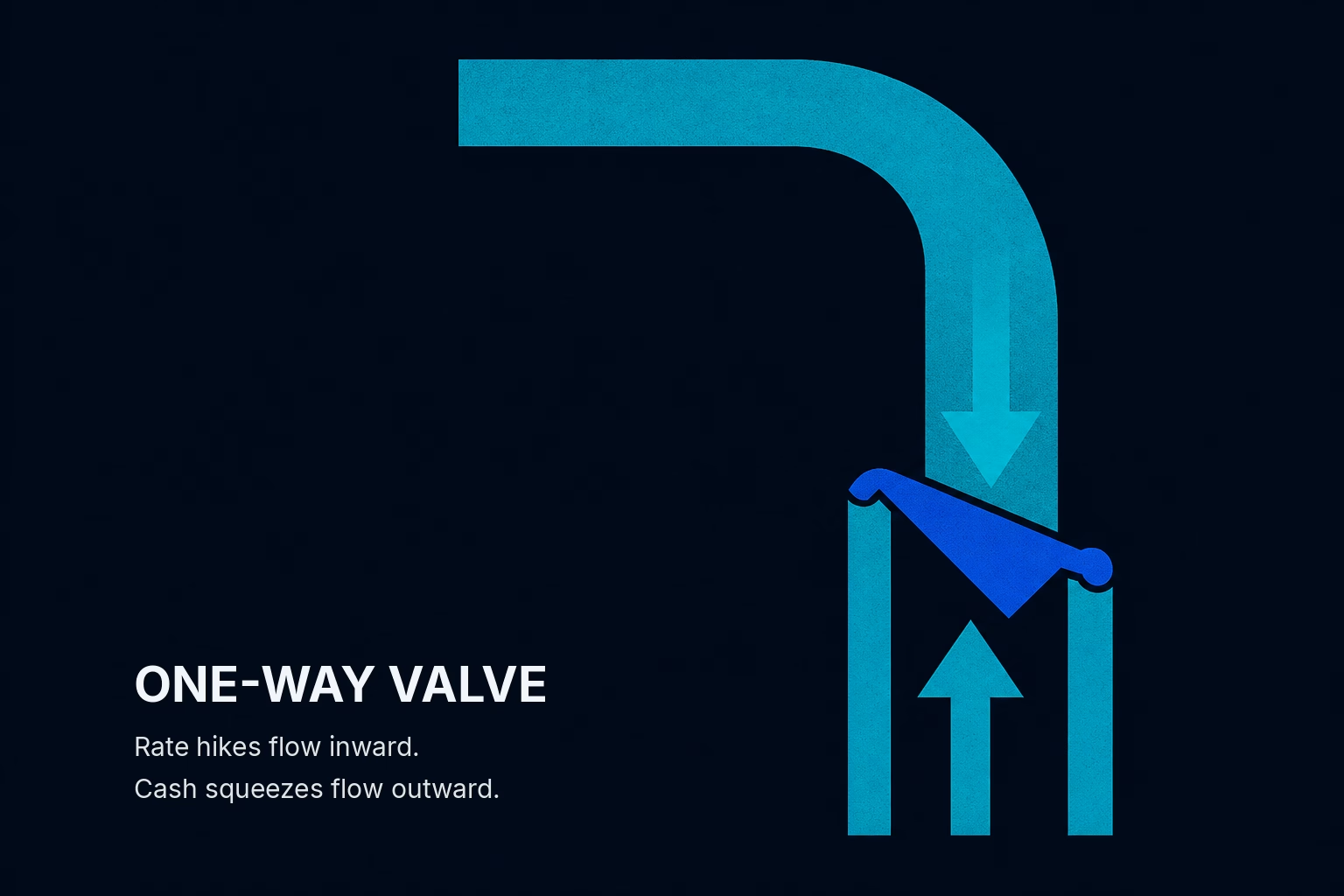
The distortion lives inside the same mechanism that makes transmission so clean. The RRP is not just a floor; it is an escape hatch. And an escape hatch changes behavior in a stress.
Consider what a prime money fund manager faces when risk rises. On one side sits corporate commercial paper yielding, say, 40 basis points over the government rate. On the other sits the RRP, paying a guaranteed rate with zero credit risk and zero redemption friction. In normal times the extra yield on the private paper is worth the modest risk. But the manager's clients expect a stable $1.00 and can redeem at any moment. The manager is not paid to be brave; the manager is paid to return a dollar.
So the moment credit risk looks like it might rise, the calculus inverts. Forty basis points of extra yield is not worth the chance of breaking the buck and triggering a run. The rational move is to abandon private paper and pile into government assets and the RRP. Every prime fund manager faces the same incentive at the same moment, so they all move together.
This is how a policy tightening can turn into a funding run. Raising rates is meant to slow the economy by making credit more expensive. But when money funds flee private borrowers en masse, the effect is not a gentle increase in the price of credit; it is a sudden withdrawal of its availability. The commercial paper market does not get expensive; it disappears. That is precisely the sequence that hit General Electric in 2008, when even a AAA-adjacent issuer briefly could not sell paper at any reasonable price.
The RRP makes this worse, not better, in one specific sense. Before 2013, a fund fleeing private risk had to find another private-ish home for its cash. Now it has a perfect, unlimited, government-guaranteed destination. The escape hatch is wider and faster than it used to be, which means the flight from risk can be larger and more sudden.
The practical implication: watch the composition of money fund assets, not just their yield. When cash rushes from prime funds into government funds and the RRP balance swells, that is the transmission belt tightening into a whip. It is an early warning that private funding is losing its lenders, and it often precedes visible stress in commercial paper and repo markets. 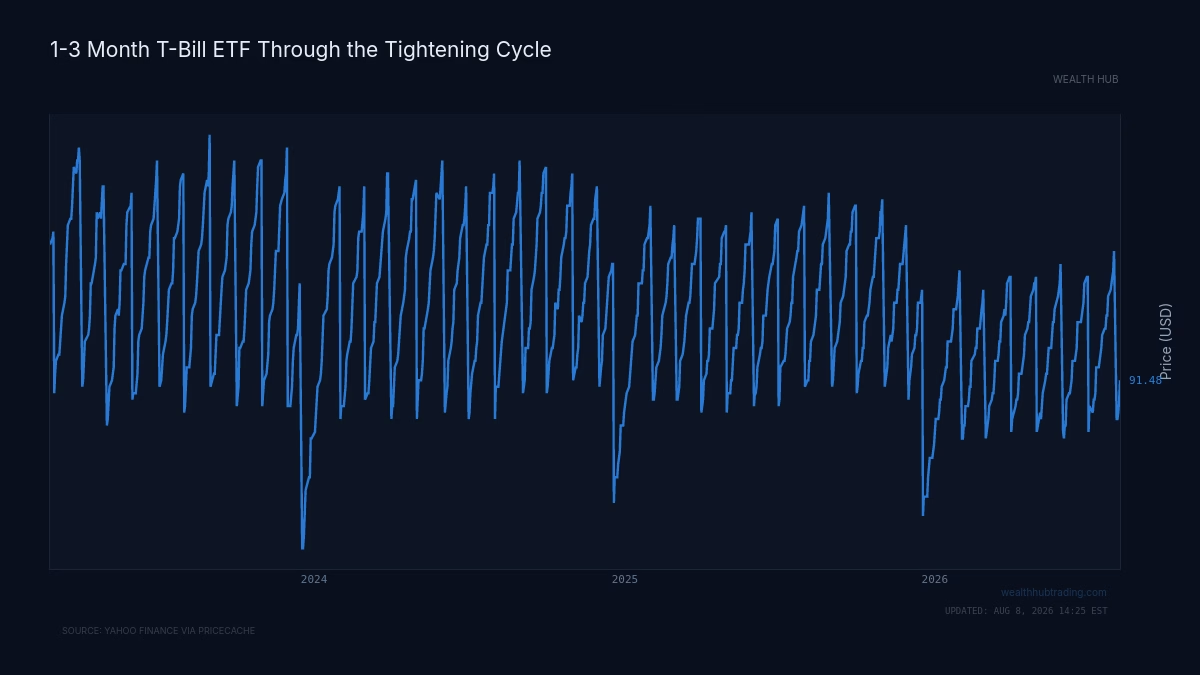
Reading the mechanism today
Generalize the lesson. The same structure that transmits policy so efficiently in normal conditions amplifies stress in abnormal ones. Efficiency and fragility come from the same feature: a very large pool of cash that can move instantly toward safety and has a risk-free place to go.
Most commentary focuses on the visible effect, the yield on money funds and how it tracks the Fed. That is the easy half. The half that drives outcomes is the composition shift, the migration between private and government assets that happens when trust wavers. The yield tells you what the Fed decided. The composition tells you what the market believes about credit.
Two clarifications matter. First, not every rate hike produces a funding run; most do not, because most tightening happens without a credit scare attached. The flight mechanism requires a trigger, a Lehman, a regional-bank failure, a sovereign wobble, that makes private paper suddenly look unsafe. The RRP escape hatch does not create the fear; it amplifies whatever fear already exists. Second, post-2008 reforms let prime funds float their NAV and impose redemption fees, which was meant to reduce the incentive to run first. Whether those reforms hold under real stress has not been fully tested, and the incentive to reach the exit before the door closes has not disappeared.
The single sentence to carry away: money funds transmit policy by anchoring private funding to the Fed's administered rate, and they distort it by giving cash a risk-free exit that turns a credit scare into a funding freeze. If you want to know whether a tightening cycle is proceeding smoothly or about to break something, do not just watch the yield. Watch where the money is going.