
The most important interest rate in finance is not the one the Federal Reserve announces. It is the overnight repo rate, the price at which banks and funds borrow cash against government bonds for a single night. When that rate spikes, the Fed's policy stops transmitting, and a system that looks solvent can freeze in hours.
This article walks through the mechanism in four steps: (1) what a repo transaction actually is, (2) how the market recycles the same collateral into system-wide liquidity, (3) how a seizure propagates from one desk to the whole system, and (4) what a reader should watch to see stress before it reaches the headlines.
What a repo actually is
A repo, short for repurchase agreement, is a collateralized loan dressed as a sale. One party sells a security (almost always a Treasury bond) and agrees to buy it back the next day at a slightly higher price. The difference between the sale price and the repurchase price is the interest on the loan.
Why does this matter? Because it lets an institution holding $100 million in Treasuries turn those bonds into cash overnight without selling them, then reverse the trade the next morning. The bond never leaves the institution's economic ownership; it is pledged, not liquidated.
The mechanics are simple. Assume a dealer pledges a $100 million Treasury and receives $99.8 million in cash. The lender keeps a small cushion, called a haircut, in case the collateral loses value before the loan is repaid.
Repo rate = (Repurchase price − Sale price) / Sale price, annualized.
If the dealer repurchases the bond for $99,812,000 the next day against $99,800,000 received, the overnight interest is $12,000. Annualized over 360 days, that is roughly 4.3%. The haircut here is 0.2%, or $200,000 on $100 million of collateral.
The practical point: repo is how the financial system funds its inventory. Nearly every large bank and bond dealer relies on it to carry positions overnight.
How collateral becomes system-wide liquidity
The repo market is not a set of isolated loans. The same Treasury bond can be pledged, re-pledged, and pledged again in a chain, a process called rehypothecation. One bond supports multiple layers of borrowing.
Trace the sequence. (1) A hedge fund pledges a Treasury to a dealer for cash. (2) The dealer re-pledges that same Treasury to a money market fund for its own cash. (3) The money fund now holds a claim on the bond it never bought. A single security has financed three separate participants.
This is why the repo market is the plumbing of the whole system. It converts a fixed stock of government bonds into a far larger flow of daily liquidity. Estimates put daily US repo volume in the trillions of dollars, dwarfing the visible stock market.
The efficiency has a cost. Each link in the chain assumes the link behind it will perform. If any participant cannot deliver cash or return collateral, every claim built on top of that transaction is suddenly in question.
What this means for you: when you read that the system has "ample liquidity," most of that liquidity is not idle cash. It is the same collateral working several shifts at once. Ample can become scarce faster than the headline number suggests.
How a seizure propagates
A repo market seizes when lenders stop rolling over their overnight loans. Because the loans are one night long, the entire market must be renewed every single morning. There is no cushion of term financing to absorb a shock.
The propagation runs in a fixed sequence. (1) A lender grows nervous about a borrower or about collateral values and declines to roll the loan. (2) The borrower must repay cash it does not have, so it sells assets into the market to raise it. (3) Those forced sales push asset prices down, which raises everyone else's haircuts, which forces the next borrower to sell. The loop feeds itself.
The anchoring episode is September 2019. Overnight repo rates, normally near the Fed's target of about 2.2%, spiked to 10% intraday. No bank had failed. A routine collision of corporate tax payments and Treasury settlement had simply drained cash from the system faster than lenders could supply it. The Fed had to inject tens of billions of dollars per day to force the rate back down.
The deeper lesson from 2008 is the same mechanism at larger scale. When Lehman's collateral became suspect, lenders raised haircuts across the board, and firms that depended on overnight funding could not roll their positions. The funding market froze before the solvency question was ever settled.
The practical implication: a repo seizure is a liquidity event, not necessarily a solvency event. Institutions that are perfectly solvent can fail simply because the overnight window slams shut. That distinction is why the Fed intervenes in repo before it intervenes anywhere
What to watch
The repo market gives an early warning that equity indices do not. The signal is the spread between the repo rate and the Fed's target rate.
When repo trades in line with the target, the plumbing is clear. When it trades persistently above the top of the Fed's range, cash is scarce relative to collateral, and stress is building underneath a calm surface. The 2019 spike was visible in this spread days before it became a headline.
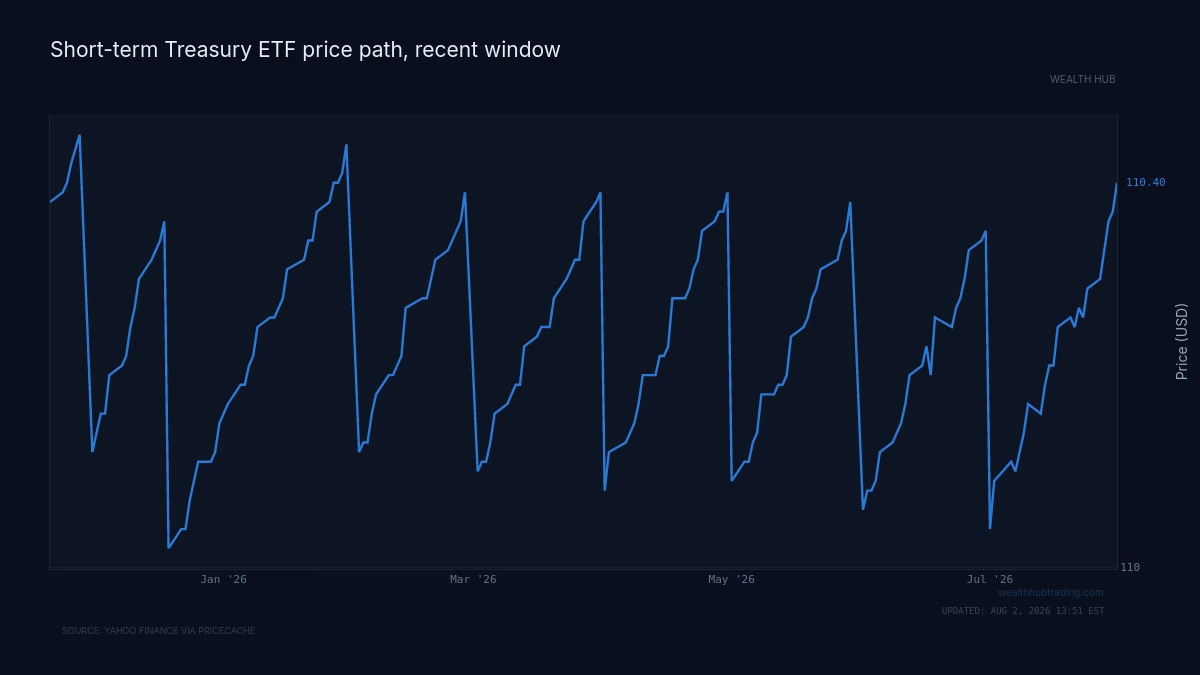
SHV over the thesis window.
Watch two things in particular. First, whether the Fed is running its standing repo facility, which lends cash against Treasuries on demand to cap the rate. Heavy use means the private market is not clearing on its own. Second, month-end and quarter-end dates, when banks shrink their balance sheets for regulatory reporting and repo funding predictably tightens.
The mechanism in one sentence: the repo market turns a fixed pool of government collateral into the daily liquidity the entire system runs on, and because it must be renewed every night, it is the first place a shortage of cash becomes a shortage of everything. It matters because the Fed's announced rate is only a target; the repo rate is where that policy either transmits or fails, and it fails there first.