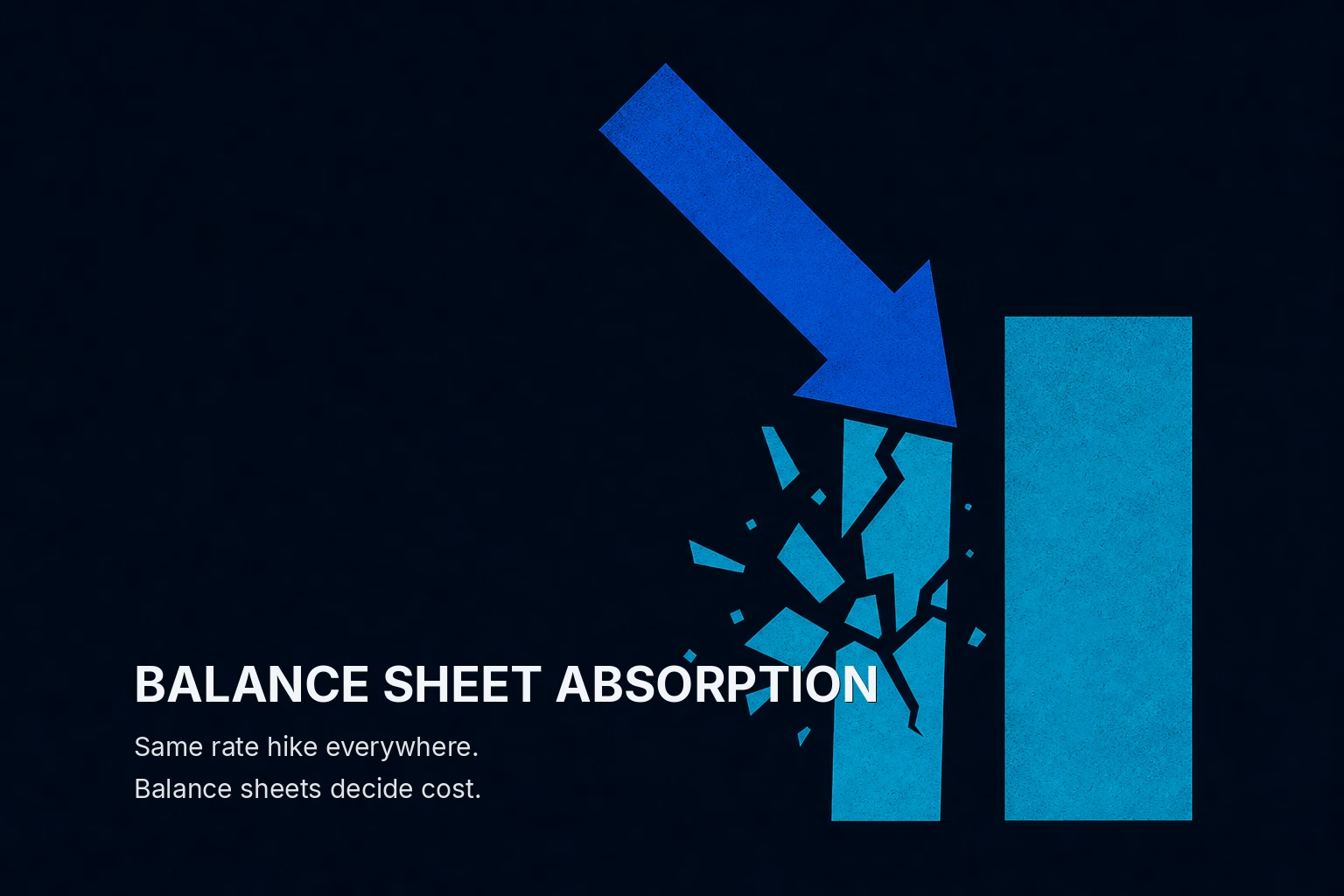
The number that should worry private credit investors is not the average. It is the conditioning. The Bank for International Settlements has effectively published a stress multiplier, and the market is reading it as a footnote.
The headline finding from the BIS work is deliberately anticlimactic: a one percentage point increase in central bank policy rates raises private-market loan default rates by roughly 0.1 percentage point on average. Against a US private-loan default rate of 1.3% and a European rate of 1.4%, that is noise. If that were the whole story, a rate cycle would be a rounding error for private credit, and the asset class deserves none of the attention it gets.
But an average is a weighted blend of very different worlds, and the entire analytical value of the study is in what it does after computing the mean. It asks which world you are standing in when the hiking starts. The answer changes the coefficient by a factor of three.
Why the Average Hides the Trade
Regulatory and quasi-regulatory research rarely moves prices on the day it lands, because the market files it under procedural noise and moves on. That is the mistake here. The BIS is not warning that rate hikes cause defaults; everyone already knows that. It is quantifying the state-dependence of the effect, which is the part that tells you who is forced to act and when.
The study splits the response by the macro conditions prevailing before the first hike, and by whether monetary policy was already loose or tight going in. When the economy is healthy at the start of the cycle, rate hikes are absorbed with almost no rise in defaults. The pass-through to loss rates is close to the benign benchmark. When adverse conditions are already in place, the same one-point move produces a materially larger jump.
The adverse conditions that matter are high aggregate debt and a high share of floating-rate loans. Both describe the present. A large fraction of the private-credit stock that has been originated over the last several years carries floating coupons, which means every basis point of policy tightening flows almost immediately into borrower interest expense with no fixed-rate buffer to slow it down.
The Mechanism Is Cash Flow, Not Credit
The transmission channel is not a credit-quality re-rating. It is a debt-service arithmetic problem.
A floating-rate borrower at the margin of coverage does not default because a rating agency downgrades it. It defaults because its interest expense resets higher against operating cash flow that has not grown to match. In a fixed-rate world, a hiking cycle punishes new borrowers and refinancers while leaving the existing stock untouched until maturity. In a floating-rate world, the hike hits the entire outstanding book at the next reset date. That is the mechanical reason the BIS conditioning matters: the floating-rate share determines how much of the loan stock is exposed to the policy rate in year one rather than at some distant refinancing wall.
Layer the two regional complications on top and the picture sharpens. The US carries the additional burden of elevated inflation, which is precisely what keeps the policy rate from falling to relieve the pressure. Europe faces a growth slowdown, which erodes the operating cash flow on the other side of the coverage ratio. Each factor pushes the response above the conditional estimate rather than below it.
What the One-Point Move Actually Costs
Put the pieces together for the current state and the relevant figure is not 0.1. In the configuration that fits today, high debt, high floating-rate share, and tight prior policy, the study points to roughly a 0.3 percentage point rise in default rates in the first year following a one-point hike.
That is where the arithmetic turns from dull to material. A 0.3 point increase against a 1.3% to 1.4% base is not a small absolute number sitting next to a small absolute number. It is a rise of close to a third in the default rate. The same nominal move that looks trivial in the average case is a roughly 23% relative increase in expected loss frequency in the conditioned case.
The timing is not symmetric across the Atlantic. A further one-point increase is currently priced into Eurozone money markets; it is not priced for the US. That means the European private-credit book is closer to realizing the conditioned outcome on a shorter horizon, while the US exposure depends on whether inflation forces a policy path that money markets are not yet discounting. The rates channel is doing real causal work here, so the pricing gap is the variable to track.
The Case Against Worrying
The honest counterargument is that a third of a small number is still a small number. Moving from 1.3% to roughly 1.7% in default rate does not, by itself, break a diversified private-credit portfolio. The BIS estimate is a first-year response, not a terminal loss rate, and it is an average within the adverse-conditions bucket, not a floor. Well-underwritten books with genuine covenant protection and real equity cushions beneath the debt will absorb a 40-basis-point rise in the default rate without distress.
There is also a self-correcting element. If defaults rise because policy is tight, and if that tightness eventually cools inflation or growth enough to justify cuts, the same floating-rate mechanism that amplified the pain on the way up reverses on the way down. The exposure that hurts fastest also heals fastest.
And the confidence intervals around these conditional estimates are wide. The study is honest about that; the reference benchmark carries a 90% band precisely because the response is noisy. Treating the 0.3 point figure as a precise forecast rather than a central tendency in a distribution overstates what the evidence can bear.
Where the Thesis Breaks, and Where It Holds
The thesis breaks if the floating-rate share of the private-credit stock is lower than assumed, or if borrower coverage ratios are fat enough that a full reset still leaves cash flow comfortably above debt service. In that case the conditioning that turns 0.1 into 0.3 does not apply, and the average is the right number after all. The single most important thing an investor can verify before accepting the alarming read is the interest-coverage distribution of the specific book they hold, not the market aggregate.
It also breaks if central banks do not deliver the hikes. The US case in particular is contingent on an inflation path that forces policy higher; if inflation cools without further tightening, the conditioned scenario simply does not trigger.
But absent those conditions, the cleaner reading of the BIS evidence is that the private-credit market is carrying a state-dependent tail that the average default rate conceals. The observable condition that would confirm the worry is straightforward: watch the pace of coupon resets flowing through to interest expense on floating-rate books over the first four quarters after any hike, and watch the Eurozone first, because that is where the priced-in move meets the most exposed balance sheet soonest. If default rates in that market drift toward the high-1% range on a single one-point hike, the conditioning held, and the average was the wrong thing to have been reassured by.