Situational Awareness did not blow up because Leopold Aschenbrenner was wrong about AI. It blew up because his positions became known, and once positions are known, the price of holding them is set by other people's decisions about when you will be forced to sell. That is the mechanism worth understanding here, and it is the one that intuition reliably gets backwards.
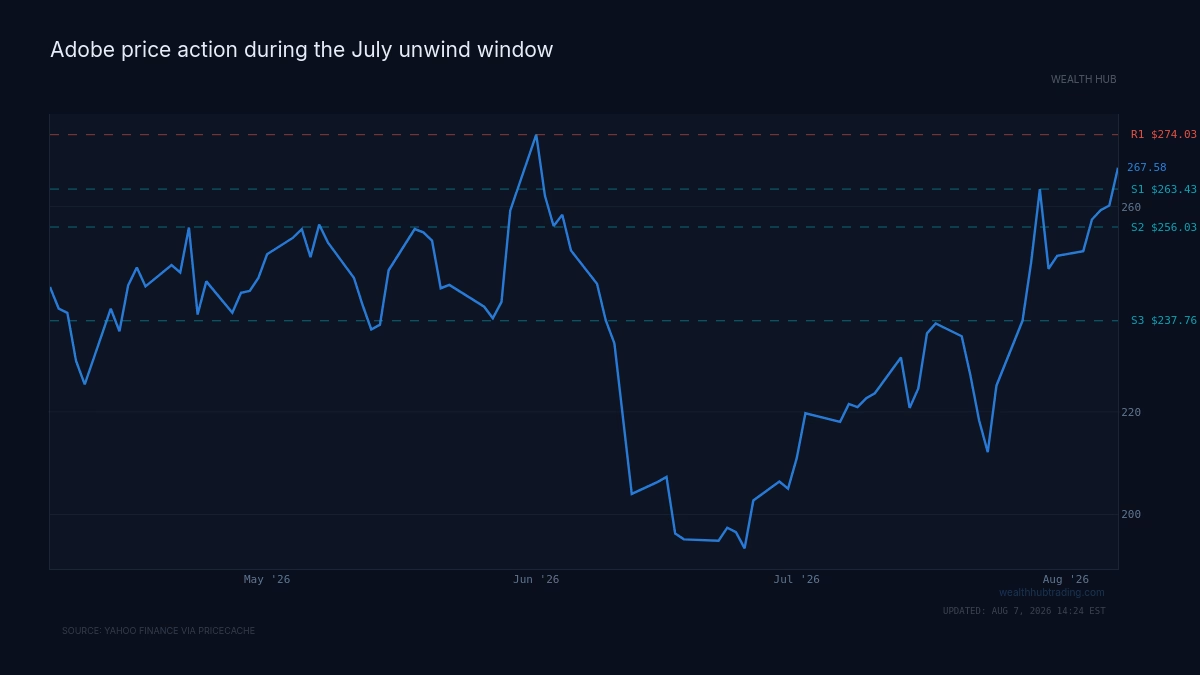
The natural reading of a 67% monthly loss is that the manager made a bad call. But the public book fell roughly 85% once the private holdings such as Anthropic are stripped out, and the long positions declined an average of 21% while a short like Adobe rose 26%. Those are large moves, but they are not fund-ending moves on their own. A 21% drawdown in an unlevered long book is a bad month, not a bank run. The fund-ending part came from the interaction of three things Steve Cohen named years ago: liquidity, leverage, and concentration. Any one is survivable. The combination is a mechanism for converting a drawdown into a liquidation.
The three inputs that only matter together
Cohen's framing is not a checklist of independent risks. It is a description of a feedback loop. Leverage of three to four times means a 21% decline in the underlying does not cost you 21%; it costs you a multiple of that against equity. Concentration means the same names carry the loss with no offset. And illiquidity means that when you finally have to sell, you cannot sell into depth, you sell into whatever the counterparty will pay.
Each input feeds the next. Leverage forces the sale. Concentration ensures the sale is large relative to the names' float. Illiquidity ensures the large sale moves the price against you, which increases the loss, which tightens the leverage constraint further. Aschenbrenner's own letter described exactly this: "vulnerability begetting more vulnerability." He was not describing a market view going wrong. He was describing collateral math going wrong.
The place intuition fails is the assumption that good positions protect you. They do not, because in a forced-sale regime the quality of the thesis is irrelevant to the clearing price. What sets the price is how visible your distress is and how quickly you have to transact.
Why being known was the fatal variable
The detail that turns this from a generic leverage story into a specific one is visibility. Aschenbrenner's fund grew fivefold in three months to a peak near $45 billion. A move that fast in a concentrated book does not stay private. Once names became "publicly associated" with the fund, other participants could trade against a position they knew would eventually have to be unwound.
This is the part that resembles a bank run more than a market call. In a bank run, the depositors are not making a judgment about the loans; they are making a judgment about whether other depositors will withdraw first. In a crowded, levered, illiquid book, the counterparties are not making a judgment about AI; they are making a judgment about whether the fund will be forced to sell before they have to cover. The rational move, once distress is visible, is to press the position. That pressing is what dries up the liquidity the fund needs.
Aschenbrenner's July 24 letter inviting fresh capital is the tell. Inviting investors to "add funds" at what he framed as an opportune moment is what a manager does when the collateral constraint is closing and the recapitalization has to come from inside, because the market outside has turned adversarial. By the time that letter went out, the mechanism was already running.
The exit that stopped the loop
The resolution is instructive because it shows what actually breaks the feedback loop, and it is not a market rebound. It is the removal of leverage. Aschenbrenner liquidated most of the public book in a single block trade to Citadel at a roughly 10% discount to market value. The discount is the cost of certainty: he paid 10% to convert a position of unknown liquidation cost into a closed one, and in doing so removed the leverage that had been forcing every prior sale.
The 10% haircut is not the scandal; it is the rational price of ending a run. The alternative was continued forced selling into a market that knew he was selling, at discounts that would have compounded. Trading the block to a single large counterparty removes the public price discovery that was doing the damage. The loop stops because the collateral constraint is gone, not because the thesis was vindicated.
The counterargument the record supports
Here is the fact that could break the tidy moral of this story: catastrophic single blowups are not disqualifying, and the historical record is unusually clear on this. John Arnold, one of his generation's best traders, said his hiring philosophy held that the optimal number of past blowups was one. Ken Griffin's Citadel was down 55% in 2008 and Chris Hohn's TCI down 43% in the same year; both went on to build dominant franchises. After LTCM's 1998 collapse, John Meriwether raised JWM Partners to $2.7 billion. Ryan Jacob's Internet Fund fell two thirds in the early 2000s and is still running 25 years later.
So the case that Aschenbrenner is finished is weak. He kept the private book, including the roughly $10 billion Anthropic stake that never had to be marked to a forced sale, and he stated he will run the public book fully paid for going forward. That last line is the substantive change. A fully-paid-for book removes exactly one of Cohen's three inputs, the one that turns a drawdown into a liquidation. Remove leverage and the same concentration and illiquidity that were fatal become merely uncomfortable.
The closest precedent is not LTCM but Amaranth, the largest hedge fund collapse of its era two decades ago, undone by a concentrated, levered energy position that the market could see and lean on. The pattern of a visible, crowded, levered book unwinding into a hostile market is one that recurs, and it is a signal worth watching whenever a fund's assets quintuple in a quarter. It does not always end in liquidation, but the conditions that produced this one are legible in advance.
What would confirm or break the read
If the mechanism read is correct, the tell going forward is structural, not directional. A manager who has genuinely absorbed the lesson runs the reconstituted book with position sizes small enough relative to name liquidity that a forced sale is never the marginal price-setter, and with visibility managed so that the fund is not the trade other people are pressing. The thesis about AI can be entirely intact while the plumbing is rebuilt.
The read breaks if the comeback fund rebuilds leverage back toward three to four times on a concentrated book. That would mean the diagnosis was "we were early" rather than "we were fragile," and the same three inputs would still be primed. The observable condition is not the next AI print or the next Anthropic mark. It is the leverage ratio and the position concentration on the day the public book is rebuilt.
For readers, the transferable point has nothing to do with AI conviction. It is that the loss function of a crowded, levered, illiquid book is set by other participants' knowledge of your constraints, not by the merit of your holdings.