Meta reports a mid-50s return on invested capital, and that number is both accurate and about to become the most misleading figure in the story. The reason is a single line on the balance sheet that most return calculations wave straight into the denominator: Construction in Progress. As of the second quarter, roughly $80 billion of Meta's asset base is CIP — capital that has been spent, sits on the books, and generates precisely zero operating profit today. Against an average invested capital base of only about $127 billion under a properly adjusted methodology, that is not a footnote. It is the majority of the future denominator, waiting to switch on.
The market anchors to the headline ROIC and to management's guided narrative about AI infrastructure returns. What it prices less carefully is the mechanical certainty in the filing: the reported return has to fall, and the only open question is how far.
Why the Numerator Has to Be Rebuilt First
Return on invested capital is only honest when the two halves of the ratio describe the same business. The discipline that separates a real ROIC from a mechanical one is simple to state and easy to violate: anything added to invested capital needs a corresponding item in NOPAT, or you are just depressing the ratio without economic content.
Start with the profit figure. To make NOPAT comparable across a long series, the one-off charges have to come out — the 2019 FTC settlement, the 2022 restructuring and layoff costs, the legal and severance items in the most recent quarter. These are real cash events, but they are not the recurring economics of the advertising engine, and leaving them in distorts the trend for exactly the periods an investor most wants to compare. Then a normalized tax rate — 21% rather than Meta's typically lower effective rate — nets out the year-to-year tax variability that has nothing to do with operating quality.
That normalization choice on the numerator is what forces two corrections on the denominator most models get wrong. If you tax NOPAT at a normalized rate, you have already absorbed the impact of long-term income tax liabilities, so those liabilities have to be netted out of invested capital too — otherwise the same item is counted once in the numerator's tax rate and again in the denominator's base. The same logic applies to operating leases. If NOPAT already carries the full lease expense, including its embedded financing cost, then leaving roughly $24 billion of right-of-use assets in the capital base while ignoring the offsetting lease liabilities understates the return. Both are cases where an unpaired adjustment quietly lies about the business.
The Line That Isn't Earning Anything
The equity-investment adjustment is where the recent optics get interesting. Equity investments went from essentially zero in mid-2020 to roughly $30 billion now, most of it arriving with the ScaleAI stake. That balance has no impact on NOPAT — it is not operating capital producing operating profit — so leaving it in the denominator would mechanically drag the reported ROIC down in exactly the recent quarters where the AI narrative is most scrutinized. Net it out and the return reflects the operating business, not the venture book.
Construction in Progress is the same principle at a scale that dwarfs everything else. CIP is, by definition, non-depreciable and non-earning: it is buildings and infrastructure not yet placed in service. It contributes nothing to NOPAT, so it does not belong in a base meant to measure the capital actually generating that profit. Subtract it, and the true operating ROIC lands in the mid-50s — remarkable for a company of this size, and precisely the number that explains why the same shareholders admire the business and fear the capex.
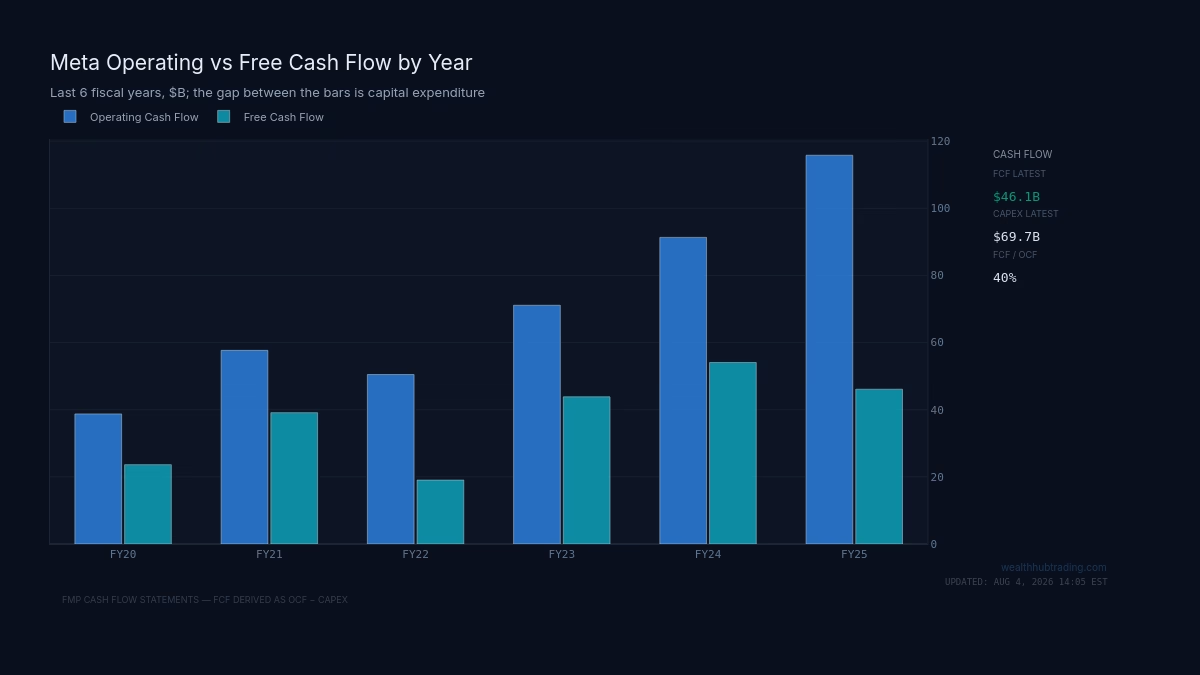
Because the moment that $80 billion of CIP is placed in service, the accounting reverses. It stops being an excluded, non-earning asset and becomes a depreciable one — adding to invested capital and adding depreciation expense to the cost line — while the incremental revenue it supports is still ramping. The denominator swells, the numerator absorbs new depreciation, and the reported LTM ROIC declines. This is not a forecast about demand or a bet on AI monetization. It is the arithmetic of assets moving from one column to another, and almost all of that $80 billion is expected to come online within the next 18 to 24 months.
What Investors Are Actually Afraid Of
The fear underneath the capex debate is not the level of ROIC. It is the gap between the overall return and the incremental return. Investors dislike it when a company reinvests at a rate meaningfully below its existing returns, because it dilutes the average and signals that the reinvestment opportunity is worse than the legacy business.
Meta will almost certainly show incremental ROIC well below its current mid-50s figure. That is close to inevitable given the sheer size of the deployment — you cannot spend at this scale and match the return of an advertising business that was built over two decades with far less capital intensity. But there is a category error in treating any decline as damning. If the incremental return on this build settles in the 20-to-30% range, that is dramatically lower than the current true ROIC and still an enormous premium over the cost of capital. Capital compounding at 20-plus percent is not value destruction; it is a lower grade of an exceptional business.
The Multiple Question, Answered Sideways
The intuitive objection follows directly: if incremental returns are falling, shouldn't the multiple compress? It sounds right and it misreads what a multiple pays for.
A high multiple is not purely a function of return level — it is a function of return times runway. A business earning 55% on capital with nowhere to reinvest can justify a lower multiple than a business earning a respectable return with an enormous reinvestment opportunity in front of it. The value of Meta's capex program, if the incremental economics hold at even a fraction of the current return, is that it converts a limited-runway cash machine into a business that can absorb tens of billions at returns still far above its cost of capital. That reinvestment optionality is what a premium multiple is buying, not the trailing ROIC print that is about to fall.
The counterargument that would break this read is specific and testable. If the incremental return on the CIP wave comes in below the low-20s — not merely below the current ROIC, but approaching the cost of capital — then the reinvestment-runway defense collapses, and a falling ROIC really does argue for a lower multiple. The distinction between a 25% incremental return and a 12% one is the entire bull-bear axis, and it is the one number worth extracting from the filings as those assets convert.
The Condition to Watch
The observable that resolves this is not the headline ROIC, which is guaranteed to drift down as CIP converts and which will be misread as deterioration when it is mostly mix. The number that matters is the trajectory of incremental NOPAT against the incremental invested capital as the $80 billion moves from Construction in Progress into service over the next two years. If that ratio holds in the 20-to-30% range, the reported decline is cosmetic and the reinvestment story is intact. If it sinks toward the cost of capital, the multiple debate reopens on very different terms. Until the assets switch on and start producing, the mid-50s true ROIC is the cleaner read of the business as it stands — and the falling headline number that follows should be read as the bill for a runway, not the end of one.