The state moratoria on new data centers are being read as a demand question. They are better read as a depreciation question, and the contracts already say who pays. Microsoft has declined to renew the Oracle capacity it rented for AI Bing because the older Nvidia hardware "no longer fit the company's specifications." That is the first clean market price for aging GPU capacity this cycle, and it came in at zero. Put that next to a policy shock that delays new campuses by one or two years, and the mechanism is plain. Every month of regulatory delay makes the landlord's chips a month older. The tenant keeps its options open, and the landlord keeps its obligations.
A Renewal That Priced the Collateral
The 2023 Oracle-Microsoft arrangement was once cited as proof that compute was so scarce Microsoft would rent from a direct rival. The deal's full size was never disclosed, so the revenue hit to Oracle cannot be sized from public information. That caveat limits the earnings read. It does not limit the signal.
Oracle's bull case has rested on a specific number. In September, the company said it was renewing contracts for four-year-old GPUs at a 20% premium to the original price. As recently as this Wednesday, a Wells Fargo note cited Oracle's 97.9% AI infrastructure utilization and a "20% average renewal/resale premium" as evidence that token economics remain attractive. An Oracle spokesperson told Bloomberg that demand "remains strong, including for earlier-generation" GPUs.
The largest buyer of rented compute in the world just declined that bargain. One contract does not cancel an average. It does tell you what the most sophisticated counterparty will pay for an older rack when it has alternatives: nothing.
Microsoft's broader behavior points the same way. It committed more than $80 billion to rent capacity from neoclouds including CoreWeave, Nscale and Nebius. Bloomberg reports that its leadership has grown frustrated with costs and delays and has debated signing any new neocloud deals at all. In October it walked from Nscale's UK deal. This week came word that it will not expand its Texas deal with Nscale, and that it spent $5 billion less on Q3 capex than projected because third-party capacity, including IREN's, was late. The pattern is a tenant with the deepest pockets in AI tightening its terms on three variables at once: new chips, on schedule, built to its own specifications. A landlord that misses any one of them is replaceable.
How a Moratorium Becomes a Balance Sheet Problem
The policy shock matters because of the second variable, schedule.
Cleanview counts nine states where the governor or governor-elect has promised or imposed a pause on new data centers. Together they hold 158.6 GW of planned capacity, about 41% of the US pipeline. The exposure is not evenly spread. Every gigawatt of OpenAI's planned capacity sits in a state whose new governor backed a pause on the campaign trail, as does 45% of Microsoft's.
For Oracle, OpenAI exposure is Oracle exposure. The $300 billion compute contract that lifted the stock in September 2025 is being built across Texas, New Mexico, Wisconsin and Michigan. Texas and New Mexico produced the most hostile results on Tuesday.
New Mexico is where the contract terms do the damage. Project Jupiter, the 2.45 GW Oracle-OpenAI Stargate campus, has been under a force majeure notice Oracle sent on September 24 to the Blue Owl unit developing the site. Oracle called the notice commonplace. The FT reported that Oracle remains liable regardless: if Jupiter is not ready, Oracle owes a "carry cost" in lieu of rent for up to three years, sized to cover the interest on the debt in full plus a set equity return for Blue Owl's funds. In the words of one person familiar with the contract, "The power delivery risk sits with Oracle, not the investors."
Governor-elect Deb Haaland told reporters the morning after the vote that her day-one plan is "a moratorium for large-scale data centers with the legislature passing a set of guardrails." She has written that Jupiter's gas plants would "not exist" under her administration. The campus was already trucking in compressed natural gas because its pipeline was late, and the FT quoted the $18 billion of construction loans behind it at 89 to 91 cents on the dollar before the election.
This is the second-order read the market has been slow to price. A moratorium does not need to kill a project to hurt Oracle. It only needs to extend the period in which Oracle pays carry on an unpowered campus while its existing fleet, the one Microsoft just declined to renew, ages toward the same fate. Delay is costless to OpenAI and Microsoft in contractual terms. For Oracle it is an open-ended expense with a ceiling measured in years.
Texas adds a calendar. Governor-elect Gina Hinojosa converts Governor Abbott's audit-based freeze into one tied to legislation, which keeps it in place at least through the session's end on May 31, 2027. Goldman's TMT desk attributed part of Friday's bounce to "benign comments" from Hinojosa on data centers. A market rallying on the absence of hostility is a market that has not yet priced the timeline.
Who Is Forced to Move
Policy delays sort actors into those who can wait and those who must act. That sorting is where the trade sits.
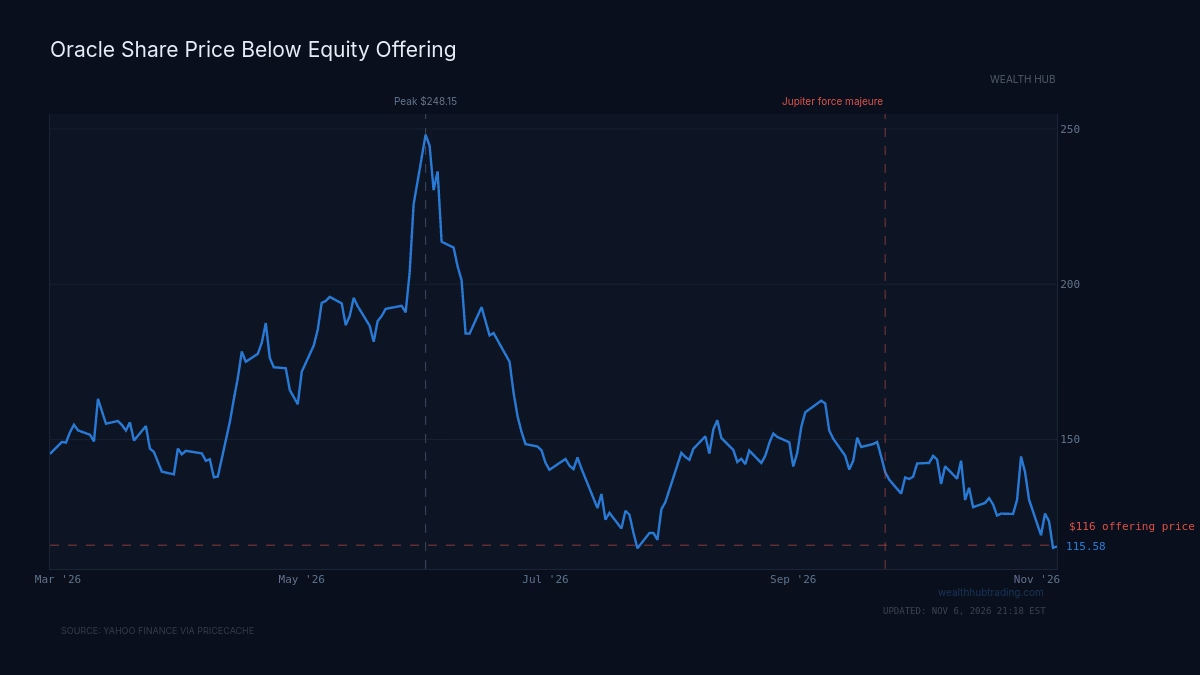
Oracle has already acted. It sold $10 billion of stock at $116 this week and blew through a four-year $20 billion "hard cap" on issuance in a single morning, five days after setting it. After the Microsoft report the stock slid 4%, below the offering price, leaving buyers of the "de-risked" story underwater within four days. Shares peaked at $248.15 on June 1 and have lost more than half their value in five months. A company that must raise equity into weakness to fund carry costs on stalled campuses is a forced seller of its own paper.
Lenders are next. Construction loans quoted below par before the vote now face a governor who has publicly ruled out the site's power source. ING was reported to be selling a $500 million data center loan portfolio on Thursday. Bloomberg reports the ECB is weighing a review of bank loans to data centers, following the Bank of England's probe last year. Supervisory reviews often move slowly and then all at once, because a capital charge or a provisioning request forces balance sheets to reprice even when no borrower has defaulted. That is the regulatory channel most likely to be underweighted as procedural noise, and it acts on credit before it shows up in equity.
The funding math explains why credit is the pressure point. Goldman credit strategist Amanda Lynam estimates hyperscalers are financing 36% of this year's capex with credit and 35% next year, and that only 43% of the $687 billion in AI-related financing so far this year came from hyperscalers themselves. The majority came from elsewhere: neoclouds, developers, private credit vehicles, and Oracle. Those are the balance sheets that hold depreciating hardware and absorb schedule slippage.
Microsoft and OpenAI sit at the other end. They keep the ability to walk, renegotiate, or shift workloads to newer capacity. Nomura's Ting Lu argues that China's AI buildout "may benefit significantly" from a slower US build. That link is speculative and depends on export-control and chip-supply variables outside this story, so it deserves less weight than the domestic transfer from tenant to landlord.
The Case That Timing Is Harmless
The strongest counterargument comes from Goldman, and it has numbers behind it. Hardware analyst Mike Ng says capacity already under construction implies 22 GW-IT and 24 GW-IT of net additions in 2027 and 2028, at or above his 20 and 24 GW forecasts. He calls the key risk "timing rather than cancellations." E&C analyst Adam Bubes raised his US data center construction spending forecasts to $80 billion for 2026 and $100 billion for 2027, introduced $125 billion for 2028, and noted that every project in the 2027 forecast has broken ground. Moratoria, in his view, mainly hit unstarted projects and smooth the cycle into 2029 and 2030 without shrinking the addressable market. Jefferies' Julien Dumoulin-Smith summarized the consensus: "Demand moves right, not away."
At the aggregate level this is probably correct, and it should temper any read that the AI capex cycle is ending. The Microsoft non-renewal is also a single, undisclosed-size contract dating to 2023, and Microsoft's stated reason was hardware specification, not regulation. Oracle's 97.9% utilization figure, if it holds, says most of its fleet is still earning.
The counterargument still misses the ownership question. Goldman's own exposure data shows Texas accounting for 20% of 2027 and 27% of 2028 under-construction additions, and only about half of the 2028 watch list has broken ground. The unstarted share is exactly what a moratorium hits first. "Timing" is an industry-level description. At the firm level, a two-year slip delivers a campus into a world where the chips ordered for it are two years older, financed by debt that accrues interest the whole time. For a hyperscaler, delay is scheduling. For the owner of the GPUs and the signer of the carry clause, it is a depreciation and funding expense. The aggregate TAM can stay intact while the distribution of losses shifts sharply toward the landlords.
What Settles the Read
The view that regulatory delay is a cost transfer to Oracle and its lenders rests on observable, dated conditions.
The nearest is November 23, the decision deadline for Jupiter's pending fuel-cell air permit. Approval would give the campus a power path that does not depend on the gas plants Haaland has opposed. Denial or deferral would extend the carry-cost period with no clear end before the new administration takes office. After that, the Texas freeze runs at least to May 31, 2027, which sets a floor on delay for the largest single block of under-construction additions.
On the company side, the decisive variable is renewal pricing. If Oracle's next disclosure reaffirms a roughly 20% premium on earlier-generation GPU renewals across a material share of its fleet, the Microsoft exit looks like a specification mismatch with one customer. If the company stops citing the figure, or if renewals shift toward shorter terms or discounts, the market will have its answer about the residual value of the collateral.
The last signal comes from credit. Watch where the Jupiter construction loans trade relative to the 89 to 91 cent range, and whether the ECB review becomes formal guidance. If the debt holds near par through the permit decision, the timing camp wins. If it gaps lower while Oracle keeps issuing equity below $116, the moratoria will have done what policy delays sometimes do: leave demand intact and force the party holding the risk to pay for every month of waiting.