
Five consecutive quarters of 29 to 30 percent constant-currency GMV growth at Shopify's scale is not a data point. It is an anomaly that ought to make a careful reader suspicious before it makes them enthusiastic, because the more durable a "miraculous" growth streak looks, the more the market stops asking what is underneath it.
Let me acknowledge what the bulls have right. The number is real, the deceleration is graceful, and the mix behind it is not one fragile engine but four. International grew 37 percent constant-currency, with Europe up 34 percent against North America's 28 percent. Offline point-of-sale grew 32 percent. B2B grew 76 percent. Payments penetration reached 68 percent of GMV, up three points year over year, with European penetration climbing more than 350 basis points. That is not a company running out of reservoirs. That is a company that has structurally arranged to keep finding them.
The part consensus misses is that this diversification of growth engines is exactly what makes the headline number harder to underwrite, not easier. When one engine drives growth, you can model it. When four engines each decelerate on their own schedule, the composite can hold at 30 percent for a remarkably long time and then fall through the floor with no single warning shot.
What Is Actually Sustaining the Streak?
The bull answer is Brian Arthur's increasing returns to scale. The platform gets more valuable as more merchants and payment rails and geographies attach, and the flywheel spins faster the larger it gets. There is genuine truth here. Shopify's GMV now stands at roughly 44 percent of Amazon's estimated retail GMV, up from about 10 percent in 2017. On the earnings call, management cited eMarketer data claiming Shopify merchants captured nearly half of all incremental US e-commerce dollars since the start of 2025 while representing only about 14 percent of US e-commerce.
Read that sentence again. Half the incremental dollars from an eighth of the base. That is not a flywheel. That is a share-shift that mathematically cannot persist at that ratio, because the base grows into the incremental until they converge. The eMarketer figure is a description of a moment near the steepest part of an S-curve, and management is presenting a derivative as if it were a level.
On an incremental basis, the story already moderated. Shopify added roughly 80 percent as much GMV year over year as Amazon retail likely did this quarter, down from the 95 to 130 percent range of the prior few quarters. The trajectory toward half of Amazon's GMV is intact; it may even arrive slightly early. But the second derivative turned quarters ago, and the celebration is still anchored to the first.
Where Does B2B Really Sit in the Curve?
B2B is the engine everyone points to and the one whose deceleration is most legible. It was doubling annually through 3Q'25, then plus 84 percent in 4Q'25, plus 80 percent in 1Q'26, and now plus 76 percent. Management frames this as "decelerating as the base scales," which is honest arithmetic. A larger base grows slower. Nobody disputes it.
The question consensus is not asking: what is the composite growth rate when B2B falls from 76 percent toward the mid-40s over the next four quarters, offline normalizes off its post-COVID reopening comps, and international laps the 37 percent it just printed? Each of those is individually benign. Together they are how a 30 percent composite becomes a 22 percent composite without any single line item collapsing.
This is the disclosure gap the guided narrative papers over. The guidance language emphasizes durability. The engine-by-engine growth rates in the release describe convergence. A company can tell both stories at once because the composite has not yet caught up to the components.
Why Compare Shopify to a Semiconductor Peer Set?
Here the analysis hits an honest wall worth naming plainly. The retrievable peer fundamentals available to us are a semiconductor set anchored to a ticker collision, not the payments-and-commerce peers Shopify's thesis actually requires. The comparison to $ACLS, $ADCT, or $AMAT tells you nothing about Shopify's platform model. The thesis peers are Amazon's marketplace, Adyen and Stripe on payments, and the broader e-commerce infrastructure stack, and their comparable figures are not available in this bundle.
I flag this rather than dress up an irrelevant comparison as insight. What I can say from the general shape of the business is that Shopify's growth is bought increasingly through payments penetration, which is a lower-margin, higher-volume take-rate model than pure subscription software. Sixty-eight percent payments penetration means the marginal GMV dollar arrives with a payments-economics profile, not a software-economics profile. GMV growth and gross-profit-dollar growth are diverging in composition even when both look strong, and the release's headline GMV number does not tell you which one is compounding faster.
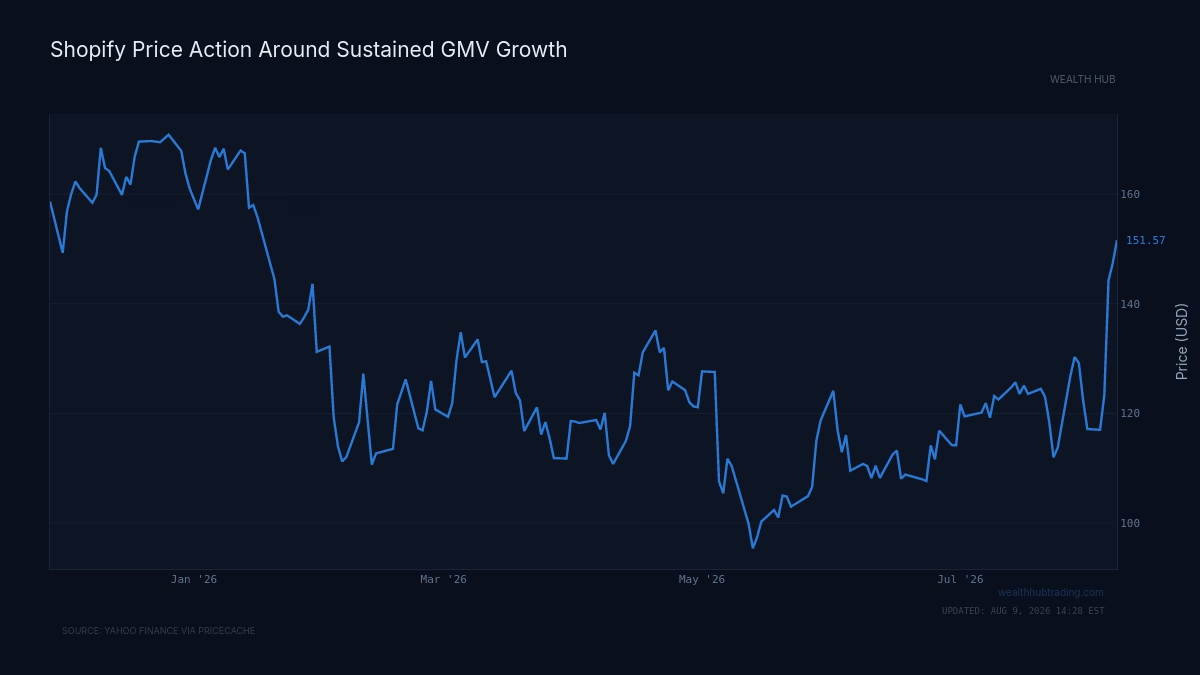
What Would Have to Be True for the Bulls to Be Right?
The bull case requires the increasing-returns flywheel to outrun the arithmetic of convergence for several more years. That is one outcome. It is not the most likely of the three, and it is emphatically the one the market has adopted as its default.
The base case is more prosaic and more probable: the composite growth rate glides down as the four engines decelerate on their staggered schedules, GMV reaches half of Amazon's on roughly the promised timeline, and the multiple compresses as the market re-rates a 30-percent grower toward a 20-percent grower. Nothing breaks. The stock simply stops being priced for a miracle it was never going to sustain.
The bear case is not a tail. It is closer to a coin's edge than the bulls admit: any two engines disappoint in the same quarter, the incremental-dollar share reverts as the base converges, and the composite prints below the psychological line that the entire "sustained miraculous growth" narrative rests on. When every holder owns the same story, there is no marginal buyer left to absorb the first disappointing print.
Galbraith observed in "A Short History of Financial Euphoria" that the recurring feature of speculative episodes is the conviction that this time the arithmetic has been repealed. Increasing returns to scale is real. It is also the exact intellectual frame that makes a decelerating growth curve feel like a permanent one.
The GMV number is not the risk. The market's certainty that it will hold is the risk.