The reverse repo facility is not a policy tool the Fed uses to steer rates day to day. It is a parking lot. When money market funds have cash they cannot lend anywhere for a better return, they lend it to the Fed overnight and take back a small, guaranteed rate. The balance in that parking lot tells you how much idle cash the financial system is carrying. That number matters because it decides whether quantitative tightening is painless or dangerous.
This article walks through the mechanism in four steps: (1) what the RRP actually is and why cash flows into it, (2) how the balance rises and falls, (3) why the drawdown to near-zero is the moment that changes everything, and (4) what a reader should watch as the buffer empties.
What the RRP is and why cash parks there
The reverse repo facility (RRP) is an overnight transaction where an eligible counterparty — mostly money market funds — hands cash to the Federal Reserve and receives a Treasury security as collateral, then reverses the trade the next morning with a small interest payment attached. The rate the Fed pays is the RRP award rate, and it functions as a floor on short-term rates.
Why does cash choose the parking lot over lending in private markets? Because a money fund exists to hold the safest, most liquid short-term assets available. When private repo rates or Treasury bill yields sit below what the Fed offers, the fund gets a better risk-free return by lending to the Fed than to anyone else. The RRP balance therefore grows precisely when the system has more cash than it has attractive places to put it.
The practical point for you: the RRP balance is not a market forecast. It is a real-time reading of excess liquidity — cash that has nowhere better to go.
How the balance rises and falls
The mechanism runs in a fixed sequence: Run the sequence in reverse and you get the drawdown. When the Fed shrinks its balance sheet — quantitative tightening (QT), the process of letting bonds roll off without reinvesting — the Treasury and banks issue and hold more short-term paper. Bill yields rise above the RRP floor. Money funds pull cash out of the parking lot to buy those higher-yielding bills. The RRP balance falls.
The RRP peaked above $2.5 trillion in late 2022 and drained steadily through 2023 and 2024 as bill issuance climbed. That drawdown was the system quietly absorbing QT with idle cash.
The practical point: a falling RRP is not a warning by itself. It is QT working as designed, drawing down the buffer that was built to be drawn down.
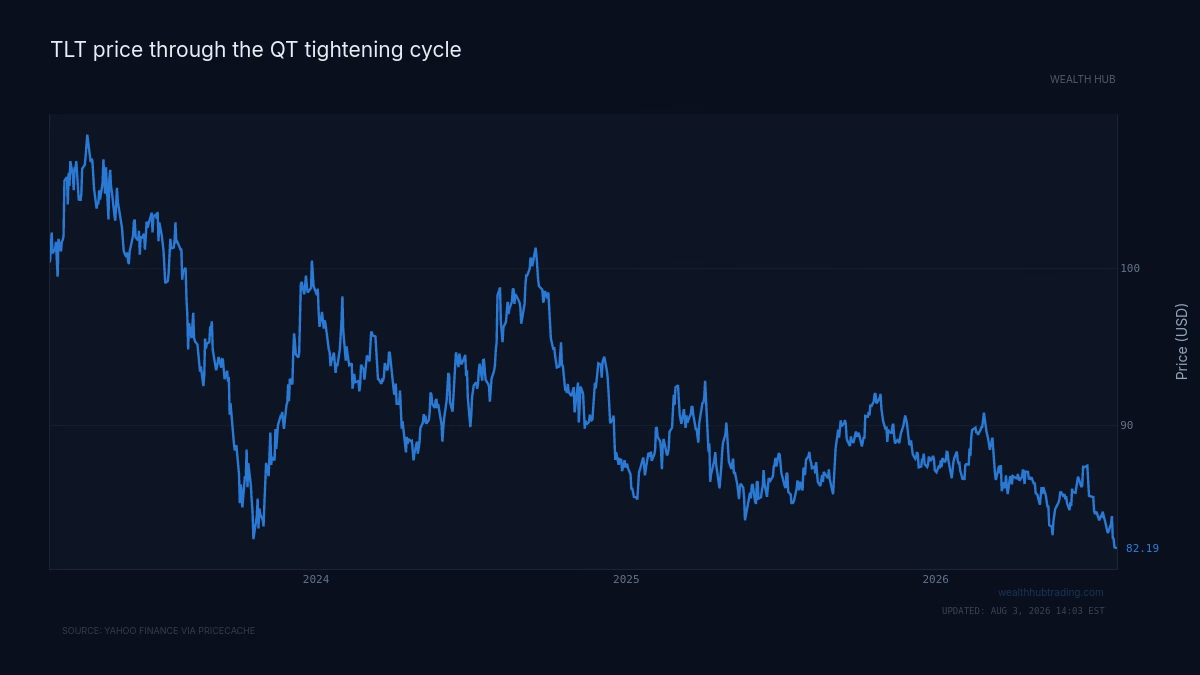
TLT over the thesis window.
Why the near-zero moment changes everything
Here is where intuition gets it wrong. Most readers assume the RRP balance and bank reserves are two separate pools. They are not sequential in the way that matters.
While the RRP has cash in it, QT drains that idle pool first. Bank reserves — the working capital banks use to settle payments and meet regulatory liquidity requirements — stay roughly intact. The system feels no strain.
Once the RRP approaches zero, the buffer is gone. QT does not stop; the bonds keep rolling off. But now there is no idle cash left to absorb the drain, so the reduction comes straight out of bank reserves. Reserves are the constrained resource. When they fall below the level banks need for comfort, funding markets seize.
This is exactly what happened in September 2019. Reserves had been drained too far, and overnight repo rates spiked to nearly 10% intraday as banks scrambled for cash they no longer had in surplus. The Fed had to intervene within days. The lesson: the danger is not in the drawdown, it is in the moment after the buffer empties.
The practical point: watch the level, not just the direction. A falling RRP with $500 billion left is a comfortable buffer. A falling RRP near zero is the last warning before reserves take the hit.
What to watch as the buffer empties
You do not need to model repo markets to read this. Track three things in sequence.
First, the RRP balance itself, published daily by the New York Fed. When it approaches zero, the absorbing buffer is nearly exhausted.
Second, bank reserve levels, reported weekly. Once the RRP is empty, this is the number QT starts eating. The question shifts from "how much idle cash is left" to "how far above the scarcity threshold are reserves."
Third, the spread between overnight funding rates and the RRP floor. When private repo rates begin trading persistently above the Fed's floor, cash is genuinely scarce rather than merely reallocating. That spread widening is the tape confirming what the balance sheet already implied.
The mechanism in one sentence: the RRP absorbs quantitative tightening painlessly until it empties, and the day it empties is the day tightening starts draining the reserves that keep funding markets liquid. That is why the balance matters more than almost any single number the Fed publishes.