
Most investors believe the Federal Reserve is the only entity that controls how much cash sloshes through the financial system. They watch rate decisions, balance-sheet runoff, and reserve balances, and they treat the Treasury as a passive borrower that issues bonds and pays bills. That view is incomplete, and the missing piece explains why liquidity conditions can swing hard even in a week when the Fed does nothing at all.
The missing piece is the Treasury General Account, or TGA — the U.S. government's operating checking account, held at the Federal Reserve rather than at a commercial bank. Every dollar of tax revenue and every dollar raised through bond auctions lands here before it is spent. When the balance in this account rises, cash is drained out of the private banking system. When it falls, cash floods back in. The Treasury is not trying to move markets when it manages this balance, but it does anyway, and the mechanism sits almost entirely outside the field of view of people who watch only the Fed.
Why the misconception persists
The confusion is understandable, because the Fed and the Treasury share the same ledger. Reserves, the TGA, and a facility called the reverse repo program are all liabilities on the Fed's balance sheet, and they sum to a roughly fixed total in the short run. Most commentary collapses all of this into one word, "liquidity," and attributes changes to whatever the Fed announced most recently.
There is a second reason the channel stays hidden. The Fed's actions are scheduled, telegraphed, and discussed for weeks in advance. The Treasury's cash management is driven by tax deadlines, debt-ceiling politics, and auction calendars — mechanical, non-monetary events that no one frames as policy. A quarterly tax date is not a market story in the way an FOMC meeting is, so the liquidity it removes goes unnoticed until prices have already moved.
The practical consequence: if you only track the Fed, you will occasionally be blindsided by liquidity shifts that were fully predictable from the Treasury's own published schedule.
The mechanism, stated plainly
Start with the balance-sheet identity. The Fed's liabilities are dominated by three items: bank reserves (the cash commercial banks hold at the Fed), the TGA (Treasury's cash), and the reverse repo facility (where money market funds park cash overnight). In the short run their total is roughly set by the size of the Fed's asset holdings. So a dollar added to one must come out of another.
Follow the dollar through a tax payment. When a corporation wires its quarterly taxes, the money leaves its bank account. The bank settles that payment by transferring reserves to the Treasury's account at the Fed. Reserves fall; the TGA rises. Nothing about the Fed's balance sheet has grown or shrunk but the banking system now holds less cash, because that cash is sitting idle in the government's account instead of circulating.
Now run it in reverse. When the Treasury spends a Social Security payment, a defense contractor invoice, an interest coupon it draws down the TGA and credits the recipient's bank. The TGA falls; reserves rise. Cash that was locked in the government's account re-enters the private system, where it can be lent, invested, or bid into risk assets.
The size of these moves is not trivial. The TGA has swung by several hundred billion dollars in a matter of weeks around debt-ceiling resolutions, and during the 2021 drawdown the balance fell by more than a trillion dollars over several months, pushing reserves and reverse-repo balances sharply higher. Those are liquidity injections comparable in scale to a round of quantitative easing, executed by the Treasury's plumbing rather than by any monetary decision.
The place intuition gets it wrong is the direction. It feels natural to assume that heavy government spending drains the private system the government is "taking" money. The opposite is true. Spending down the TGA adds reserves to banks. Rebuilding the TGA, which happens through tax collection and net new borrowing, is what drains them. The liquidity effect runs against the everyday intuition about who is giving and who is taking.
What this means for you
Track the Treasury's own numbers. The daily TGA balance is published, and the Treasury announces its cash-balance targets in its quarterly refunding statements. A stated intention to rebuild the account from, say, $400 billion to $800 billion tells you cash will be pulled out of the banking system over the coming weeks, regardless of what the Fed is doing. That is information you can act on before it shows up in prices.
The debt-ceiling episode that made it visible
The clearest teaching case is the debt-ceiling standoff. When Congress refuses to raise the borrowing limit, the Treasury cannot issue new debt, so it funds operations by drawing down the TGA. That forced drawdown injects reserves into the banking system, often for months. Liquidity improves, and risk assets tend to trade well, for a reason that has nothing to do with fundamentals and everything to do with plumbing.
Then the ceiling is raised. The Treasury immediately floods the market with new bill issuance to rebuild its cash balance back to target. That rebuild pulls reserves back out, sometimes faster than they went in. The liquidity tailwind reverses into a headwind at the exact moment most commentators declare the debt-ceiling risk "resolved" and stop paying attention.
Whether the rebuild bites hard or passes quietly depends on where the drained cash comes from. If money market funds fund the new bills by pulling cash out of the reverse repo facility, reserves are largely spared and the effect is muted. If instead the drain hits bank reserves directly, funding markets tighten and the effect is real. This distinction is where the intuition of even sophisticated observers tends to fail, and I want to flag it as the genuinely uncertain link: the timing and magnitude of a TGA swing are knowable from published schedules, but which liability absorbs it depends on money-fund behavior that is harder to forecast in advance.
Where the channel breaks down
The TGA effect is not a mechanical law you can trade blindly, and treating it as one is the fastest way to get hurt. Its power depends on how scarce reserves are to begin with. When the banking system is flooded with excess reserves, a few hundred billion moving into the TGA barely registers banks have ample cushion. When reserves are near the level the system actually needs to function, the same drain can spike short-term funding rates violently.
September 2019 is the anchor here. A corporate tax date and a bond-settlement date landed together, pulling cash into the TGA at a moment when reserves had already been drawn down by years of balance-sheet runoff. Overnight repo rates spiked toward 10 percent, and the Fed had to intervene. The cause was not a crisis of confidence; it was the TGA mechanism operating in a low-reserve environment where there was no slack to absorb the drain.
So the same TGA move produces a shrug in one regime and a funding scare in another. You cannot read the balance change alone. You have to read it against the level of reserves and the state of the reverse repo facility, which is why the channel rewards attention and punishes mechanical application.
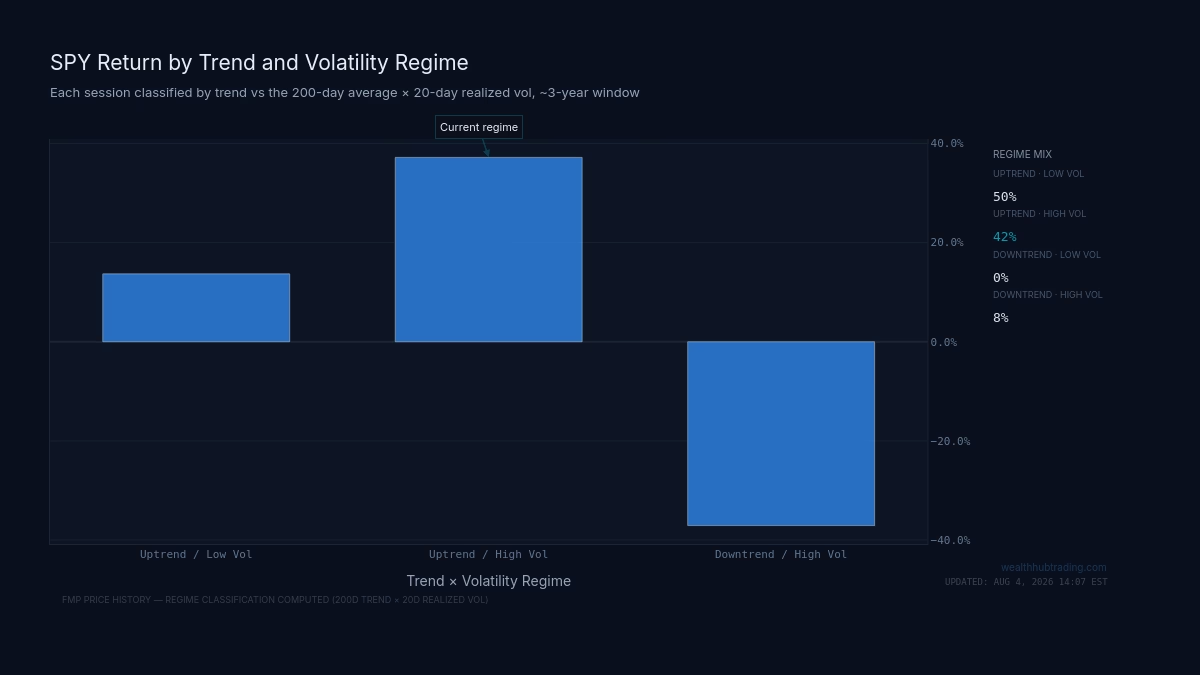
SPY sessions classified by trend (200d avg) × 20d realized vol, ~3-year daily window (866 sessions). Annualized Return realized per regime. Time in regime: Uptrend / Low Vol 50%, Uptrend / High Vol 42%, Downtrend / High Vol 8%.
The one thing to carry away
The Treasury General Account is a liquidity lever that the government pulls for fiscal reasons and that moves markets through a monetary side effect the Treasury never intended. Cash leaves the private system when the account is built and floods back when it is spent, and the direction runs opposite to everyday intuition about government spending. Read the Treasury's published cash targets alongside the level of bank reserves, and you will see liquidity shifts coming that Fed-only watchers experience as surprises.