The Banque de France ranking shows that the US safe asset has split in two, and the consequence is not in the Treasury market alone. If investors in a risk-off episode still run to the dollar but no longer to the long bond, then the dollar is doing the hedging work that duration used to do. Every portfolio built on the assumption that Treasuries rally when equities fall is carrying a hedge whose mechanism has moved somewhere else.
A Haven Split in Two
The study, by Burban and co-authors at the Banque de France, scores assets by how they behave during episodes of heightened risk aversion. It covers sovereign and investment-grade corporate bonds, currencies, and alternatives including gold, silver, oil and Bitcoin. The strongest observation is a divergence. The US dollar remains at the top of the full asset ranking, the asset with the most pronounced safe-haven behaviour. US Treasuries are sliding down that same ranking, and the researchers note the slide resembles what happened during and after the Global Financial Crisis.
That separation is the thesis. For most of the post-crisis era, "the dollar" and "Treasuries" were treated as one trade in a crisis. Foreign money arrived, bought dollars, and parked them in Treasuries, so the currency and the bond rallied together. The new ranking says the second leg of that sequence has weakened while the first has held. A March post on the same subject argued that investors should "trust the dollar, not the Treasury". The study's data supports that view.
The alternatives deserve one sentence because readers will ask about them. Bitcoin, oil and silver show no safe-haven characteristic at all. Gold does, but it ranks well below most government bonds and the dollar. Gold is a partial hedge, not a replacement for the role Treasuries are losing.
What Sweden and Norway Reveal About the Treasury Exception
The long-run averages show the problem. Swedish government bonds have overtaken US Treasuries on the average safe-haven score, and Norwegian government bonds follow. The authors identify a general rule: the less indebted the sovereign, the more its bonds behave like a haven. US Treasuries have been the notable exception. They earned haven status despite US leverage, because the depth of the market and the dollar's reserve role outweighed the debt load.
The exception now looks less secure. Treasuries falling behind Swedish paper suggests that the fiscal variable, which the market waived for the US for decades, is starting to count. At the bottom of the sovereign table sit French, Korean and Belgian government bonds, which behave about as much like havens as Japanese corporate bonds. That bottom group has a common feature. These are sovereigns where fiscal or political credibility is in question, and the market treats their paper as risk rather than refuge.
A second detail supports the debt-load reading. Swedish, Norwegian and Australian investment-grade corporate bonds behave much like German Bunds or Swiss government bonds in risk-off episodes. Corporate credit from low-debt jurisdictions borrowing haven behaviour from the sovereign shows that country balance-sheet quality is doing real work in these scores. The ranking appears to reward low sovereign leverage, and that reward is what has started to move against the US.
Where the Hedge Goes When Duration Stops Working
The rates read matters most for what it forces elsewhere.
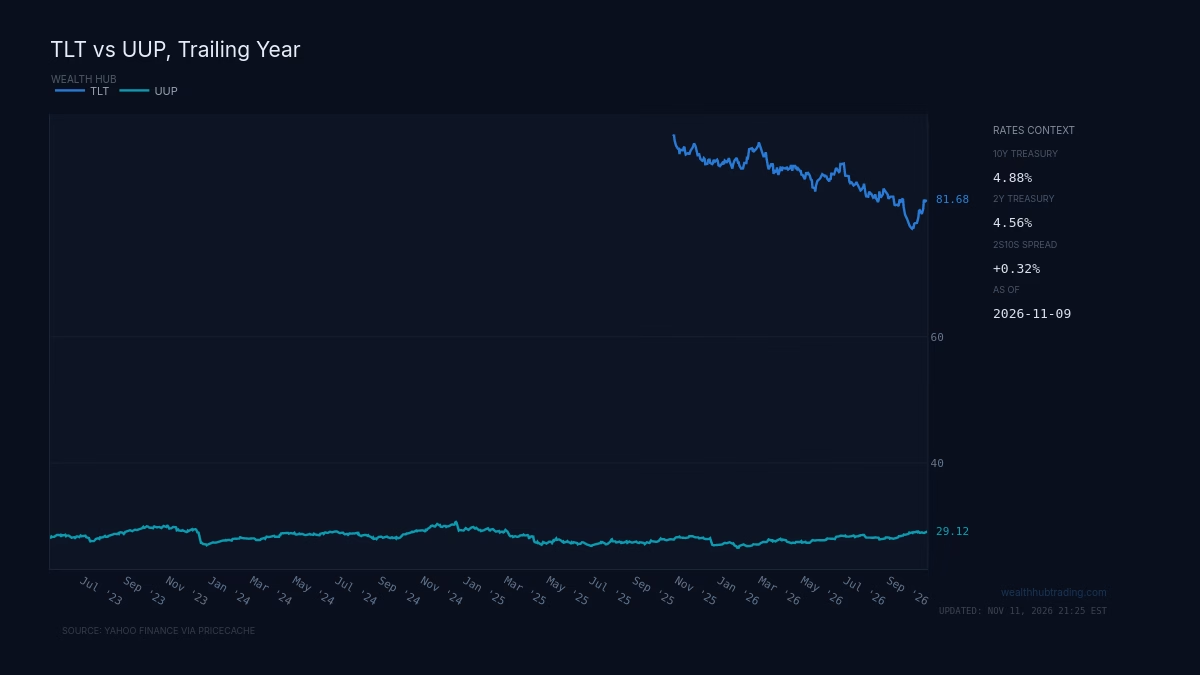
Start with the Treasury curve. As of November 9, the 10-year yield stood at 4.88% and the 2-year at 4.56%, a positive 2s10s spread of 32 basis points. A positively sloped curve with long yields near 4.9% is consistent with investors demanding compensation to hold duration. That is the term-premium channel through which a weaker haven status would show up. The curve shape does not prove the study's thesis, because supply, policy expectations and inflation risk all feed the long end. It is the pricing you would expect if long Treasuries had become a less reliable hedge.
Now follow the flow. If a frightened investor still wants dollars but not long Treasuries, the money has to sit somewhere. The natural destination is the front end and cash equivalents: bills, money funds, short paper. That has three second-order effects.
- Stress steepens the curve instead of flattening it. In the older pattern, a flight to quality pulled long yields down hard. If haven demand concentrates at the short end, risk-off episodes push 2-year yields down further than 10-year yields, and the long end can sell off alongside equities.
- The stock-bond correlation stops working for the 60/40 investor. A long-duration sleeve that does not rally in a drawdown is not a hedge. It is a second risk asset with a coupon.
- For non-US investors, the hedge becomes the currency exposure itself. A European or Japanese allocator holding US assets unhedged gets paid by dollar strength in a crisis even if the Treasury leg disappoints. FX-hedging US bond holdings removes the part of the trade the ranking says still works and keeps the part it says is failing.
The third point is the least appreciated. Hedging decisions are usually framed as a cost question, a matter of the carry on the hedge. The safe-haven ranking reframes it as a question of which leg provides the protection. On this evidence, it is the currency.
The smaller sovereigns cannot take over the role in size. Sweden and Norway top the scores, but their bond markets are a fraction of the Treasury market. A reserve manager cannot move a meaningful share of a crisis allocation into Scandinavian government paper without moving the price. The ranking tells us where haven behaviour is cleanest, not where haven capital can actually go. The practical result is that safe-haven demand stays in dollars and shortens maturity rather than migrating abroad.
The Case That This Is a Cycle, Not a Verdict
The strongest counterargument comes from the study's own analog. Treasuries lost ranking during and after the Global Financial Crisis, then recovered it. A decline that happened once and reversed could reverse again. On that reading, the current slide reflects a period of fiscal anxiety and inflation volatility, and the haven bid returns once inflation is clearly contained and the Fed has room to cut aggressively in a downturn. Much of the long bond's haven power in the 2010s came from the market's confidence that a recession meant immediate rate cuts. Restore that confidence and duration hedges again.
Three further cautions apply.
- The scores measure co-movement, not size or trust. A ranking built from behaviour in risk-aversion episodes captures how assets moved, not why. The dollar's top position could partly reflect mechanical funding demand in stress, borrowers scrambling to cover dollar liabilities, rather than investor faith. A dollar bid driven by a funding squeeze is still a hedge, but it is less a vote of confidence than the "trust the dollar" framing implies.
- "Falling behind" is relative. Treasuries remain above most government bond markets in the sample. The fact that Sweden and Norway rank higher matters as a signal of direction. It does not mean Treasuries have stopped being a haven.
- Inflation regime may matter more than debt. Stock-bond correlations often turn positive when inflation is the dominant macro risk, regardless of the debt level. If that is the main driver, the debt-load interpretation overstates a structural shift that is partly cyclical.
These points weaken the conclusion that the Treasury haven is permanently impaired. They do not weaken the narrower claim, which is that, for now, the dollar and the long bond no longer act as one hedge in a crisis.
The Tell on the Next Risk-Off Day
The decision variable is observable, and it shows up on the first day equities fall hard. Watch three moves together: the dollar, the 2-year yield, and the 10-year yield.
If the dollar rises, the 2-year rallies, and the 10-year yield rises or barely moves, the curve is steepening into stress. That is the haven split the Banque de France ranking describes, and it confirms that protection has moved from duration to currency and the front end. If instead the 10-year rallies hard alongside the dollar and the curve flattens, the old relationship is intact and the ranking's decline is closer to the post-GFC episode that reversed.
The thesis breaks if long Treasuries again rally reliably in equity drawdowns while the dollar firms. Until that happens, the cleaner reading is that a portfolio's crisis protection now sits in its dollar exposure and its short-dated paper. The 30-year bond's role as a hedge is now an assumption that needs testing rather than a given.