Note: The fundamentals context supplied points to Energy Transfer LP ($ET), which is a homonym-driven mismatch for a Treasury refunding story. Per source discipline, I will not force an unrelated midstream energy company into a fiscal-policy article. I will write the Treasury piece on its own terms.
SUBTITLE: The steady auction schedule is the story: by refusing to grow coupon sizes into a swelling deficit, Treasury is quietly committing to a bill-heavy balance sheet it has not yet chosen to defend.
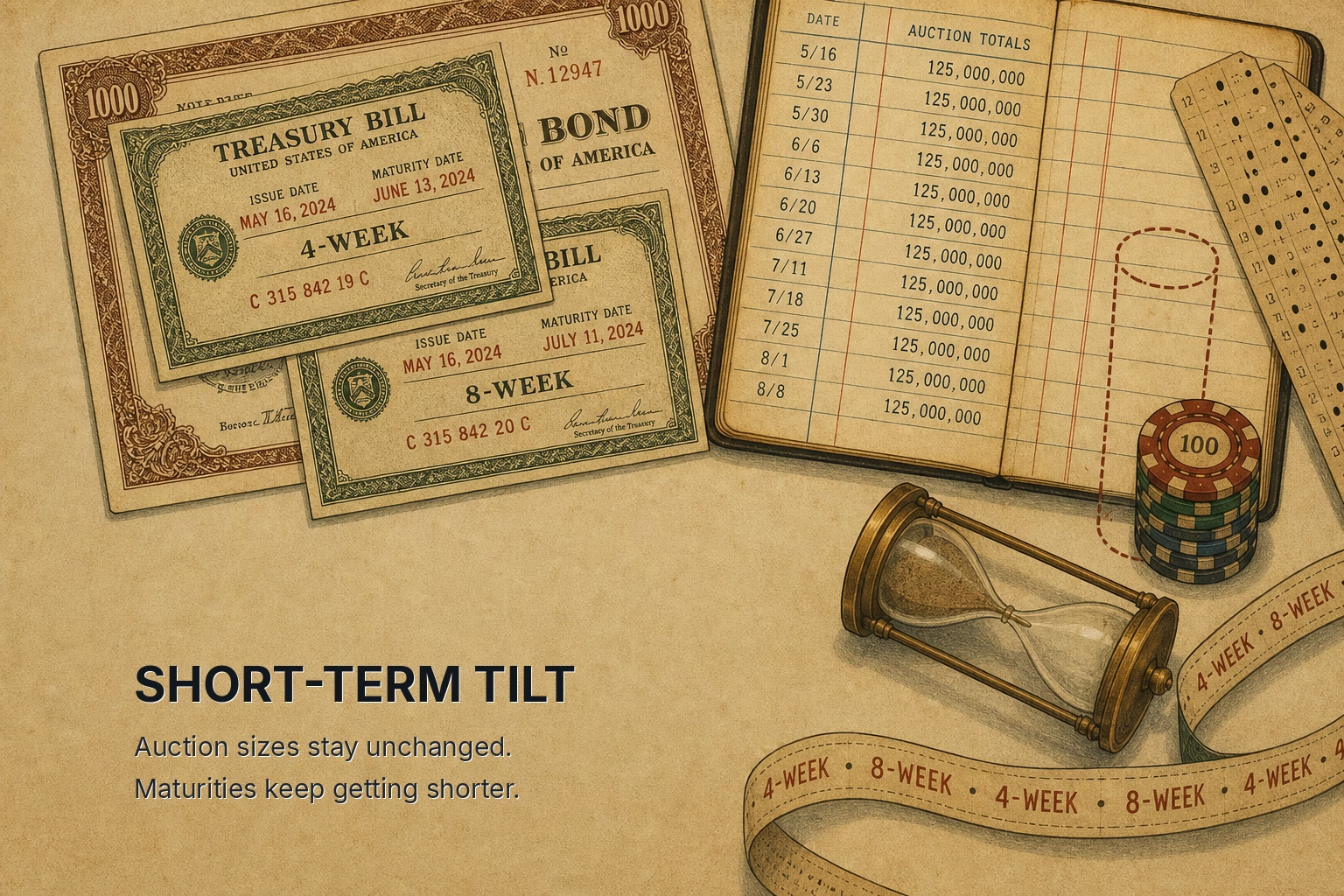
The market read the refunding as a non-event. That is the mistake. The absence of a change to auction sizes is not neutrality; it is an active decision to let the T-bill share of the federal debt keep climbing, because the arithmetic of a $739 billion borrowing quarter and flat coupon issuance leaves no other outlet. The headline says nothing changed. The mechanism says the funding structure of the United States is being reshaped by default rather than by design.
What Standing Still Actually Commits To
Treasury held note and bond auction sizes flat and repeated the now-familiar line that it expects to keep nominal coupon sales steady "for at least the next several quarters." Next week's $125 billion refunding, $58 billion in 3-year notes, $42 billion in 10-year notes, and $25 billion in 30-year bonds, raises roughly $28.7 billion in new cash. That is the same guidance language carried forward since early 2024.
Here is why standing still is not standing still. Borrowing needs are not flat. Treasury raised its estimate for current-quarter borrowing to $739 billion, up $68 billion from May, and total federal debt crosses $40 trillion within weeks. If the coupon calendar is fixed and the cash requirement is rising, the residual has to be funded somewhere. That somewhere is bills. Every quarter the deficit runs ahead of coupon capacity, the bill share ratchets up mechanically. Dealers call it "T-bill and chill." A blander name for it is duration risk being pushed off the government's balance sheet and onto the front end.
The Front End Is Doing the Deficit's Heavy Lifting
The ratio of bills to total marketable debt is now historically elevated, well above the roughly 20% average the Treasury Borrowing Advisory Committee has historically pointed to as a reasonable ceiling. Officials have declined to name their own tolerance level, which is the tell. When a debt manager refuses to state a target, it is usually because the honest target is "wherever demand takes us."
For now demand is genuinely there. Money market funds have absorbed enormous bill supply, and the Federal Reserve, still running down its mortgage portfolio, has been recycling maturing principal into the front end. That is a real, structural bid, and it is the strongest part of the bull case for the current strategy: bills are cheap to issue, the buyer base is deep, and rolling short paper at the front of the curve avoids locking in the elevated long-end yields that would otherwise raise the government's average coupon.
That last point matters more than the refunding statement lets on. Benchmark 10-year yields hit their highest since Bessent took office in the week before this announcement. Terming out into that would be expensive. Declining to boost coupon sizes while the long end is under pressure is defensible cost management on its face, and Treasury said as much, describing a bias toward the shorter end for any future increase in coupon auctions and citing "trends in structural demand and potential costs and risks of various issuance profiles."
Why Cheap Funding Now Is a Reset Risk Later
The problem with financing a structural deficit with a rolling stock of paper that matures inside a year is that it converts a slow-moving liability into a fast-moving one. A coupon debt stock reprices over a decade. A bill-heavy stock reprices in months. The more of the debt that sits in bills, the more the government's interest expense tracks the front of the curve in near real time.
That sensitivity cuts both ways, and the direction it cuts next is the live question. The refunding lands at a moment when traders are increasingly positioned for the Fed to be forced tighter rather than looser. If front-end rates stay high or rise, a debt structure deliberately concentrated at the front end sees its servicing cost climb almost immediately, with no coupon lag to cushion it. Cheap funding today is only cheap if the front end cooperates tomorrow.
There is also a governance dimension worth naming plainly rather than hedging. Some strategists have tied the reluctance to touch forward guidance to the November elections, the logic being that any signal of larger coupon supply risks pushing long yields higher into a politically sensitive window. Whether or not that is the motive, the structural consequence is the same: the longer issuance guidance stays frozen while the bill share drifts up, the larger and more abrupt the eventual coupon increase has to be. Deferred adjustment is not avoided adjustment. It compounds.
The Case That Nothing Is Wrong
The honest counterargument is that this is much ado about an accounting share. A high bill ratio is not a solvency problem, and a sovereign that issues in its own currency does not face a rollover crisis the way a corporate does. As long as money funds and the Fed keep clearing bill auctions at yields Treasury is happy to pay, the strategy funds the government at low cost and keeps the long end from absorbing supply it does not want. On this reading, "no change" is competent stewardship, not drift, and the elevated bill share is simply the rational response to where the cheapest, deepest demand currently sits.
That case is strong precisely while demand holds. It weakens the moment the marginal bill buyer steps back. If money market fund inflows stall, or the Fed ends balance-sheet runoff and stops recycling principal into the front end, the front-end bid that makes "T-bill and chill" work thins out, and auction sizes that looked comfortable start clearing at wider concessions.
What Would Force the Hand
The condition to watch is not the refunding statement, which will keep saying the same thing until it suddenly does not. It is the bill auction tail and the composition of the buyer base. Watch two things: whether benchmark bill auctions begin clearing at rising yield concessions, and whether the money-fund and Fed bid at the front end holds as balance-sheet runoff continues. If either deteriorates while borrowing needs keep swelling, the "for at least the next several quarters" language becomes untenable, and Treasury is forced into exactly the coupon-size increase it has spent eighteen months deferring, into a long end already at multi-year highs.
Until one of those two conditions breaks, the flat schedule is the cheaper reading and the market is right to shrug. The moment either breaks, the shrug becomes the story, and the adjustment will be larger for having been postponed.