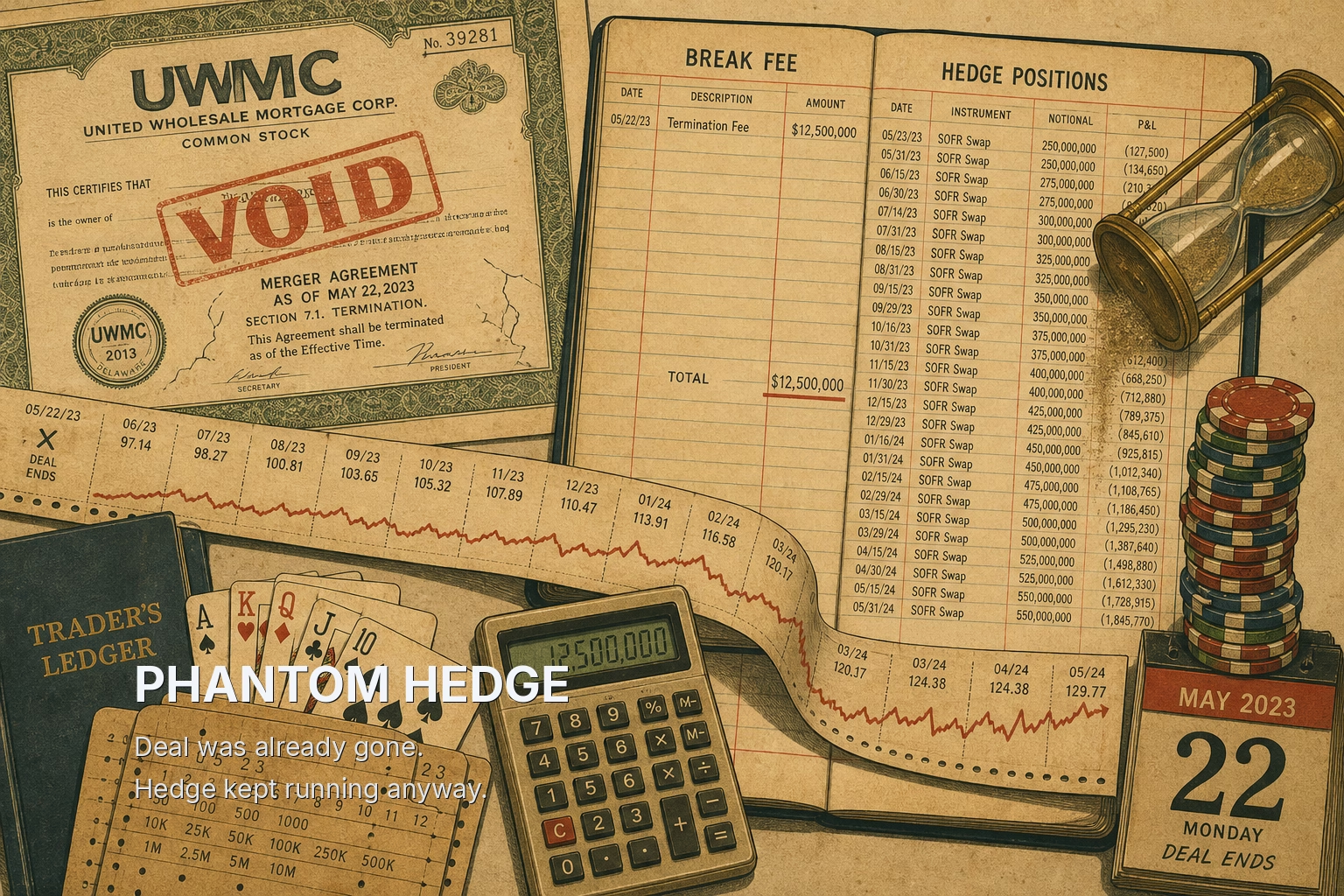
The most revealing number in UWM Holdings' recent quarter is not the roughly $600 million hedging loss. It is the calendar. The break fee for the failed Two Harbors acquisition landed in UWM's account on March 31. The hedging loss showed up in the second quarter, which begins April 1. A company does not accumulate a nine-figure hedging loss on an asset it stopped being under contract for at the exact moment the quarter began. Either the hedge and the deal were never the same thing, or the guidance narrative connecting them is a convenience.
That gap between what management said and what the sequence of events allows is the whole story. Consensus is anchoring to the framing UWM offered, that a busted deal forced a bad hedge that forced an expensive capital raise. The disclosure the market is underpricing is that the timeline breaks the first link in that chain.
The Deal That Died Before the Loss Began
Start with the sequence, because it does the analytical work here. Two Harbors agreed in December to an all-stock acquisition by UWM. UWM's stock fell more than 30% into late March, which mechanically shrank the value of an all-stock bid and reopened the door for a cash rival. A superior proposal emerged in mid-March. UWM responded, first, with a press release describing Two Harbors as a "melting ice cube," and then, remarkably, by raising its bid for the same melting ice cube and restarting a contest it went on to lose.
The definitive fact in all of this is the break-fee wire. UWM received it on March 31. A break fee is the counterparty admitting the deal is over; you do not pay it and then remain on the hook to hedge the other side's mortgage book. So by the first day of the second quarter, UWM had no contractual exposure to Two Harbors' assets.
Which is why blaming a second-quarter hedging loss on the busted deal reads as an explanation searching for a cause. If the hedge existed to protect against rate moves on an asset UWM was acquiring, that rationale expired on March 31. Whatever produced the loss in April, May and June was UWM's own positioning, not a residual obligation to a deal that had already paid it to walk away.
What a Hedging Loss Usually Hides
There is a benign version of this, and it deserves a fair hearing. Mortgage originators carry large, genuinely volatile hedging programs against their servicing portfolios and their pipeline of loans in process. The mortgage servicing right is a negative-convexity asset: its value swings hard as rates move and prepayment expectations shift. Hedging that exposure produces gains and losses every quarter that can look enormous in isolation and mean very little in aggregate, because they offset changes in the value of the underlying servicing book. A hedging "loss" is frequently the mirror image of a servicing "gain" that sits elsewhere in the results.
If that is what happened, the Two Harbors framing is not fraud, it is spin. Management reached for a dead deal to explain an ordinary quarter of hedge noise because a dead deal is a more sympathetic villain than "we mispositioned our own book." That reading is plausible and, on the evidence available, cannot be dismissed.
But the spin still matters, because it was deployed to explain a capital raise. UWM's own cash flow tells you why the raise was not cosmetic. The FY2025 cash flow statement shows operating cash flow of negative $2.6 billion and free cash flow of roughly negative $2.7 billion, against $3.2 billion of revenue and $1.8 billion of reported operating income. That is the signature of an originator that books accounting income while consuming cash, because loans held for sale and servicing assets absorb capital before they return it. A company generating $1.8 billion of operating income on paper and burning $2.7 billion of cash is a company whose reported margin, 58%, is not the number that governs its solvency.
The Balance Sheet Behind the Story
The capital-structure context sharpens the point. UWM's balance sheet carried about $16.9 billion of total assets against roughly $14.4 billion of total debt at fiscal year-end, with cash and equivalents near $503 million. That is a highly levered book, which is normal for the business but leaves thin margin for narrative errors. When a levered lender needs "very expensive capital," the reason the market should care about is the cash burn, not the hedging headline attached to it.
Set UWM against its nominal peer set and the comparability warning writes itself. Citizens Financial reported FY2025 revenue of $11.1 billion with a 20.9% operating margin and positive free cash flow near $2.0 billion. UWM's 58% operating margin looks superior only until you notice the sign on the cash flow line: Citizens converts income into cash, UWM does not. The other tickers that surface as peers, a bitcoin miner and a brokerage, are not comparable businesses at all, which is itself a reminder that a screen-level "financials" bucket tells you nothing about whether two companies face the same risks. On any honest basis, UWM's headline profitability and its cash reality point in opposite directions.
What the Timeline Cannot Prove, and What It Can
Here is the fact that would break the bear reading. If UWM can show that the second-quarter hedge was a servicing-book hedge that always existed independent of the Two Harbors deal, then the calendar objection dissolves; the March 31 break fee is irrelevant to a hedge that was never about Two Harbors in the first place. In that case the loss is ordinary MSR hedge volatility and the only sin is a misleading press narrative that tied it to a dead acquisition for sympathy. That is a real possibility and the disclosure does not, from the outside, foreclose it.
What the timeline can establish is narrower and still damaging. Management chose to explain a capital raise by pointing at a deal it had already been paid to abandon, rather than at the cash-consuming mechanics of its own originate-and-hold-then-sell model. The behavior around the bid, calling the target a melting ice cube and then chasing it higher, is not a rounding error of tone. It is the same management judgment now narrating the loss. When the storyteller has already shown you it will raise a bid for an asset it just disparaged, the burden of proof on its later explanations should be higher, not lower.
The thesis breaks if UWM discloses that the hedge was a standing servicing hedge unconnected to the acquisition, with gains booked against the servicing asset elsewhere. Until that reconciliation appears, the cleaner reading is that the Two Harbors story is doing narrative work the cash flow statement cannot support, and the number that should drive the view is the $2.7 billion of negative free cash flow, not the hedging line the company would prefer you read instead. Watch the next servicing-value disclosure: if the servicing gain that should offset a genuine hedge loss is missing, the benign explanation goes with it.