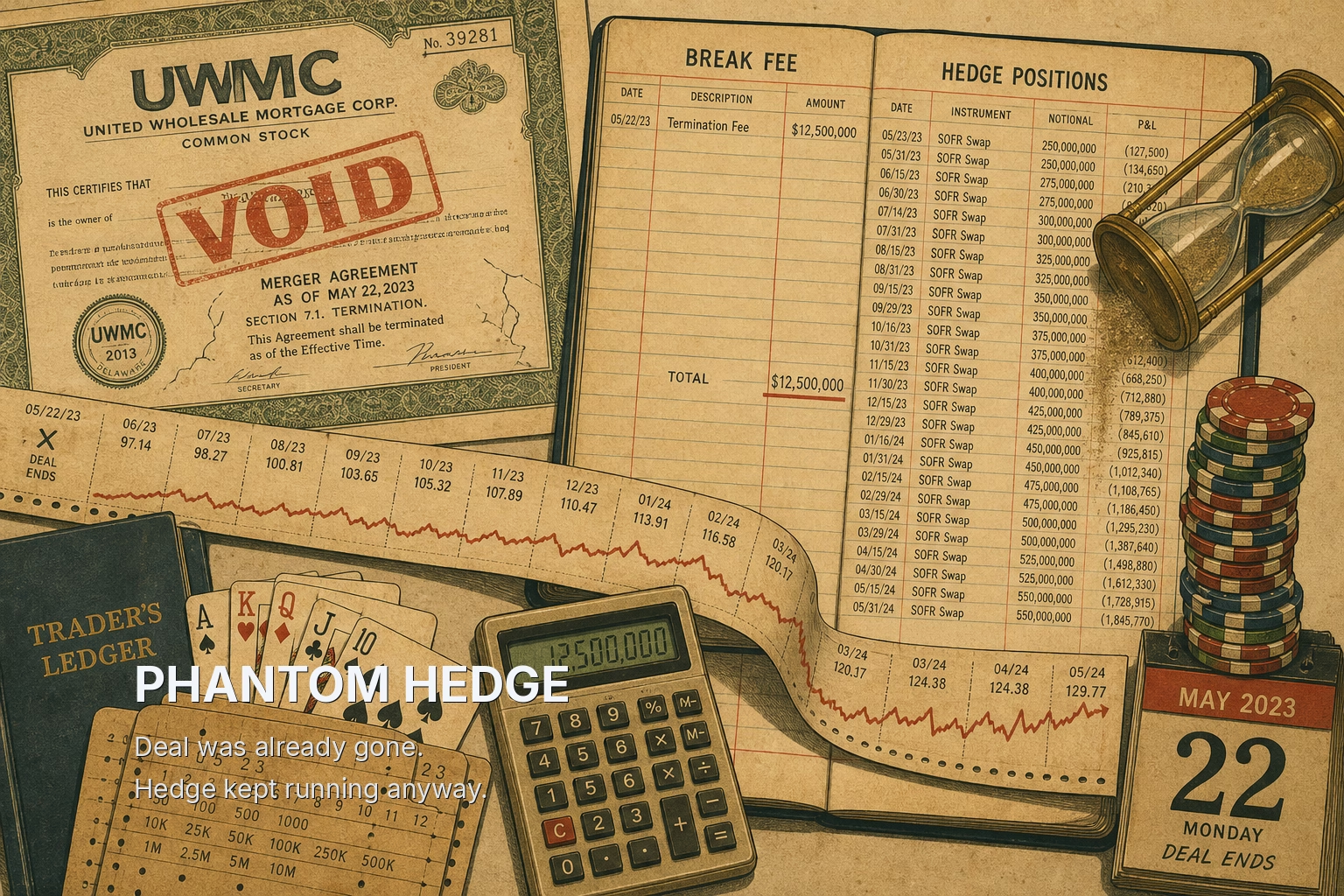
A leading data center operator does not get incorporated on the same morning the contract with it is announced. And yet that is precisely what the record shows for New York GreenCloud, the entity behind 2CRSi's headline $610 million contract and its more recent $290 million purchase order. The company the market is pricing as a customer did not exist as a customer. It was created, on the day of the announcement, by the very company reporting the revenue.
The consensus read on 2CRSi is that a French data-center hardware maker sold its largest subsidiary, took the cash, and pivoted into a fast-growing American cloud business. The turnaround story has a shape investors recognize and reward. The part that shape omits is the counterparty. Strip out New York GreenCloud and its founder, and the American business does not shrink. It disappears.
Why did a 3% region suddenly become the whole story?
Boston Limited was 2CRSi. In 2023, the company sold the subsidiary that carried more than 83% of its revenue. That is not a divestiture at the margin; that is selling the business and keeping the ticker. What remained needed a new engine, and it needed one immediately, because a listed company without a revenue story is a listed company waiting to be repriced.
The engine arrived precisely on schedule. The US region, which had historically thrown off roughly 3% of total revenue, began to boom right as the Boston hole opened. A region that had been a rounding error became the narrative. The timing is not suspicious in the abstract; the timing is the tell. Revenue that appears at the exact moment a company requires revenue to appear, in the exact geography that had never mattered, is revenue that should be examined before it is believed.
Ask the plainest question first. Where were the customers a year earlier? A business that generates 3% of revenue in a region does not have latent nine-figure contracts sitting unsigned. It has a small sales presence and a few relationships. The leap from 3% to the centerpiece of the entire enterprise does not happen through organic growth in eighteen months. It happens through announcement.
Who is Joseph Church?
Joseph Church is a veterinarian in Plattsburgh, New York. He co-owns a small animal hospital. That animal hospital is the registered headquarters of the ecosystem of companies that constitute 2CRSi's American future, including New York GreenCloud, the counterparty to the $610 million contract.
Consensus, to be fair, has no reason to know this. The name New York GreenCloud reads as a data-center operator. 2CRSi described it as "a leading data center operator." The market took the description at face value, because the market almost always takes the guided description at face value; the whole point of a guided narrative is that it substitutes for the filing.
The part the description omits is that Church has never built a data center. He has never operated one. What he has done, by the record of his own interviews with regional media, is buy old power plants at scrap value and attach the phrase "green data center" to them. He created multiple companies and credentials across 2023 and 2024, all headquartered at the animal hospital, all appearing at the moment 2CRSi needed American substance to point at. Church has worked with 2CRSi since at least 2022. The relationship is not that of a vendor and an arm's-length customer. It has the texture of a related party operating undisclosed.
The counterparty was manufactured. The specifications 2CRSi published for New York GreenCloud read as a marketing fantasy: a power-usage-effectiveness figure below the most efficient facilities on earth, biomass uptime exceeding any peer, pyrolysis upgrades at a scale no one has demonstrated. These are not aggressive targets. They are numbers chosen for a slide, not for a plant.
What does the counterparty actually say about the timeline?
Here is where the guided narrative and the primary source diverge most violently, and where the market has not yet done the arithmetic.
2CRSi's $610 million contract and its $290 million purchase order are described as near-term, with deliveries scheduled over the coming months. That is the framing that supports the revenue recognition, and revenue recognition is the entire game. But Church, describing his own California project to regional media, states that permitting alone might begin in late 2027 in the best case, and that over $1 billion of capex is required to build the facility. New York GreenCloud, by his own account, will not begin client discussions until 2028. It does not yet know what servers it will use.
Read those two timelines against each other. A company that will not talk to clients until 2028, and does not know what hardware it will deploy, does not need hundreds of millions of dollars of servers delivered in the coming months. There is no facility to receive them. There is no power to run them. There is a biomass operation and a set of projections resting on funding that has not been raised and clients who have not signed.
The delivery schedule 2CRSi disclosed is not compressed relative to the counterparty's own stated plan. It is impossible relative to it. A purchase order for near-term delivery to a buyer whose facility begins permitting in 2027 is not an aggressive commercial arrangement. It is a fabricated one.
The disclosure the market is not pricing is this: New York GreenCloud's website was built and is hosted by 2CRSi's own IT department, and 2CRSi's CEO appears as "Co-founder" on New York GreenCloud's fundraising presentation. 
The seller of the servers is the co-founder of the buyer. The seller built the buyer's website. The buyer was incorporated the day the contract was announced. When the two sides of a nine-figure transaction share an IT department and a founder, there is only one side.
Have we seen this shape before?
We have, and the shape is old enough that the literature named it long ago. Charles Kindleberger described the terminal phase of a mania as the point where fraud rises to meet the credulity that the boom manufactured. The AI-infrastructure cycle has manufactured extraordinary credulity. "Green data center" and "$610 million contract" and "leading operator" are the passwords that open capital, and the passwords are being spoken by people who have never held the keys.
The 2022 tightening cycle is instructive here for a reason unrelated to rates. What that episode demonstrated is that stories priced for a benign outcome unwind faster than they were built once the benign outcome is questioned. Equities fell roughly 20% that year as the soft-landing consensus met a harder reality. The same asymmetry governs a fabricated-revenue story. The upside was already paid for on the announcement. The downside arrives all at once, on the day the counterparty's own timeline becomes common knowledge.
I do not know the precise date the recognition lands. These constructions can persist through two or three reporting cycles because the disclosures that undo them sit in interviews and incorporation records, not in the headline. Satellite images, site visits, and conversations with local officials point to close to nothing taking place across the sites tied to 2CRSi's American operations and its "2CRSi Cloud Solutions" subsidiary. Some of the older announced projects, dating from 2022, have quietly disappeared from the company's own materials. A project that vanishes from the record was never a project. It was a sentence.
The consensus is not wrong that the AI-infrastructure demand is real. The long-run demand for compute is intact, and that is exactly why the fabrication works: a true megatrend is the ideal cover for a false contract, because skepticism reads as failure to understand the future.
What consensus gets wrong is the counterparty. It has priced a customer. There is no customer. There is a veterinarian, an animal hospital, and a set of power plants bought at scrap.
The revenue is not aggressive. It is invented.