The Odessa grain corridor did not collapse because Ukraine lost a naval battle. It collapsed because Ukraine handed Moscow the one thing it had lacked since 2022: a defensible pretext to break the food-supply taboo. The mid-July drone assault on Russian-connected shipping in the Sea of Azov looks, on the feed, like another escalation in a war saturated with them. The mechanism it set in motion is what matters, and it is the opposite of what the raid's authors intended.
The Taboo Was the Asset
For three years the two sides observed an unwritten rule that most observers treated as inertia rather than strategy. Global food supplies moving through the Black Sea were largely left alone. Russian hardliners hated the arrangement, and their public frustration was itself the evidence that the restraint was deliberate on Putin's side, not accidental. Weapons flowed into Odessa; Russian grain flowed out of Azov; neither party fired on the other's export lifeline. The taboo functioned as a firebreak.
A firebreak only works while both sides respect it. The July raid did not just damage vessels; several of the ships hit were carrying Russian grain exports. That detail is the whole story. It converted the firebreak from an asset Moscow was maintaining into a constraint Kyiv had already violated. Aristotle's line about power cutting both ways is the frame: the restraint that lay in Ukraine's power to keep also lay in its power to discard, and discarding it removed the only argument that had held Putin's own hardliners at bay.
How the Pretext Becomes a Blockade
The mechanism runs through legitimacy, not firepower. Russia has been able to seal Ukraine's deep-water ports since early in the war; capacity was never the binding constraint. The binding constraint was the political cost of being the side that starved global markets. Attacks on grain cargoes removed that cost. Within days of the Azov strikes, Russia launched a sustained campaign against the ships and infrastructure of the Odessa complex, and by the reporting we have seen, effectively closed it to all shipping from July 22.
Here is where intuition gets it wrong. The natural read is that Ukraine struck a blow and Russia retaliated in kind, a familiar tit-for-tat. That framing misses the asymmetry. Ukraine's raid was tactical and reversible. Russia's response was structural: it turned a coastal nation into a landlocked one. Officials cited in the source reporting warn agricultural exports, the backbone of Ukraine's economy, may fall by roughly 50% because land, rail, and river routes carry far less volume at far higher cost. A tactical win purchased a strategic loss, and the exchange rate was brutal.
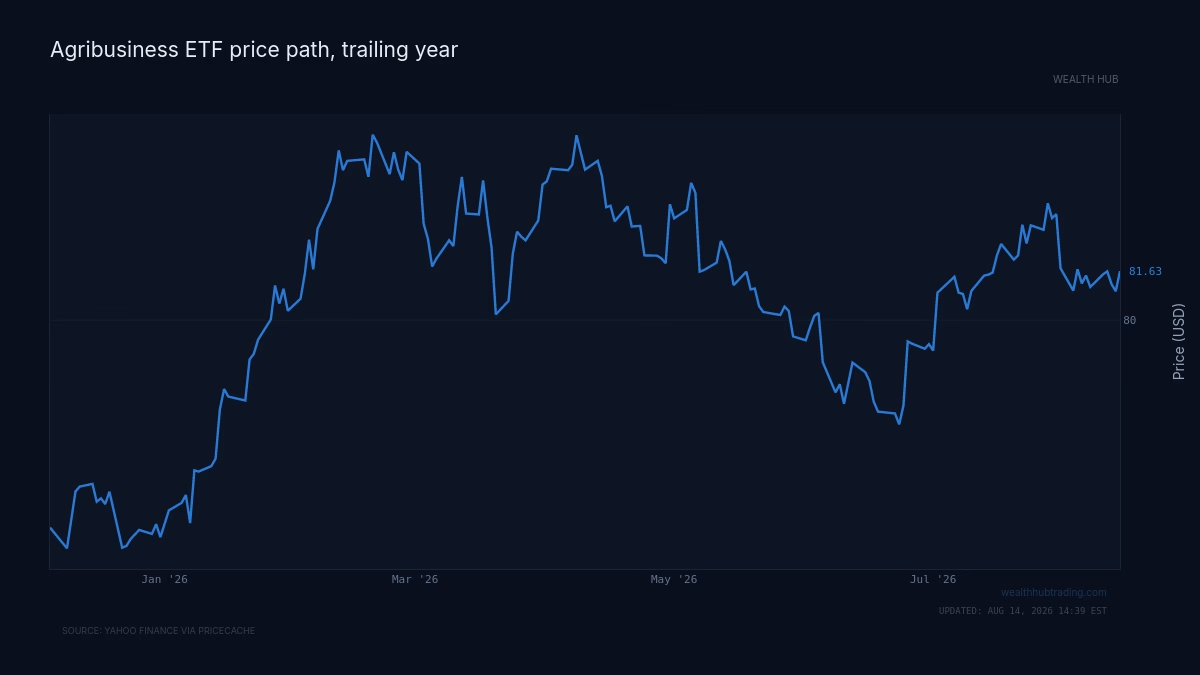
The reason the swap is so lopsided is that grain exports are not a battlefield metric. They are a fiscal one. Ukraine finances a large share of its war effort through its export economy, and the deep-water ports are the throat of that economy. Closing the throat does not win Russia territory this month; it drains the treasury that funds the defense of territory over the next year. That is the mechanism worth tracking, and it operates on a slower clock than the drone footage suggests.
Turkey Is the Variable That Changes the Weather
The second-order move is where the analysis leaves the Black Sea and reaches Brussels. Congressional records referenced by the Kyiv Independent describe Ukraine purchasing a substantial US-made package via Turkey: 70 M39 ATACMS missiles, a dozen M270 launchers, over 2,000 cluster munitions, and 47,000 howitzer rounds, with transfer expected to begin in late August. This is almost certainly the real reason Russia moved so fast and so disproportionately. The grain pretext was convenient; the Turkish arms channel was the actual provocation.
Turkey's entry changes the register of the conflict because Ankara controls the Bosphorus and, through TurkStream, sits on the plumbing of Russian gas into southeastern Europe. Once Erdoğan becomes a visible supplier of long-range strike capability to Kyiv, Moscow gains a rationale to treat energy flows through Turkish-linked infrastructure as leverage rather than commerce. The link from an ATACMS shipment to a European gas curtailment is not mechanical, and it should be hedged as inference rather than stated as fact. But the channel exists, and it is short. That is the point most European policymakers are underpricing: the distance between a weapons deal recorded in a congressional minute and a pressure point on the continent's winter heating is measured in political will, not in physical steps.
To state the causal chain plainly and with the appropriate caution: the Azov raid supplied the pretext, the port closure supplied the fiscal damage to Ukraine, and the Turkish arms channel supplies Russia with a reason to escalate into the energy domain where Europe is most exposed. Each link is better supported than the next. The first is documented, the second is reported with specifics, the third is a reasoned projection that I will not dress up as certainty.
What Would Break This Read
The thesis is vulnerable in two places, and honesty requires naming both.
First, the open-source provenance. Pro-Ukrainian feeds and pro-Russian channels are both interested parties, and "dozens of vessels allegedly hit" is a claim before it is a fact. Video evidence and the rueful tone in Russian channels lend weight, but the scale of the Azov damage could be materially smaller than reported. If it is, the pretext framing still holds, because Putin needs only the appearance of a broken taboo, not a large one. A minor detail is sufficient when you are looking for permission.
Second, and more decisive: the energy escalation is a forecast, not an observation. Russia closing Odessa is happening. Russia weaponizing Turkish-linked gas flows into a European supply shock is a scenario that depends on Erdoğan pressing forward with the arms transfer and on Putin choosing energy coercion over other tools. If the Turkish package stalls, is quietly rerouted, or Ankara distances itself from the deal, the third link never loads and the story stays a regional grain crisis rather than a continental energy one. That is the fork.
The Condition to Watch
The read confirms or fails on one observable: whether the late-August ATACMS transfer through Turkey actually proceeds and whether Moscow's rhetoric shifts from grain and ports toward energy infrastructure and Turkish complicity. If Russian messaging begins framing Turkey as a co-belligerent, the energy channel is arming. If the transfer slips and the framing stays fixed on Odessa, Europe gets a food-price and refugee problem rather than a heating one.
The trap in this whole sequence is treating the drone raid as the event. It was the permission slip. The event is what the permission slip unlocked: a landlocked Ukraine, a drained export economy, and a new pretext structure that puts a European winter within reach of a decision made in Moscow. What lay in Ukraine's power not to do, it did, and the consequence is now largely out of its hands.