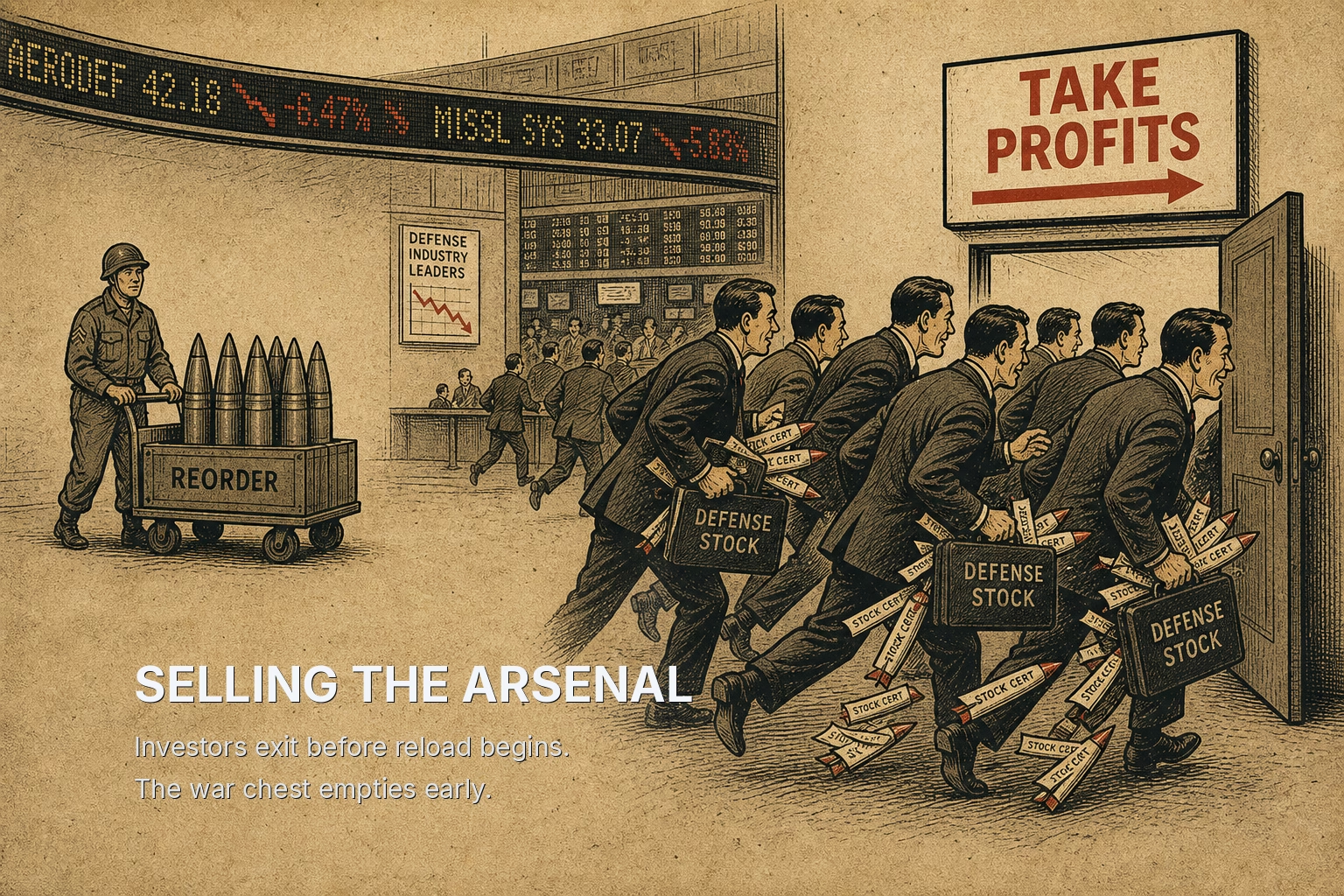
The consensus bought defense stocks as a war story and is now selling them as the war arrives. That is exactly backwards, and the mechanism explains why.
Here is what the market has misread. A defense stock is not a bet on conflict. It is a bet on the replenishment of consumables after conflict has drained the shelves. The two are not the same trade, and they do not fire at the same time. The offensive names, the platform builders, the drone momentum stocks, all of these price on the anticipation of war. The munitions industrial base prices on the aftermath, on the boring, grinding, multi-year reality of manufacturing the thing that was already fired. And the aftermath has only just begun.
Consensus has the direction right. Global defense allocation sits well below the peacetime norm, let alone anything resembling a wartime footing. The 2018 window was, as the source material puts it, likely the cheapest year for organized protection in recorded history. Pax Romana and Pax Britannica could not match the complacency of the "End of History." Budgets are going up. That much is not contrarian.
The part consensus misses is which line item goes up, and when the market pays for it.
Why did defense stocks top just as the fundamentals started to scream?
Because the fast money was never trading the fundamentals. It was trading the narrative.
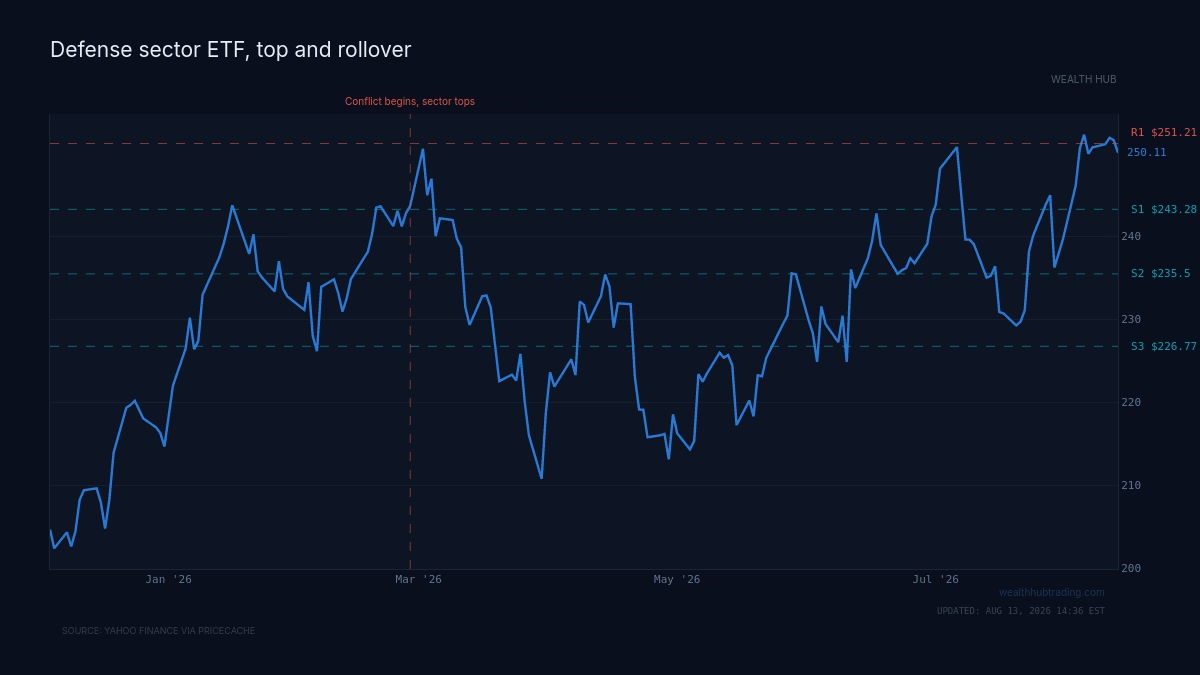
The Iranian conflict beginning February 27 marked the top for many US defense names. That is not a coincidence and it is not a failure of the thesis. It is the textbook signature of a buy-the-rumor, sell-the-news unwind. The stocks priced the anticipation of war for two years, from the drone-and-hypersonic momentum bid of 2024 forward. When the actual shooting started, the anticipation trade had nothing left to anticipate. The catalyst arrived, and the catalyst was the exit.
Meanwhile the interceptors were being fired. In five months the US military expended more missiles and interceptors than in any year since Desert Storm. That is the fundamental signal, and it arrived precisely as the share prices rolled over. The market sold the war story on the day the war became a supply problem.
This is the decoupling that matters. The narrative that inflated the stocks and the mechanism that will sustain the earnings are two different clocks. One ran out. The other has barely started ticking.
What actually depletes when a war goes kinetic?
The consumables. Not the platforms.
Understand the asymmetry the source material names twice, because it is the whole mechanism. On one side sit expensive, exquisite, long-lead traditional assets. On the other sit cheap, abundant, autonomous drones and loitering munitions that a lesser power can accumulate by the thousand and throw at an adversary faster than that adversary can shoot them down. Iran and Russia have built the cheap side at scale. The US and its allies are burning the expensive side to defend against it.
Think of it as a bathtub. Everyone watched the faucet, the budget top-line, the 5x increase in dollars allocated to missiles in the FY2027 DoW request. Almost no one watched the drain. The interceptor magazine empties every time a $30,000 drone forces a multi-million-dollar interceptor off the rail. The exchange ratio runs the wrong way. You are spending Rolls-Royce parts to shoot down mopeds, and the mopeds are made faster than the parts.
The White House told you where the drain is. The June 11, 2026 Presidential Determination under Section 708 of the Defense Production Act names it in plain language: "systemic constraints in the munitions industrial base, including limited production capacity, fragile supply chains, long-lead dependencies." An administration does not invoke wartime industrial authority to boost quarterly earnings. It invokes it because the shelves are bare and the delivery cadence cannot refill them.
The most acute bottleneck is the missile complex. That is where the drain runs fastest and the faucet is smallest.
Why is a supply bottleneck a longer trade than a war?
Because a war can end in a headline. A production ramp cannot be headlined into existence.
This is where intuition fails hardest. The instinct is to treat defense as a geopolitical bet, a thing that rises and falls with the news cycle. Ceasefire announced, sell. Escalation, buy. That is trading the faucet. But the munitions industrial base does not respond to news cycles. It responds to the physics of manufacturing, and those physics are brutal: solid rocket motor lines, specialized propellant chemistry, machined seeker heads, workforce that takes years to train. Long-lead dependencies, the determination calls them, and long-lead means exactly that. You cannot buy your way to capacity in a quarter. You build it over years, and once built, it runs for years to refill inventories drawn down below the level military planners are willing to say out loud.
Prior estimates across a wider range of munitions show expenditures through five months already dramatically exceeding annual production capacity and current delivery cadence. Sit with that. The rate of fire is beating the rate of manufacture by a margin large enough that the gap does not close in a good year or a bad year. It closes over a capital cycle, the kind Citrini's framing is built to catch, where both the duration and the magnitude are underpriced because the market is still fixated on compute buildout and the drama of the conflict itself.
The war may pause. The interceptors fired do not un-fire. The magazine that emptied does not refill on a ceasefire. The demand for restocking is structural, mandated, and now backed by the Defense Production Act; it is the least news-sensitive demand in the entire complex. When a source of demand survives the resolution of the event that created it, that demand was never really about the event.
So what does the correct read leave the reader holding?
A distinction, not a ticker. The mechanism first; the trade is downstream of getting the mechanism right.
The offensive-narrative trade and the replenishment-mechanism trade wear the same "defense" label and behave nothing alike. The first already ran and already sold off, on schedule, in buy-the-rumor fashion around February 27. The second is a multi-year restock of a physically constrained munitions base, mandated in writing, funded by a near-5x missile line in the FY2027 request, and almost entirely uncorrelated with whether the current conflict escalates or settles. The consensus conflated them, rode the first to its top, and is now extrapolating that top onto the second.
I will not pretend to name the precise winners with conviction the data here does not support. The source names categories, not verified positioning; specific single-name expressions and their exposures are not something we have pulled to a standard that would justify calling a ticker. What the analysis does support is the shape: the missile complex is where the drain runs fastest and the faucet is smallest, and that is the segment where the restocking cycle has the longest tail and the least sensitivity to a headline.
Edward Chancellor, in Devil Take the Hindmost, described how capital floods the visible, glamorous end of a boom while the unglamorous bottleneck starves; the money chases the story and neglects the plumbing. The compute story is the faucet everyone is watching. The empty missile magazine is the drain no one is pricing.
The war is the headline. The restocking is the trade.