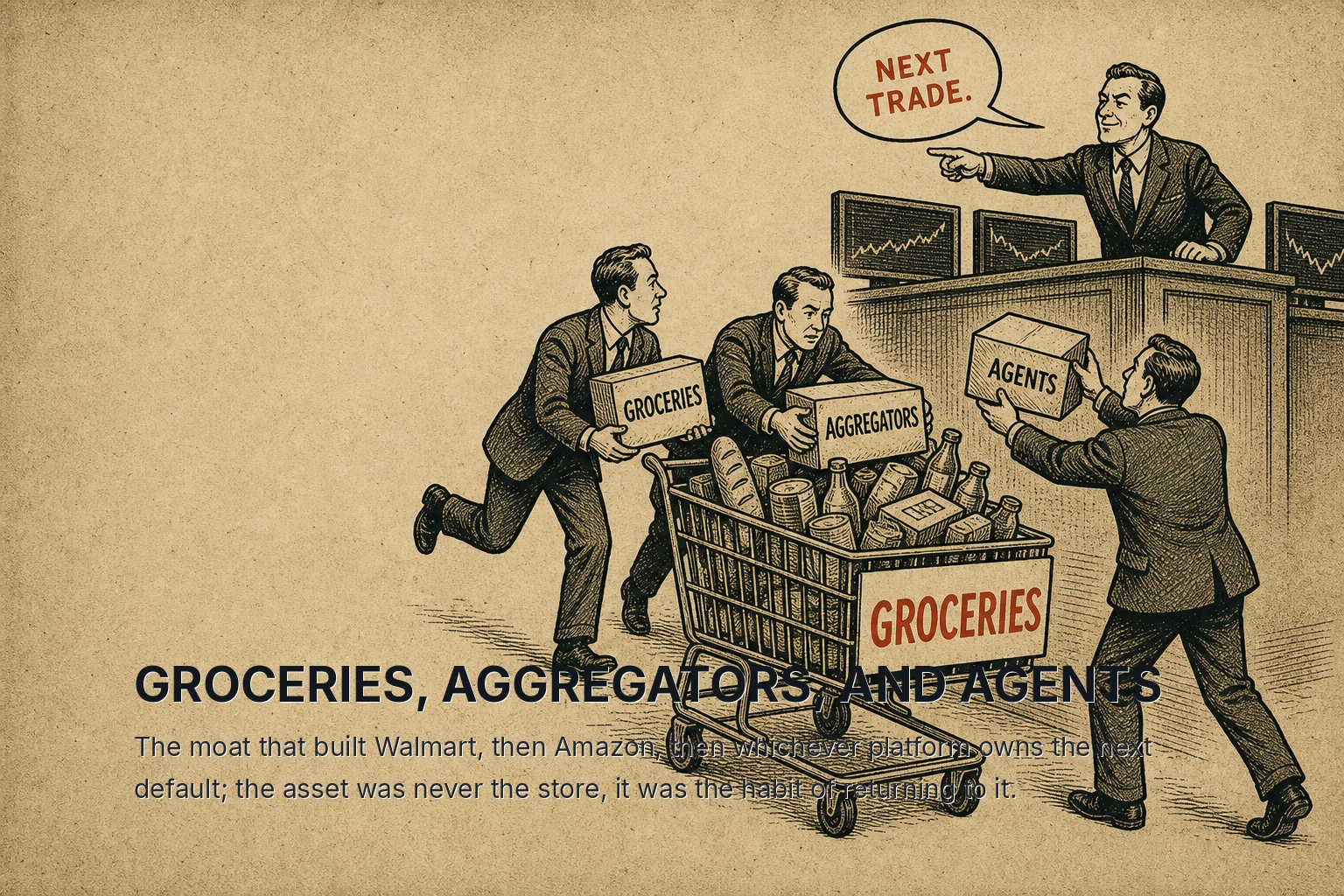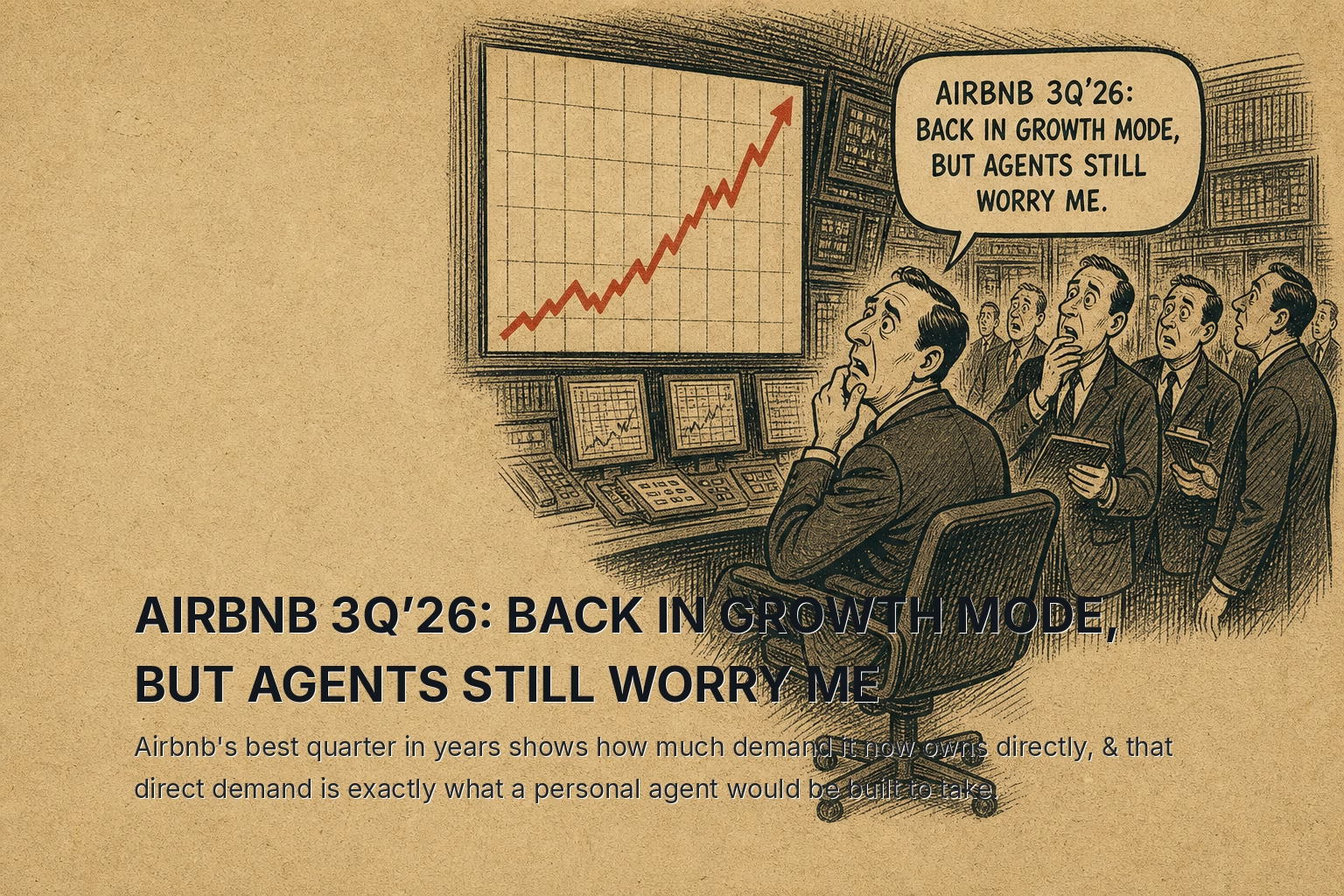
Airbnb's strongest quarter in years is also the clearest map of what a consumer AI agent would be paid to dismantle. In travel distribution, the intermediary that owns the customer has sometimes posted its best numbers just as a new layer was forming above it. The rhyme here is easy to miss because the numbers are so good.
A quarter that settled the near-term argument
In the third quarter of 2026, Airbnb answered most of the doubts that had followed the stock down from the $170s. Nights and seats booked grew 16% year over year, up from 10% in the second quarter. Gross booking value grew 21% excluding currency, and revenue grew 19% as reported, or 16% excluding currency. All three beat guidance.
The headline flattered the business somewhat. Reserve Now, Pay Later added a net three points to nights growth, so underlying nights grew closer to 13%. Those bookings cancel more often: the cancellation rate rose from roughly 16% to roughly 19%, and the CFO called Q3 the peak of the net benefit. Revenue is the cleaner read. Currency-neutral revenue growth rose from 13% to 16%, and the Q4 guide of 16% to 18% (about two points of it from FX) implies the momentum holds as the RNPL tailwind fades.
The geography was broad. North American nights grew in the low double digits, the fastest in four years, with average daily rate up 6%. EMEA nights grew in the mid-teens, and LatAm and APAC each grew more than 20%. Against Booking Holdings, the gap widened to about 1,000 basis points of currency-neutral GBV growth (21% against 11%), up from roughly 200 basis points a year earlier and 700 in the second quarter. Booking's own quarter improved too, with room nights up 7% and adjusted revenue up 9%. Its reported revenue fell 1% only because of a $900 million reduction tied to an FTC matter at Priceline.

The margin line was better still. EBITDA margin, with stock compensation counted as a cost, reached 41.8%, up about 160 basis points, mostly from operations and support, where an AI assistant now resolves about 40% of issues without a human. Management repurchased $712 million of stock at roughly $162 a share. Last-twelve-month buybacks, including taxes paid on employee equity awards, came to $4.6 billion against $4.9 billion of free cash flow, and the diluted share count fell 3.9%.
One figure in that report matters more for the next decade than the growth rate, and it is easy to skim past. Airbnb generated about $59 of gross booking value per dollar of advertising, against $60 a year earlier. Booking generated about $21. Airbnb's demand is roughly 2.8 times cheaper to acquire than its largest rival's.
That ratio measures how much of Airbnb's traffic arrives without paying a toll. It is the moat. And a personal agent, whether Muse or Instinct or something not yet launched, intervenes at the point where that traffic originates: before the customer opens the app. Brian Chesky spent much of the call explaining why he does not see these agents as a serious threat. The analyst who wrote the source note is not yet convinced, and the history of travel distribution gives that doubt some weight.
1995: the commission cap and the agents who owned the customer
In February 1995, Delta Air Lines capped the commissions it paid travel agents on domestic tickets at $50 for a round trip, where agents had previously earned roughly 10% of the fare. The other large US carriers followed within days. At the time, independent and franchised agencies sold the large majority of US airline tickets, and they held what everyone in the industry understood to be the customer relationship. The traveller called the agent; the agent chose the carrier.
The agencies read the cap as a margin dispute. They fought it in court and through their trade association, and they assumed that because they held the relationship, the airlines would need them regardless of the economics. What the agencies did not weight properly was that their relationship rested on information asymmetry. The customer came to the agent because the agent could see fares, schedules and availability that the customer could not.
The turning point was not the cap itself but what arrived the following year. In 1996, Sabre launched Travelocity and Microsoft launched Expedia as an internal division, spun out in 1999. Both put the fare screen in front of the traveller directly. Once the customer could see what the agent saw, the relationship lost much of its content. Airlines kept cutting, and by 2002, led again by Delta, the major US carriers had eliminated base commissions on domestic tickets altogether.
The agencies that survived moved toward corporate travel, cruises and complex itineraries, where judgment rather than access was the product. The mass-market leisure booking moved to the screen.
The same data looked different to the people building that screen. To Expedia and Travelocity, the commission cap was evidence that the airlines would pay less and less for distribution that merely routed demand, and more for distribution that aggregated it. Same facts, opposite frame: the agents saw a negotiation, the aggregators saw a migration.
2011: when the aggregator met its own gatekeeper
A decade and a half later, the online travel agencies were the incumbents, and the layer above them was search. By the late 2000s, a large share of hotel and flight shopping began with a Google query, and the agencies bought that traffic through paid search. In July 2010, Google announced its acquisition of ITA Software, the fare engine behind much of the airline search industry, for about $700 million. Regulators cleared the deal in April 2011, and Google Flights launched later that year. Google's hotel price ads followed the same logic: show the traveller the comparison on the results page itself, and let the agencies bid for the click.
The agencies did not lose their business. Booking Holdings grew into the largest travel company by market value, and its scale in Europe gave it supply that search alone could not replicate. But the economics changed shape permanently. The agencies became, in large part, buyers of demand rather than owners of it, and a large share of every booking's margin went back to the gatekeeper as performance marketing.
That is what Booking's $21 of booking value per advertising dollar describes in 2026. It is the toll an aggregator pays when the customer's first stop is someone else's interface.
Priceline offers the counterexample of an incumbent that read the sequence early. It bought Booking.com in 2005 for roughly $133 million, a small Dutch hotel site that turned into the core of the company, and bought Kayak, a metasearch engine, in 2013 for about $1.8 billion. Both deals moved Priceline closer to where demand originated, rather than defending where it had previously sat. The pattern did not doom the incumbent; it repriced the incumbent's position in the chain, and the incumbents that paid to move up the chain often did better than the ones that argued the chain would not change.
Where Airbnb sits in the sequence
Airbnb escaped the search toll more completely than any travel platform of its generation. The name became a verb, the app became the first stop, and the advertising ratio is the measured result. A traveller who types "Airbnb in Lisbon" or opens the app directly has already chosen the intermediary before any comparison happens. That direct intent is why Airbnb's EBITDA margin can sit above 40% in a peak quarter while it outgrows Booking by ten points.
A personal agent reverses that order. The traveller asks for a four-bedroom house near the beach for a family of five in July, and the agent decides where to look. Intent no longer arrives pre-attached to a brand. In the 1990s, the customer gained the agent's screen; in the 2010s, the search engine put a comparison above the agencies; now the comparison itself is delegated to software that has no loyalty to any app.
The analyst's own test makes the point concrete. When he asked Muse to plan a family trip, it found the same houses on Airbnb, Vrbo, Booking.com and the property managers' own websites, with the prices on each. The excerpt does not show those prices, so the size of any gap is not established here. The structural fact is enough: a meaningful slice of the inventory a family books for a week is managed professionally and listed in several places at once. For that slice, Airbnb is not the only door, and an agent's job is to find the cheapest one.
Two details from the quarter sharpen the risk rather than soften it. Nearly all remaining hosts moved to the single 15.5% host fee in October. That simplifies the guest's view of price, but it also fixes a visible spread between a listing on Airbnb and the same listing on a manager's own site, and a spread that a human rarely bothers to check is exactly what an agent checks every time. Second, brand and performance marketing is up about 30% year to date against roughly 19% GBV growth, while Booking's marketing grew 11% against 10% bookings growth. Management attributed part of the timing to spend moving from Q3 into Q4, and the advertising ratio has mostly stopped falling. Even so, the direction is the one an analyst of the 2011 episode would recognize: the cost of keeping demand direct is rising faster than the demand itself.
The irony in the source note is worth stating plainly. The analyst sold Airbnb in the $170s to buy more Meta in the $650s, and Meta rallied on enthusiasm for Muse, apparently its own agent, while Airbnb fell. He was, in effect, rotating from the intermediary into the company building the layer above it. The quarter has since made that trade look less clever. Strong quarters often do that to structural theses, and they did so repeatedly for the agencies of the early 1990s and the OTAs of the late 2000s, whose best years arrived just before their position in the chain shifted.
What this time does not share with the earlier episodes
The parallel breaks in one important place, and it favours Chesky. Airline seats in 1995 and hotel rooms in 2011 were close to fungible: a seat on a given flight is the same seat whoever sells it, and a standard room at a chain hotel is the same room. Much of Airbnb's inventory is not. Hosts with a single home, listed only on Airbnb, are not reachable through a manager's website, and the platform's reviews, identity checks and guest protections (guest insurance revenue grew about 70% this quarter) are services an agent cannot easily replicate. An agent that wants that inventory may have to route through Airbnb on Airbnb's terms.
The excerpt cuts off before laying out Chesky's two specific arguments, so they are not reconstructed here. Whatever their exact form, the defensible version of the platform case rests on that distinction: unique supply plus trust infrastructure make Airbnb a destination an agent must query, not a toll it can route around.
The weakness in that defence is that the threat does not need to take the whole marketplace. It needs only the multi-listed professional inventory, which skews toward exactly the larger family houses and higher-value stays that drive GBV. The travel agencies were not destroyed on complex itineraries; they lost the commodity booking first. Booking was not displaced by Google; it simply began paying for demand it had once captured cheaply. Either outcome, applied to Airbnb's professionally managed slice, would compress the ratio that currently makes the company so profitable without any visible collapse in nights growth.
What the pattern says about the next decade
Across 1995, 2011 and now, the sequence is consistent enough to name. An intermediary earns its margin by owning the moment a customer chooses; a new interface moves that moment upstream; and the intermediary's reported growth often stays strong while the economics of acquiring each customer quietly reset. The early tell was rarely revenue. It was the cost of demand.
For Airbnb, the number to track across the next several years is not nights growth, which this quarter shows is healthy, but booking value per advertising dollar, which now sits at $59 against Booking's $21. If agents become a primary way people plan trips and that ratio holds, Chesky's unique-supply argument has been proven in the data. If it drifts toward Booking's, the company will have followed the online agencies into paying for its own customers, however good the quarters look along the way.
The pattern does not decide which outcome arrives. It does say where the evidence will show up first, and it says that a quarter like this one, excellent as it was, does not settle a question that is about who owns the first question a traveller asks.