The most valuable thing Walmart ever built in groceries was not a supply chain or a price advantage. It was a weekly appointment that roughly a hundred ...
Consider a single household in 2026. A father describes his wife ordering from Instacart every other day, small fill-in deliveries that have quietly replaced the Saturday cart of sixty to a hundred items. There is nothing dramatic in the scene. No chain went bankrupt, no headline announced a shift. But what is being unwound in that kitchen is the exact mechanism that made Walmart the largest grocer in the United States, and understanding why requires looking at how the frequency asset has been won and lost before.
The habit Walmart bought in thirteen years
Walmart entered groceries in 1988, more than two and a half decades after its founding, and within thirteen years it was the largest grocery seller in the country. That speed is worth pausing on, because groceries are a low-margin, operationally punishing business that most retailers approach with caution. Walmart moved fast because it understood what groceries actually were, which was not a product line but a scheduling device.
A discretionary purchase happens when a customer decides to walk in. Groceries do not work that way. Milk expires in about twenty-one days, produce sooner, and no household can forecast its own consumption a month out. So the American shopper defaulted to a weekly big shop, sixty to a hundred items at a time, with the occasional fill-in run when something was forgotten. That cadence was not a preference. It was imposed by perishability and by the friction of getting to a store.
Walmart grasped that whoever owned the weekly trip owned everything adjacent to it. The customer who came for groceries also bought motor oil, socks, a toy, a television. Frequency created familiarity, and familiarity created something closer to inertia than loyalty. Nobody wants to relearn the aisle map of a competing chain every week, so the shopper who had solved the problem of where to buy food stopped asking the question. The grocery trip was the front door, and the discretionary basket was the house behind it.
This is the structural point that consensus tends to skip. Walmart's grocery dominance was never really about groceries. It was about controlling the highest-frequency errand in American life and monetizing the traffic that errand generated. The lesson is that in retail, the schedule is the moat.
Amazon and the aggregation of the errand
The same pattern that Walmart exploited had already been running underneath it, one layer up, in the platforms that aggregate demand rather than sell products directly. When a customer's default point of entry shifts, the moat shifts with it, and the incumbent who built the old front door does not get to keep the traffic.
The clearest instance is the general merchandise migration to Amazon over the 2010s. Amazon did not win by underpricing Walmart on every item; it often did not. It won by becoming the default place a purchase decision started. Once the customer's instinct was to search Amazon first, every retailer downstream became a supplier competing for placement rather than an owner of the relationship. The front door moved from the store to the search bar, and Walmart spent the better part of a decade and enormous capital trying to rebuild a door it had once owned outright.
What made general merchandise vulnerable was precisely that it lacked the frequency lock groceries had. You buy a television every seven years. There is no habit to defend, no weekly appointment, no aisle-map inertia. So when a more convenient aggregator appeared, the switching cost was close to zero and the migration was swift. Groceries, by contrast, looked immune. The perishability that forced the weekly trip also anchored the customer to a physical store within driving distance. You could not aggregate milk.
That belief held right up until the delivery economics changed. The pandemic did to groceries what the search bar did to general merchandise, and the mechanism is the same one that has repeated across every retail cycle: the moat is not the product, it is the position at the point where the decision starts, and that position is mobile.
When always-shopping replaces going shopping
The turn is subtle because it does not look like a crisis. It looks like convenience.
The observation that reframes everything is this: we used to go shopping, and now we are always shopping. For most categories that phrase is a throwaway line. For groceries it is structural, because it dismantles the one constraint that made the weekly trip inevitable. If a customer can add a single item to a cart and have it arrive in thirty minutes to three hours, the big stock-up trip stops being a necessity and becomes a chore to be avoided. The perishability that once forced the weekly cadence now argues for the opposite. A time-starved family that does not know how many nights it will cook at home would rather buy for today and tomorrow than plan a week ahead. A household managing cash flow would rather spend in small bites, with less waste and less breakage and less out of pocket at once.
So the weekly shop fragments into a series of ad-hoc deliveries, and here the damage to the incumbent becomes visible. Industry research now shows the average consumer taking three to four grocery trips, and more than half of consumers reporting no primary grocery at all. That last figure is the one that should worry anyone who built a business on the frequency lock. The primary grocery relationship, the thing Walmart won in thirteen years and defended for decades, is dissolving into a fragmented set of transactions with no single owner.
Notice the historical rhyme, and notice the one way it breaks. In the general merchandise migration, the aggregator that captured the front door was singular and identifiable: the search bar. In groceries, the fragmentation has not yet consolidated behind one default. The customer with three to four trips and no primary store is not loyal to a new aggregator; she is loyal to whoever fulfills the next thirty-minute window. That is the tell that this cycle is at an earlier phase than the general merchandise one. The habit has been broken, but the new habit has not yet been captured. 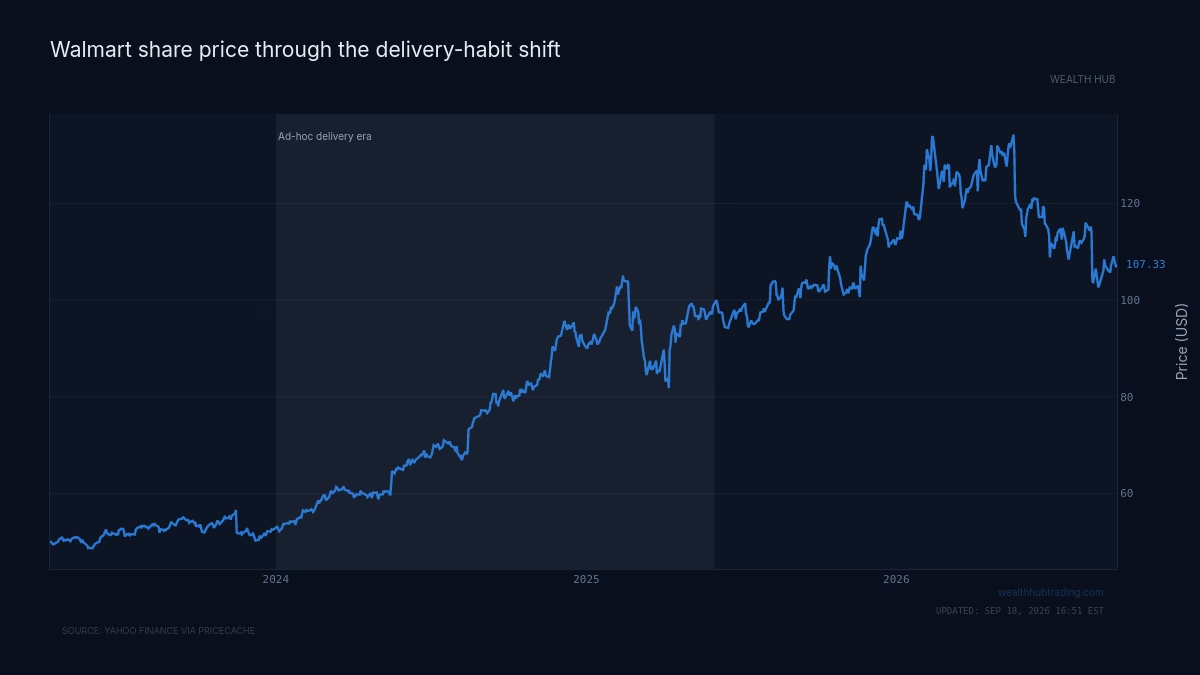
What the pattern says about agents
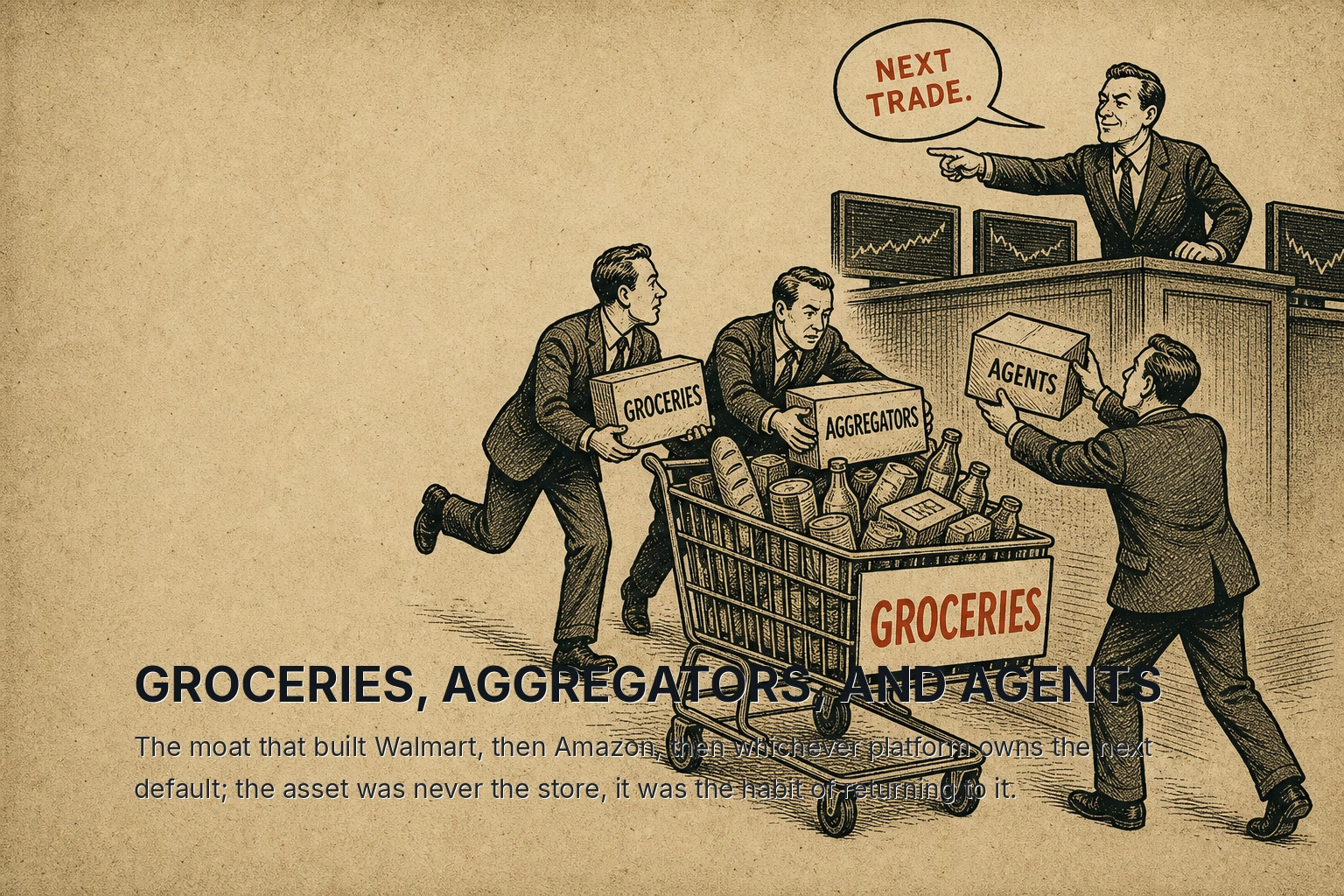
The structural pattern across these cycles is consistent. Retail power accrues to whoever occupies the point where the purchase decision begins, and that point migrates: from the store shelf, to the aggregator's search bar, to the delivery window. Each migration destroys the moat of the prior owner not by beating it on price but by relocating the front door. Walmart learned this on the winning side in 1988 and on the losing side across the 2010s. The grocery frequency lock, long assumed to be the exception, is now revealing itself to be subject to the same law.
The next relocation is the one worth naming, because the fragmentation into no-primary-grocery shopping creates exactly the vacuum that a new default fills. When a customer takes three to four ad-hoc grocery trips a week with no loyalty to any single fulfiller, the decision of what to reorder and where becomes a recurring, low-stakes, high-frequency task. That is the precise shape of task that an autonomous purchasing agent is built to absorb. The household that once kept a weekly appointment with a store, and then kept an every-other-day appointment with a delivery app, may next keep no appointment at all, delegating the fill-in reorder to software that decides which fulfiller wins each window.
If that migration happens, the moat moves again, from the delivery platform to whichever agent owns the reorder decision, and the platforms currently celebrating their delivery volumes will find themselves in the position Walmart occupied when the search bar appeared: an operator of the plumbing behind a front door someone else now controls. The rhyme is not guaranteed to complete. But the sequence, from schedule, to aggregator, to whatever comes next, has repeated often enough to be worth watching, and the one constant across every turn is that the incumbent mistakes its current position for a permanent one.
The moat was never the store. It was the habit of returning, and habits, it turns out, belong to whoever makes the next return easiest.