The Permian Basin now lifts crude at a rate approaching seven million barrels a day, and for every one of those barrels it brings roughly three to four ...
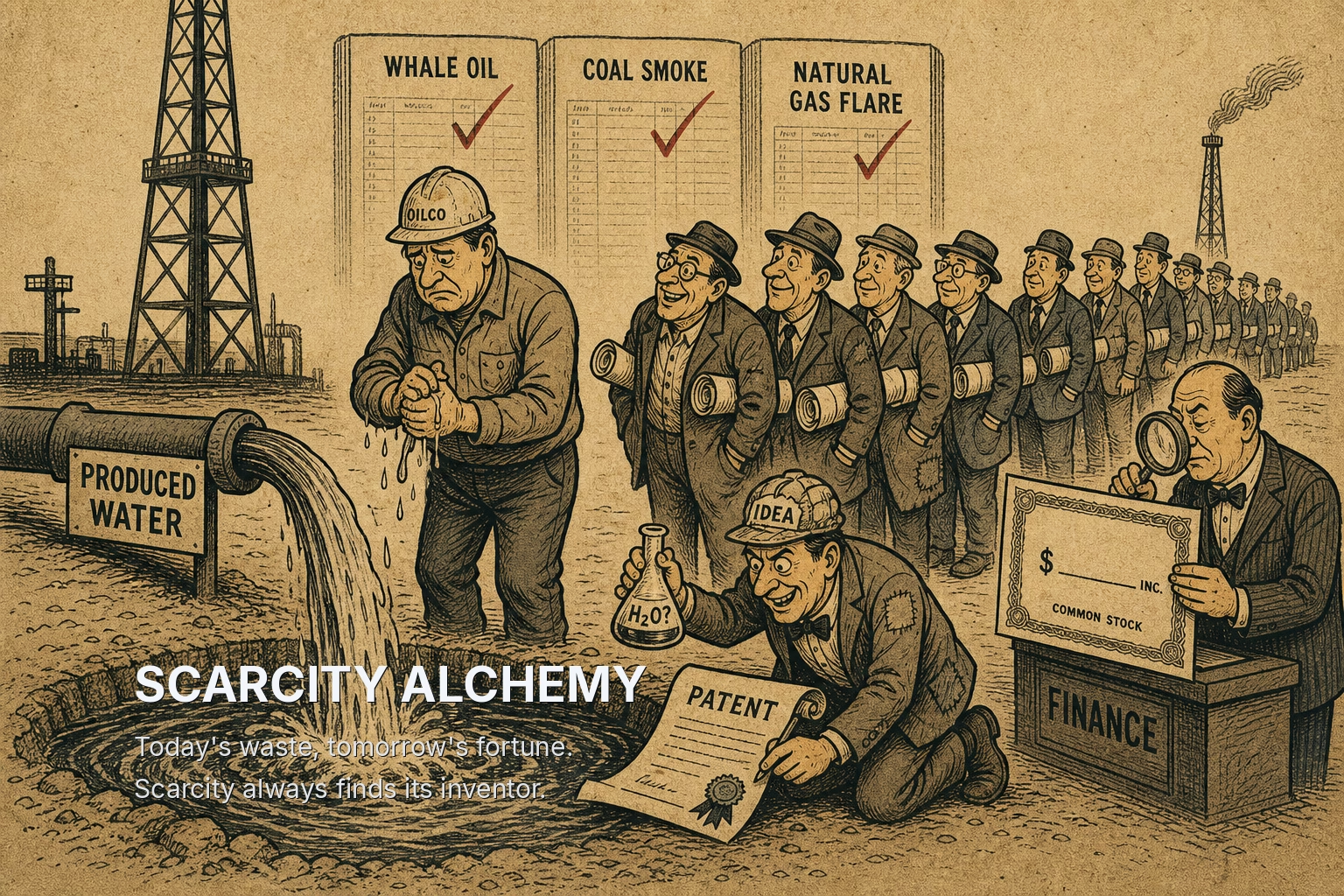
The Permian Basin now lifts crude at a rate approaching seven million barrels a day, and for every one of those barrels it brings roughly three to four barrels of hypersaline, contaminated water to the surface. That water, not geology and not price, is the ghost the scarcity crowd has settled on this year. The prediction embedded in that fixation is worth stating plainly, because it inverts the usual meaning of a bottleneck: whatever the run-out-of-everything crowd points to as the coming ceiling tends to become the next problem someone gets paid handsomely to solve. Produced water is not the exception to that pattern. It is the pattern's newest instance.
That is the claim, and it runs against the plain reading of the situation. The plain reading says a basin drowning in three-to-one waste water is a basin nearing its physical limit. The structural reading says the opposite: the visibility and scale of the constraint are precisely what pull capital and talent toward it, and the history of this specific industry rhymes on that point more reliably than almost any other trend in markets.
The scene in West Texas
Set the scene as it actually stands. Crude output in the Permian has roughly tripled over the past decade, carrying a large share of global production growth on its back. The macro backdrop is not one of easy money papering over bad economics: the 10-year Treasury sat at 4.77% in early September 2026, the 2-year at 4.34%, the curve modestly positive at a 43 basis point spread, and CPI printing at an index level of 332.8. Capital costs money again. Projects that survive this rate environment survive on returns, not on cheap financing.
Into that environment arrives the water problem. The arithmetic is genuinely daunting. At seven million barrels of oil per day and a three-to-four ratio, the basin is handling something on the order of twenty to twenty-eight million barrels of produced water daily. Disposal wells are filling. Injection has been linked to induced seismicity in parts of the region. The conventional answer, pump it back underground and forget it, is running into physical and regulatory limits at the same moment production wants to keep climbing.
So the pessimist's case writes itself. The easy disposal has been used up. The water is only getting saltier and more contaminated as wells age. Growth, at last, is on the verge of drowning in its own byproduct. It is a tidy argument, and it belongs to a genre.
The genre it belongs to
Consider what the same crowd has said before, because the value here is not in the water itself but in the recurrence.
Shale gas in Appalachia would never be economic. Then the Marcellus and Utica turned the region into one of the largest gas-producing provinces on the planet, and the complaint mutated into worry about decline rates in the Haynesville. Global crude production had peaked, an assertion made with confidence in the mid-2000s and refuted by a decade of Permian growth that the peak-oil framework had no room for. Tight oil could not be lifted profitably below some threshold price, and then the threshold kept falling as completion techniques improved, laterals lengthened, and per-well recoveries climbed.
The structure is the same in each case. A physical constraint is identified. It is real. It is expensive. The scarcity framework treats it as a ceiling, a hard stop imposed by nature. And then the constraint, by virtue of being large and expensive and highly visible, becomes the single most attractive target in the industry for engineering effort and capital, because whoever solves it captures the value the whole basin was about to leave on the table.
This is not a claim that every constraint dissolves. Sometimes a resource is genuinely uneconomic at any plausible price, and sometimes the innovation arrives late and someone is ruined waiting for it. The pattern is a signal worth watching, not a law of nature. But the base rate in this particular industry, over this particular half-century, tilts hard in one direction. The people betting that a named, well-capitalized bottleneck in a basin generating that much cash will simply cap production have a losing record long enough to be its own kind of evidence.
What the water is worth
The turn in each of these episodes is not a discovery so much as a reframing. The constraint stops being treated as waste to dispose of and starts being treated as a stream to process, and the moment the accounting flips, the economics flip with it.
Produced water is following that arc now. The volume that reads as a liability on the disposal side reads very differently once treatment technology can strip the salt and contaminants at industrial scale. Treated water has uses. It can be recycled into completions, reducing freshwater demand in a water-stressed region. It can, in principle, be cleaned to standards that permit surface discharge or agricultural use, which converts a cost center into something closer to a product. The hypersaline brine itself carries dissolved minerals that acquire value the instant extraction becomes cheap enough. Lithium in oilfield brine has moved from curiosity to active pursuit precisely because the brine is already at the surface and already being handled.
None of this is guaranteed to arrive on any particular schedule, and that caveat is the honest one. The link between a large visible problem and an imminent breakthrough is a probabilistic tendency, not a delivery date. A specific water-treatment startup can fail. A specific brine-lithium process can prove uneconomic at current metal prices. What the history supports is the direction and the mechanism, not the timing of any single company's success. Bet the pattern, hedge the name.
The actor who reads this correctly sees a basin whose constraint is an invitation. Twenty-plus million barrels a day of feedstock is not a burden if you own the technology that turns it into recycled completion fluid, dischargeable water, or extractable minerals. The scale that terrifies the pessimist is the addressable market that draws the entrepreneur. Same water, same volume, same salinity, two opposite readings, and the industry's track record says which reading has usually paid.
The actor who reads it wrong sees the disposal wells filling and extrapolates a hard ceiling. It is the same error that produced the peak-oil calls and the Appalachian gas dismissals: a real physical limit mistaken for a permanent one, because the framework had no place for the response the limit itself would provoke.
The pattern and the present
Here is what the sequence teaches, stated without embellishment. In an industry that generates enormous cash flow and sits atop a demand curve that goes up and to the right, a large and visible physical constraint is not a terminus. It is the location of the next value transfer, from the operators who will pay almost anything to keep producing to the innovators who solve the choke point. The constraint is a map to where the returns are about to be.
The one way this time genuinely differs is the macro frame. The prior shale breakthroughs matured through years of extraordinarily cheap capital, when a marginal project could be financed on hope and a low discount rate. This cycle's water problem must be solved with the 10-year near 4.8% and real financing costs that punish anything that cannot show a return. That is a filter, and a harsh one. It means the marginal, hype-funded water venture will die faster than its shale-era predecessors did. But it also means the technology that does clear the bar clears it on genuine economics, and economics that survive a 4.8% world are more durable than the ones that only worked at zero.
We can note the shape of the thing without pretending to know its calendar. The scarcity crowd has found its ghost for this cycle, and by finding it has done what it reliably does: pointed a floodlight at exactly the place the next necessary invention is most likely to appear.