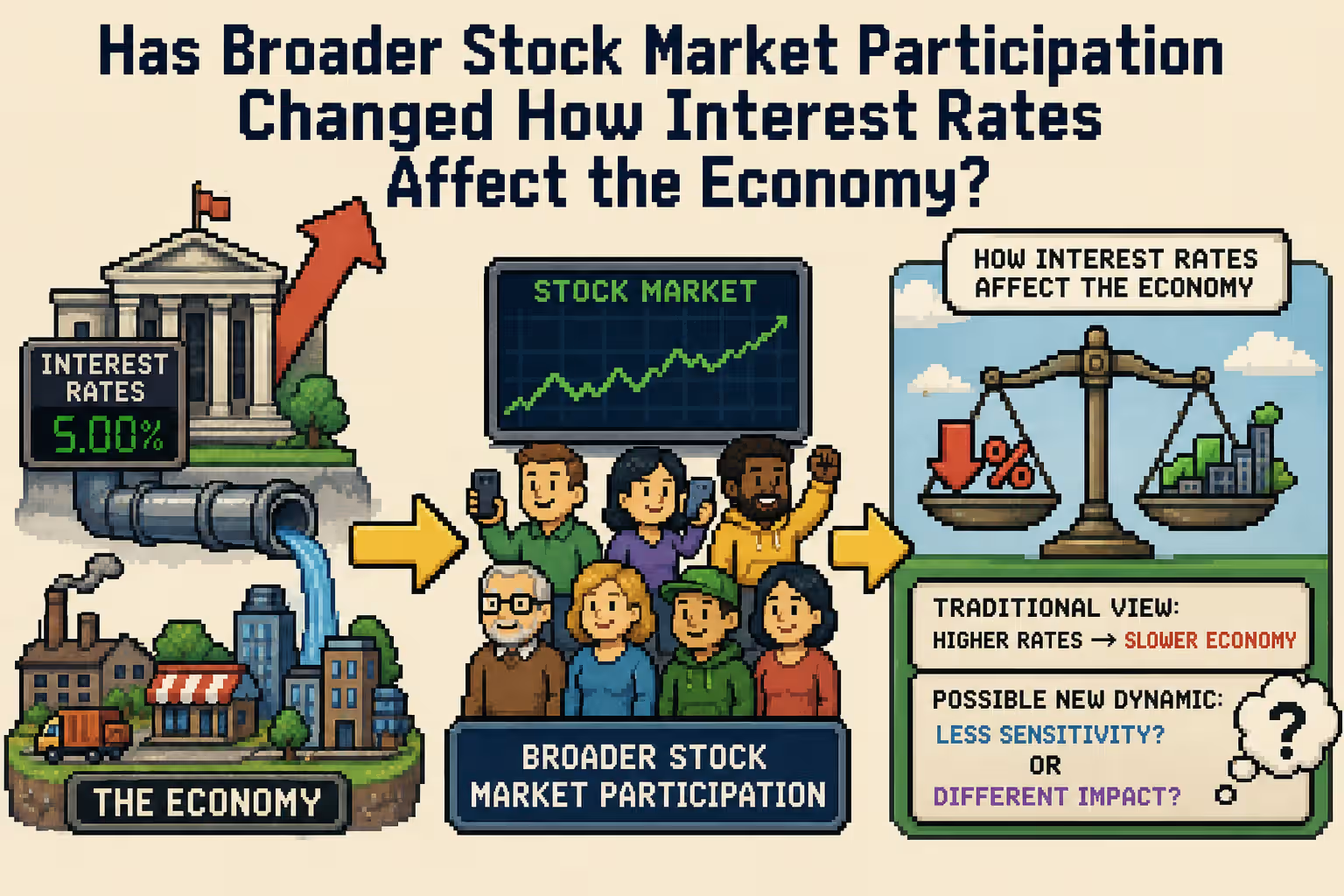
In the mid-1980s, when Paul Volcker still ran the Federal Reserve and the memory of double-digit inflation was fresh, fewer than three in ten American households owned any equity at all. The stock market was, for most families, a spectator sport. When the Fed raised rates, the pain arrived through channels that had little to do with the Dow: mortgage costs, auto loans, the price of financing a new refrigerator on installment. A rate hike bit into the borrowing of the many, not the portfolios of the few.
By the early 2000s that arrangement had inverted. More than half of U.S. households held equity, most of it not in brokerage accounts they checked daily but in the quiet machinery of 401(k)s, IRAs, and mutual funds that had spread through the workforce over two decades. The market had become a household affair. And that shift, Juan M. Morelli argues, changed something less visible than who owned what. It changed how the whole economy responds when the Fed moves.
The read worth sitting with is counterintuitive, and it runs against the instinct that a more equity-exposed public should be more sensitive to monetary policy, not less. The argument is the reverse. Broader participation may have dampened the response of output to interest rate changes, not amplified it. To see why, it helps to trace the pattern across the arc of participation itself.
The Narrow Market and the Concentrated Shock
Consider the household balance sheet of the 1980s. The minority who held equity held a great deal of it, per capita, and they often held it with leverage: they financed procyclical positions with debt, giving them outsized exposure to an asset that rose and fell with the business cycle. These were the households whose consumption moved most when rates moved. When the Fed tightened, equity prices fell and financing costs rose at the same time, and both forces pushed the same small group to cut spending sharply.
The mechanism here is not exotic. A participant who borrows to hold stock bears more aggregate risk than a bondholder who does not. When rates rise, the value of that stock drops and the cost of carrying it climbs. The rational response is to consume less, and to consume much less than a nonparticipant who feels only the second-order effects. In a narrow market, that responsive group is small, but each member is intensely responsive. The aggregate shock to consumption is carried on a few concentrated shoulders.
That was the transmission the Fed relied on, whether or not anyone at the Eccles Building described it in these terms. Rate policy worked partly because it hit a leveraged, concentrated ownership base hard, and that base translated its pain into reduced spending, softer asset prices, and weaker investment.
What Widening Ownership Actually Did
Now spread the same aggregate equity market value across a far larger pool of households. This is the arithmetic that runs from 1985 to 2005, and it is the heart of the pattern.
As participation rose, each participant came to hold a smaller per-capita equity position and to take on less leverage. The total value of the market was now distributed across many more balance sheets, each one carrying a thinner slice. The wealth effect of any given stock-price movement, felt at the household level, grew weaker. The financing pressure from a rate hike, spread thinner, grew milder. And so each participant's consumption became less responsive to interest rate changes, not more.
Here is where the intuition resists. Adding households from the group that is more sensitive to rates ought to make the aggregate more sensitive. That is one of two opposing forces, and it is real: a larger share of participants, holding individual responsiveness fixed, would indeed make aggregate consumption jump around more when the Fed moves. But the second force runs the other way and, in Morelli's calibration, dominates. As participation rises, individual responsiveness falls by enough to more than offset the growing number of responsive households. The many, each lightly exposed, absorb a shock that the few, each heavily exposed, once transmitted violently.
The effect does not stop at the dinner table. Stock prices help set firms' incentives to invest, because the market value of installed capital, measured against the cost of building new capital, is what makes an investment project attractive or not. When participation dampens the swing in stock prices, it dampens the swing in investment too. Smaller price movements mean smaller adjustments to capital spending, which mean smaller movements in output and labor income, which loop back to further soften the consumption response. The channels reinforce one another in the direction of muted.
Calibrated to match the observed responses of equity prices and investment to unexpected rate changes, and to fit the broader business-cycle and asset-pricing facts, the model delivers a specific number. Compare a low-participation economy at 25 percent with a high-participation one at 55 percent, and the output response to an unexpected rate increase is 20 percent smaller in the latter. That is not a rounding difference. It is a meaningful erosion of the lever's force.
The Household Data Behind the Claim
A model is a story with discipline, but the claim would be weaker without the household-level evidence that the story predicts. Using nondurable consumption data from the Bureau of Labor Statistics' Consumer Expenditure Survey over 1990 to 2007, Morelli estimates how the gap between participants' and nonparticipants' consumption responses evolved after unanticipated rate increases.
The prediction is precise: participants should still cut consumption by more than nonparticipants after a rate hike, but the size of that differential should shrink over the sample as participation broadens and each participant's per-capita exposure thins. Participants cut, nonparticipants cut less, and the distance between them narrows across the period. That is the fingerprint of the mechanism, and it is the reason the model's aggregate conclusion should be taken seriously rather than as a clever artifact of its assumptions.
The Pattern, and the One Way This Time Differs
The structural pattern is not really about the stock market. It is about what happens to any transmission channel when the population it works through is redistributed. A shock carried by a few concentrated, leveraged actors transmits violently; the same shock spread across many lightly exposed actors transmits gently, and it does so even though the diffuse population is drawn from the more responsive type. Concentration is what gives a channel its force. Diffusion is what saps it. This is a general fact about how aggregate outcomes emerge from distributed exposure, and equity participation is one instance of it.
We can note that the same logic appears wherever policy works through a leveraged minority. The housing channel behaved this way in reverse during the 2000s, when a widening base of mortgage debt spread rate sensitivity across more households and made the Fed's job, for a time, feel almost frictionless, right up until the concentration of risk in a few instruments revealed itself in 2008. The pattern is the same; only the instrument changed.
But the parallel comes with a limit that matters now, and it is the one way the present setup is not the same. The participation story assumes exposure is genuinely diffuse, that the fifty-five percent who own equity each hold a thin, deleveraged slice. That was a fair description of the household sector Morelli studied through 2007. It is a less certain description today. Ownership of equity has widened, but ownership of the largest positions has re-concentrated: a small share of households holds the overwhelming majority of directly held stock, and the leverage in the system has migrated from household margin accounts into corners of the market that the Consumer Expenditure Survey does not see. With the 10-year Treasury yield at 4.72 percent and the 2s10s spread positive at 0.53 percent as of mid-August 2026, the Fed is operating in a rate environment where the strength of its transmission lever is not a theoretical question.
If participation is broad but effective exposure has quietly re-concentrated at the top, then the dampening the model describes may be weaker than the headline participation rate suggests. The lever may bite harder than a simple count of equity-owning households would predict.
What the episode teaches us is that a policy channel's strength is a property of how exposure is distributed, not of how many people are nominally in the room. When a shock's carriers are many and light, the channel goes slack. When they are few and leveraged, it snaps taut. The number to watch is not participation. It is concentration.