On August 28, 2026, the 10-year Treasury yielded 4.73% and the 2-year sat at 4.34%, with the curve barely positive at plus 39 basis points. Rates had ru...
On August 28, 2026, the 10-year Treasury yielded 4.73% and the 2-year sat at 4.34%, with the curve barely positive at plus 39 basis points. Rates had run to levels the market had not seen in two decades, and equities had absorbed the move with something close to indifference. That indifference is the whole story. The textbook says higher discount rates should compress multiples; the tape says the multiple has held. Consensus reads that as resilience. The more useful reading is that the equity risk premium is doing quietly now what it did loudly, in the opposite direction, ten years ago.
The premium is the extra return investors demand to own stocks instead of risk-free bonds. It is not observable directly. It is inferred, and because it is inferred, it drifts without anyone deciding to move it. That drift is the mechanism behind three episodes that look unrelated on the surface and turn out to be the same episode running at different speeds.
The mid-2010s, when cheap money did not buy the multiple it should have
Set the scene in 2015 and 2016. The 10-year Treasury spent long stretches yielding around 2%. A first-year finance student, handed that number and the standard inverse relationship between rates and multiples, would have written down that the S&P deserved to trade near 25 times earnings. It did not. It traded in the mid-teens for years, and the gap between what the math said and what the market paid was not an error. It was the equity risk premium widening from roughly 4% to roughly 6% while nobody announced it.
The people paying up for bonds at 2% were not the same people who declined to pay 25 times for stocks, but they were pricing the same fear. The financial crisis was recent. The memory of what equities could do in a bad year was fresh, and investors demanded to be paid more to hold them even as the risk-free rate collapsed. The premium absorbed the entire benefit of low rates. Cheap money arrived and the multiple stayed home.
This is the part consensus has forgotten. Everyone remembers that rates were low. Almost nobody remembers that low rates did not deliver the valuation they were supposed to, because the premium ate the difference.
The pattern is older than one cycle
The same mechanism appeared in the late 1970s, running the other way. Treasury yields were high and rising toward the Volcker peak, and the reflexive expectation was that stocks should trade at a discount to compensate. They did, but not only because rates were high. The premium was also elevated, because a decade of inflation had taught investors that equity earnings were unreliable in real terms. High rates and a wide premium stacked, and the multiple compressed twice for one reason stated two ways.
Then look at the run into 2000. The 10-year yielded well above 5% for most of the late 1990s, and by the textbook that should have capped the multiple. It did not. The Nasdaq Composite closed at 5048.62 on March 24, 2000, at a valuation that made the discount rate almost irrelevant, because the equity risk premium had compressed toward zero and, by some measures, gone negative. Investors were so confident in equity earnings that they demanded almost no extra return to own them. High rates did not matter because the premium had collapsed to offset them.
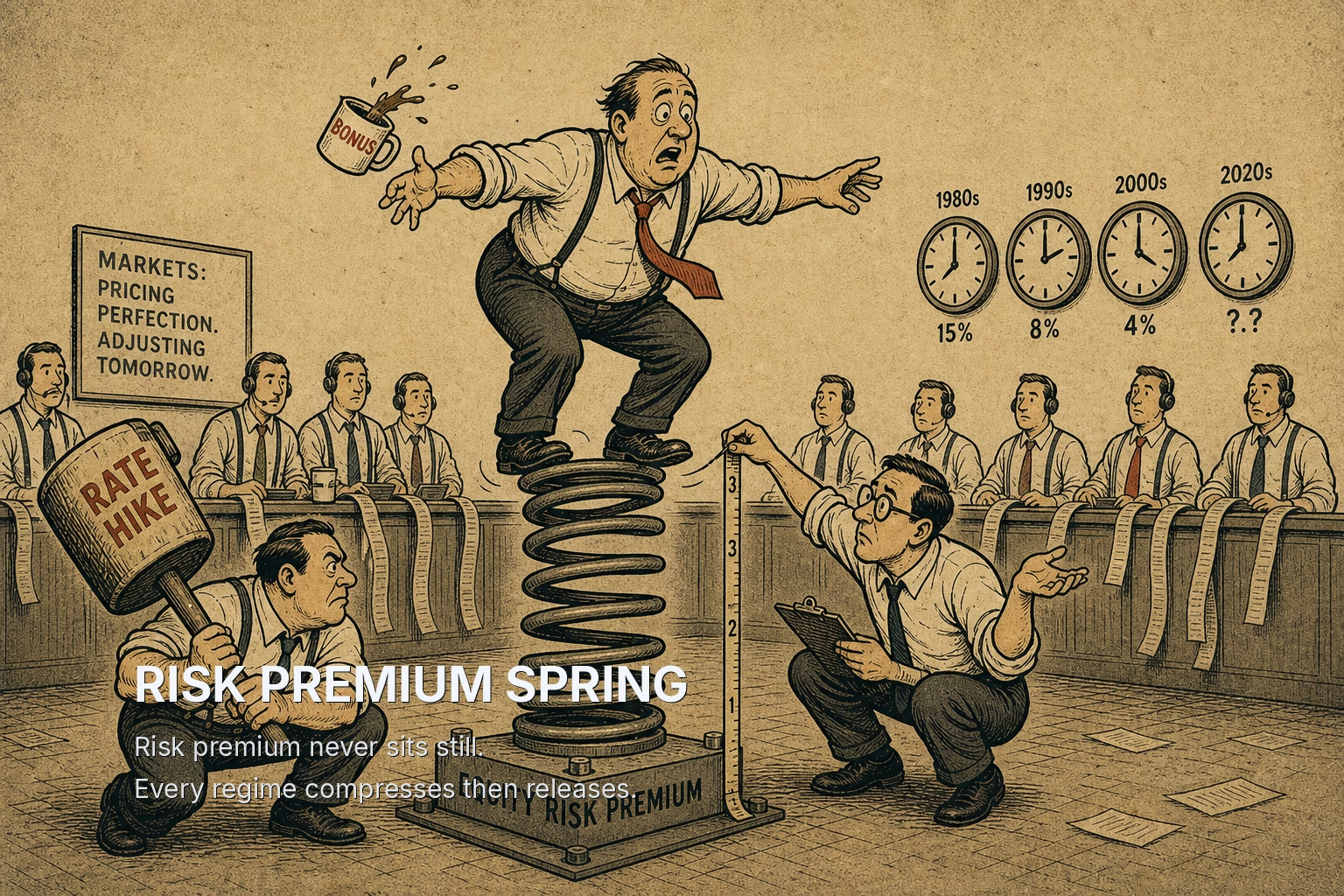
Three episodes, one variable. In the late 1970s the premium was wide and rates were high, and the two compounded downward. In 2000 the premium was thin and rates were high, and the thin premium overwhelmed the rates. In the mid-2010s the premium widened as rates fell, and the widening cancelled the fall. The premium is not a constant that sits behind the discount rate. It is a spring that stores and releases the market's changing tolerance for owning risk.
The double whammy, now running in reverse
Here is where 2026 becomes the mirror image of 2015. In the mid-2010s the premium widened while rates fell, and the two moves offset, leaving the multiple flat. The question that follows is uncomfortable and simple. If the premium can widen when rates fall, what stops it from widening again when rates rise?
Nothing stops it. And a premium that widens on top of rising rates is the same stacking that hit the late 1970s: two forces pushing the multiple down for what looks like one reason. The last decade handed earnings a tailwind from the corporate tax cuts and a second tailwind from the artificial intelligence build. Those flattered the E in the price-to-earnings ratio. If the premium now widens against a higher risk-free rate, the market faces elevated earnings, possibly peak earnings, multiplied by a multiple heading the wrong way. That is the double whammy the 2015 episode ran in reverse, and the reversal is not yet visible in the multiple because the premium moves without an announcement, exactly as it did ten years ago.
The data center buildout is where this stops being abstract. The economics of an AI data center lease are a bet on terminal value. A 15-year lease whose payments roughly cover the build cost leaves the developer underwriting whatever the property releases for in year 15 to year 25. Move the discount rate from 4% to 5% and the lease rate has to rise 5% to 10% just to hold the return constant, and the terminal value that was already the whole bet gets discounted harder at the same moment tenant credit gets scarier. If the AI trade cracks, the developer is hit on both sides: the tenant may not survive to renew, and the release goes from a hundred-million-dollar income stream to whatever the next bidder will pay for a specialized building in a saturated market. We are not there yet. But finance 101 says investment gets crowded out eventually when the cost of capital rises, and the crowding-out shows up first in the projects whose value lives furthest out in time.
What the pattern tells us about August 2026
The lesson is not that stocks must fall. It is that the calm in equities as rates hit 20-year highs is not evidence the discount rate stopped mattering. It is evidence the premium has not yet moved. In the mid-2010s the premium took years to widen from 4% to 6%, and it did so without a single day anyone could point to as the turn. A spring that has been compressed by a decade of tax cuts, easy money, and AI optimism does not have to release on schedule, but the direction of a compressed spring is not in doubt.
When a discount rate rises and the multiple does not, the market is telling us the premium is absorbing the shock, and a premium absorbing a shock is a premium that has room to widen later rather than a premium that has proven it never will. The double whammy is patient. It waited a full cycle in the mid-2010s to show that low rates could be neutralized. There is no rule that says it cannot wait again to show that high rates and a widening premium can stack the same way they did at the end of the 1970s.