For most of American financial history, we knew that bank runs happened, but we did not know how often, to whom, or under what circumstances. The runs that ended in a bank shuttering its doors left a record; the Office of the Comptroller of the Currency noted the closure. But a run that a bank survived left almost nothing behind. A crowd formed, tellers paid out, the crowd dispersed, and the episode vanished from the official ledger as though it had never occurred. The empirical record of the phenomenon most associated with banking crises was, in effect, a record of only the failures, and only the failures that regulators bothered to file.
That gap has now been substantially closed. Sergio Correia, Stephan Luck, and Emil Verner fed more than 374 million digitized newspaper articles through a keyword filter, narrowed the set to roughly a million candidates, and then handed each candidate to large language models with a simple instruction: read this the way a person would. Which bank is this about? Did depositors withdraw? Did the bank suspend payments, close, reopen? What set the panic off, and how did the bank respond? The result is the most comprehensive database of bank runs in United States history, assembled not from new records but from old ones nobody could previously read at scale.
The interesting thing is not the technology. It is what the recovered record shows once the survived runs are included alongside the fatal ones. The pattern that emerges is older than any of the tools used to find it, and it rhymes uncomfortably with episodes we have watched in real time.
The Same Sequence, Told in Nineteenth-Century Prose
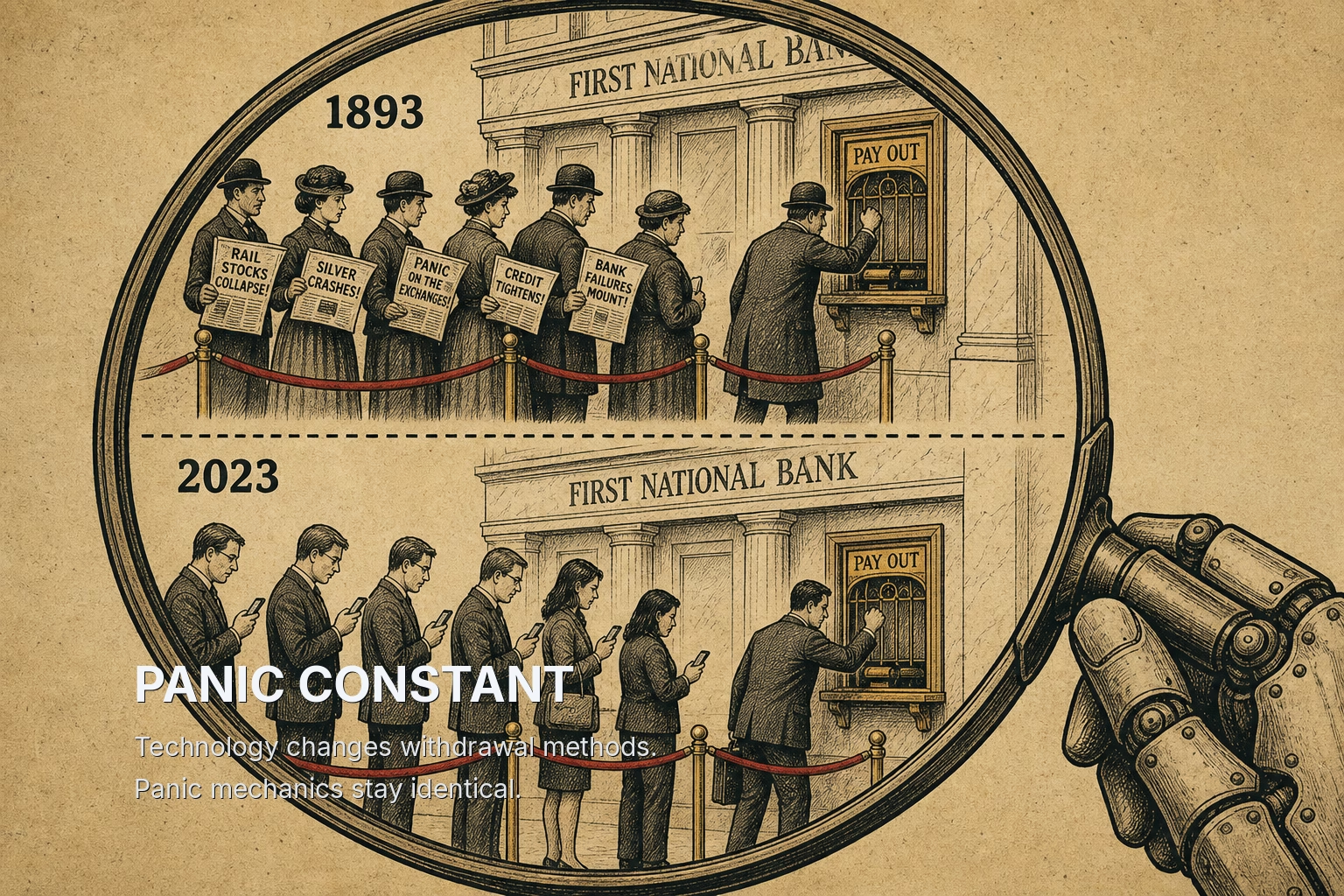
Consider what a nineteenth-century reporter actually wrote when a run was underway. He rarely used the word "run." He described depositors "clamoring for their money," a line forming before the doors opened, a cashier producing gold coin from the vault and stacking it on the counter where the crowd could see it. He described the bank's directors issuing a public statement of solvency, or a clearinghouse extending a loan, or shareholders injecting fresh capital to prove the institution could meet every claim. These were the defensive moves of a bank trying to convince a crowd that it did not need to be afraid, precisely because the crowd's fear was the only thing that could make the bank insolvent.
The language model's contribution here is subtle and worth naming exactly. A keyword search for "run" returns the ship that "runs into a riverbank" and the bank owner who "runs for office." It misses the depositor "clamoring." The model reads the sentence the way the 1890s reader did, in context, and classifies the event by what happened rather than by which words appeared. It also recognizes when three separate papers are describing the same Tuesday-morning panic in one Ohio town, so the episode is counted once. This is what makes the recovered dataset a record of the mechanism rather than a record of the vocabulary.
And the mechanism, described across thousands of these episodes, is always the same. Some piece of information arrives. It might be macroeconomic, a national panic radiating outward. It might be bank-specific, a rumor that a cashier had absconded or a loan had gone bad. Depositors, unable to distinguish a solvent bank from an insolvent one from the outside, do the rational individual thing and try to get out first. The attempt to get out is what threatens the bank. The threat validates the fear. The bank that survives is the one that convinces the crowd fast enough that getting out is unnecessary.
The Pattern Did Not Retire in 1933
The acute phase of the Great Depression ended in 1933, and with it, the era in which a physical crowd outside a bank was a recurring feature of American economic life. Deposit insurance was supposed to have retired the mechanism. For a long stretch it appeared to have done so. The lesson many drew was that the run was a pre-modern artifact, a thing of straw hats and gold coin, killed by the FDIC.
That reading was wrong, and two episodes since should have settled the question.
In September 2008, the money market fund Reserve Primary held Lehman Brothers commercial paper, marked it to zero when Lehman failed, and "broke the buck," reporting a net asset value below one dollar. There was no crowd on a sidewalk. There were redemption requests routed electronically, and they arrived at a speed no 1893 teller could have imagined. Institutional investors, unable to distinguish which funds held bad paper, pulled money from money funds broadly. The Treasury had to guarantee the entire industry to stop it. The instrument was new. The sequence was verbatim: adverse information, the rational scramble to exit first, the exit itself becoming the threat.
In March 2023, Silicon Valley Bank disclosed a capital raise and a loss on its securities portfolio on a Wednesday. By Friday it was gone. Depositors coordinated over group chats and moved balances by phone in minutes. The bank that in 1893 might have survived a two-day run because withdrawals were rate-limited by the physical speed of counting cash had no such friction. Roughly forty billion dollars was requested in a single day. The public display of solvency that once meant stacking gold on the counter now meant a press release, and a press release competes poorly with a text message telling you to move now.
We can note the one way this time genuinely is not the same, and it is not comforting. The historical runs the recovered dataset documents were governed by a physical constraint that acted as an involuntary circuit breaker. A crowd could only be served as fast as tellers could count. That friction bought banks time, and time was the input to every successful defense in the record, the clearinghouse loan, the capital injection, the calming of the crowd. The friction is gone. The rate at which fear converts into withdrawal is now bounded by nothing.
What the Recovered Record Teaches
The value of reading a century of forgotten runs is not that it tells us runs still happen. We knew that. It is that it lets us see the constant separated from the variable. The variable is the technology of withdrawal, which has moved from a physical line to a redemption gate to a phone in seconds. The constant is the informational structure: depositors who cannot verify solvency from the outside, an adverse signal, and the individually rational decision to exit before the person next to you.
Deposit insurance did not repeal that structure. It capped it, for insured depositors, below a threshold. Above the threshold, and for the uninsured wholesale funding that dominates modern banking, the 1893 sequence runs unchanged, only faster. The regulators who filed closure notices in the nineteenth century recorded only the failures. The newspapers, read at last by a machine that could understand them, recorded the near-misses too. And the near-misses are where the lesson lives, because they show that the difference between a survived run and a fatal one was almost always time.
A run is not a relic of the era before deposit insurance. It is a coordination failure driven by the inability to observe solvency, and the only thing that has ever reliably interrupted it is friction. Sometimes the friction was a queue and a coin count. Increasingly, there is no friction at all, which is why the modern run resolves in hours rather than days and why the interventions that worked when banks had time to be persuasive now have to arrive before anyone has finished reading the headline.
The chronicle assembled from newsprint does not predict the next run. It clarifies what the next run will be made of. The trigger will be some piece of information no one can immediately verify. The response will be a scramble to exit. And the outcome will turn, as it always has, on whether the institution can buy enough time to prove the fear was unwarranted, in a world that has removed almost all the mechanisms that used to supply that time.