The Tri-State small-business economy is contracting faster than the national one, and the gap is now wide enough to be a regional credit signal rather than survey noise. Revenue expectations for 2026 among small firms in New York, New Jersey, and Connecticut fell 20 to 30 percentage points year-over-year, against a 6-point decline nationally. That is not a slower rate of the same trend. It is a different trajectory, and it is the worst regional reading the Small Business Credit Survey has produced since 2020.
Equity markets do not price small private employers. There is no listed proxy for a ten-person contractor in Newark or a Bronx restaurant, so the deterioration described here will not appear on a screen until it reaches the balance sheets of the banks that lend to these firms. That lag is the entire point. The credit read here is early because the borrowers reported it before their lenders had to.
What the Diffusion Index Is Actually Saying
The headline number is a diffusion index: the share of firms expecting revenue to rise minus the share expecting it to fall. A 20-to-30-point drop in that index means a large block of regional owners flipped from expecting growth to expecting decline within a single survey cycle. This is not marginal pessimism at the edges. It is a shift in the median firm's outlook.
The comparison to the national sample is what gives the reading its weight. Nationally, 2025 revenues were roughly flat versus 2024, and the softness that did appear was concentrated in the smallest firms, those under ten employees. In the Second District, revenues worsened by more than 8 percentage points, and the deterioration ran across every size band. When the smallest firms weaken, that can be a story about thin margins and rising input costs. When firms of all sizes weaken simultaneously, that is a demand problem or a cost-of-capital problem, and both feed directly into credit quality.
Employment confirms the same divergence. National employment growth held steady except among larger small firms, whose hiring recovery has been fading since 2022. Regional employment fell across all size groups, down 9 percentage points overall. Revenue and payroll are moving together and in the same direction, which removes the easy explanation that one is a measurement artifact.
Where the Credit Channel Bites
The mechanism connecting a survey of private firms to a market consequence runs through funding cost. With the 10-year Treasury at 4.68% and the 2-year at 4.20% as of mid-August, the front-end financing that small businesses actually use, lines of credit, term loans, and card balances priced off short rates, remains expensive. A firm expecting flat-to-declining revenue into 2026 while carrying floating-rate debt at these levels is a firm whose interest coverage is compressing from both ends at once.
Profitability data in the survey is backward-looking, a snapshot from December 2024, and it looks deceptively fine: regional firms reported profits more often than losses by 8 percentage points, and profitability actually improved across size groups. But that improvement is a rear-view mirror. It reflects 2024 conditions, before the 2025 revenue collapse landed. More telling is the level. The pre-pandemic profitability differential was 41 percentage points for regional firms in December 2019. At 8 points, regional small businesses are operating with a fraction of the pre-COVID cushion, and they are heading into a year they themselves expect to be worse.
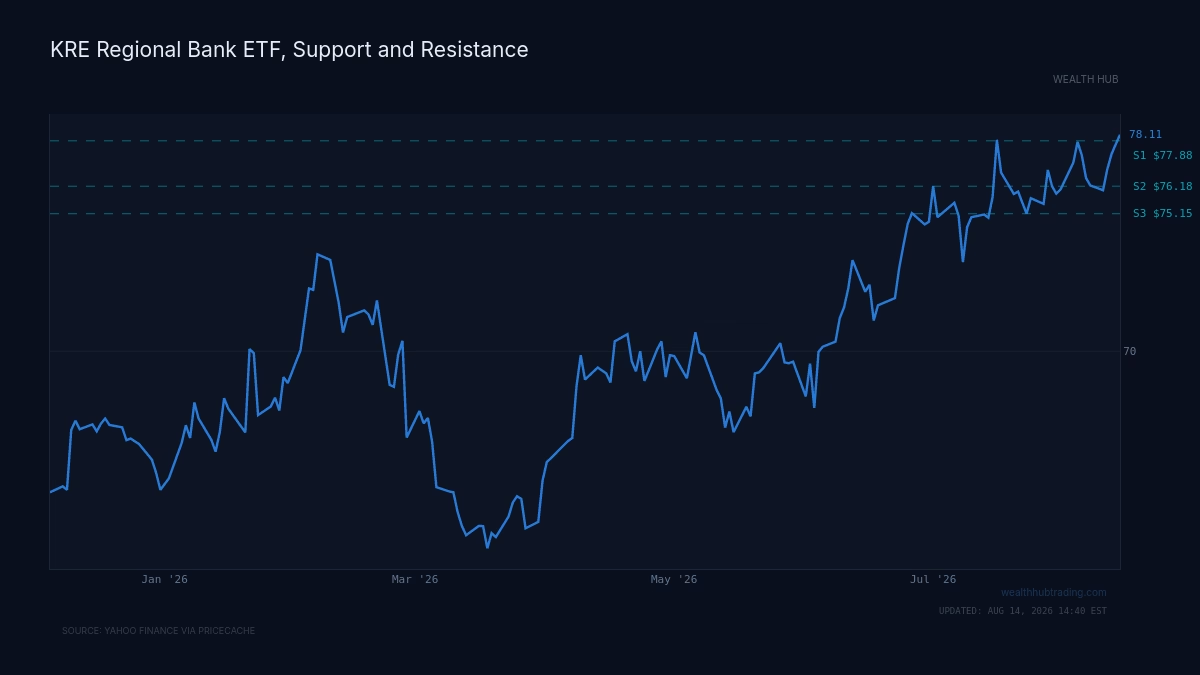
This is the setup that precedes a rise in small-business delinquencies. Thin cushions, deteriorating revenue expectations, and floating-rate liabilities at a 4.20% front end are the three ingredients. Regional and community banks with heavy small-business and commercial-real-estate exposure carry this risk on their books well before it surfaces in a credit spread that a portfolio manager can trade. The KRE regional-bank complex is the closest liquid instrument to this exposure, though the link is inferential: the survey does not name lenders, and any specific bank's small-business book could be better or worse than the regional average. Treat KRE as a proxy for the channel, not proof of it.
The 2s10s Detail That Cuts Against the Alarm
The strongest counterargument sits in the rate structure itself. The 2s10s spread is positive at +0.48%, meaning the curve has re-steepened and is no longer inverted. A steepening curve after an inversion is historically associated with the front end falling, which would relieve exactly the floating-rate pressure described above. If short rates decline through 2026, the interest-coverage squeeze eases, and the survey's pessimism could prove to be peak fear rather than a forecast.
There is a second, quieter counterpoint in the national data. The survey notes that fewer firms nationally cited higher input and wage costs as a financial challenge. If cost pressure is genuinely abating, then part of the revenue-expectation drop may reflect firms anticipating lower nominal pricing power rather than a real volume collapse. Lower revenue on lower costs is a very different credit picture from lower revenue on sticky costs.
Neither counterargument survives the regional specificity, though. A falling front end helps every borrower in the country equally; it does not explain why the Second District's expectations fell four-to-five times as much as the national reading. The re-steepening and the input-cost relief are national conditions. The revenue collapse is regional. Something is happening to Tri-State demand that the aggregate rate picture does not capture, and a national tailwind cannot offset a regional-specific shock to the firms feeling it.
What Would Confirm the Read, and What Would Break It
The signal to watch is not another survey. It is the pass-through into observable bank credit metrics for lenders concentrated in New York, New Jersey, and Connecticut: small-business loan delinquency rates, net charge-offs on commercial and industrial lending, and provisioning at regional banks reporting through the first half of 2026. If regional pessimism is real, those lines deteriorate for Second District lenders before they deteriorate nationally, and they deteriorate more.
The thesis breaks if the front end falls sharply enough and fast enough to reset small-business coverage ratios before revenue actually declines, turning expected weakness into a self-correcting scare. It also weakens if the regional revenue drop reverses in the next survey cycle, marking it as a one-year sentiment spike rather than the leading edge of a contraction.
Until one of those shows up, the cleaner reading is that the Tri-State small-business sector is transmitting a credit warning through the only channel available to firms that no index tracks, their own revenue expectations, and that the banks holding their debt have not yet had to acknowledge it.