The number that should frame the whole debate is not the deficit. It is the return. An investor who bought the 10-year Treasury at its October 2023 yiel...
The number that should frame the whole debate is not the deficit. It is the return. An investor who bought the 10-year Treasury at its October 2023 yield peak of 4.99 per cent now sits on a total return above 16 per cent, even as headline yields drifted higher. That fact sits uncomfortably alongside the story the market has been telling itself since the summer, which is that the global bond selloff is the first tremor of fiscal reckoning. Jim Reid, who runs macro research at Deutsche Bank, has proposed a quieter and more useful reading: what we are watching is not the beginning of a crisis but the closing act of one, the long unwinding of the most distorted decade in the history of sovereign debt markets.
The distinction matters because it changes what the price action means. If yields at 4.78 per cent on the US 10-year are a fiscal warning, the correct response is fear. If they are simply the price of money returning to something a person from the 1990s would recognize as ordinary, the correct response is recalibration. The two readings point in opposite directions, and the historical record leans hard toward the second.
The decade that broke the reference point
To understand why 4.78 per cent feels alarming, you have to remember how the reference point was manufactured. Between roughly 2010 and 2021, central banks in the developed world ran an experiment with no real precedent: policy rates pinned near zero, and trillions of dollars, euros, pounds and yen deployed to buy government bonds directly. The stated purpose was to hold down borrowing costs and pull growth forward. The mechanism was financial repression, a term with a specific meaning, that the state and its central bank suppress the return on savings below its natural clearing level in order to make debt cheaper to carry.
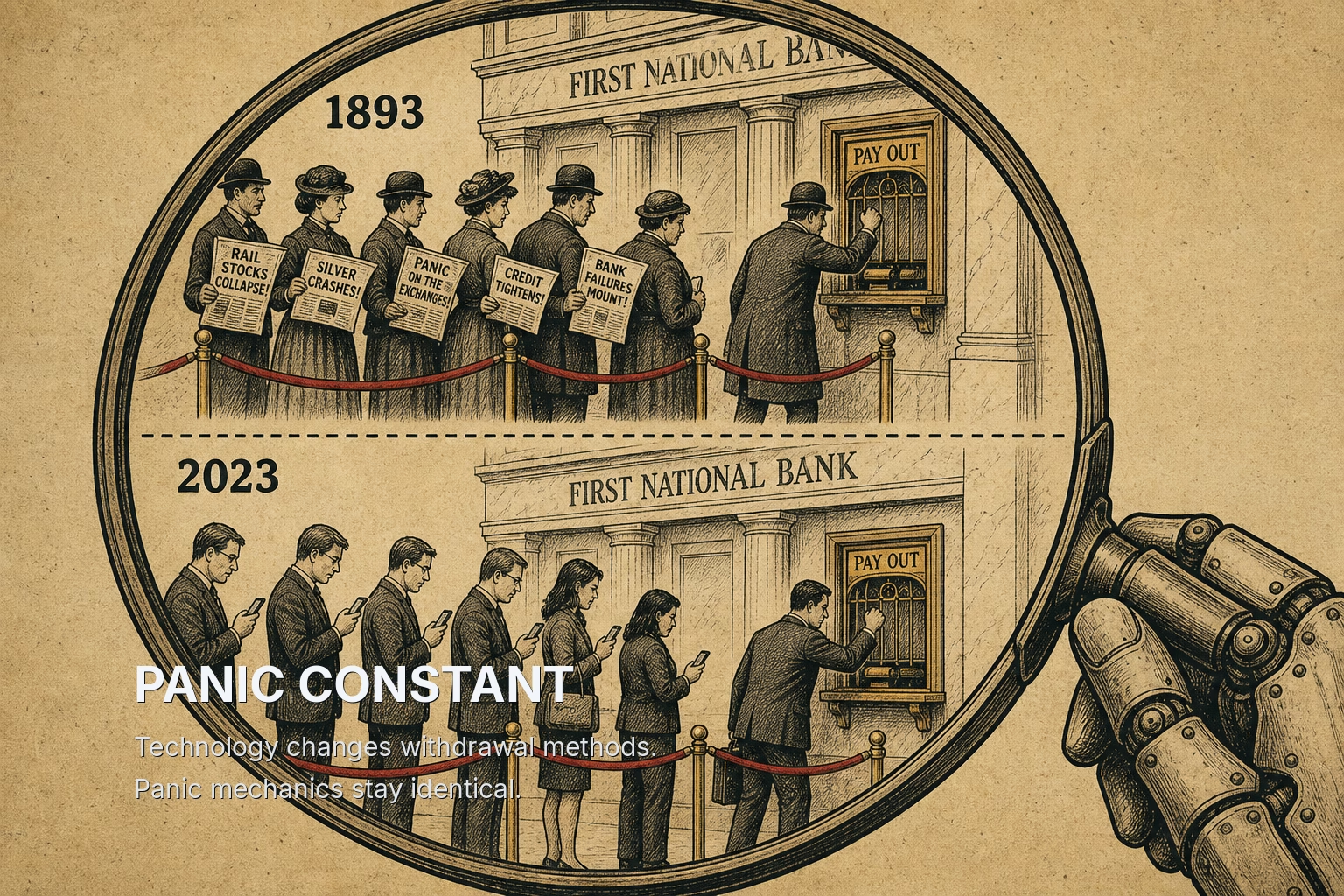
It worked, in the narrow sense. Sovereign yields spent a decade at levels that would have looked absurd to any bond trader of the prior fifty years. German bunds traded through zero. A meaningful share of the global investment-grade universe carried negative nominal yields, meaning lenders paid governments for the privilege of holding their paper. An entire cohort of market participants came of professional age inside this regime and internalized it as the baseline. That is the trap. When the anomaly lasts long enough to raise a generation of desks, the anomaly stops feeling like one.
Reid's framing captures this with an image worth keeping: had you spent the last two decades on a desert island, the yields on your return would look perfectly normal, not like a crisis. The crisis interpretation only survives if the 2010s are your yardstick. Measured against the longer span of financial history, today's levels are unremarkable.
The pattern has a name, and it has precedent
The structural pattern here is the exit from repression, and it does not resolve the way panic narratives assume. When a central bank has spent years artificially suppressing the return on sovereign debt, the eventual normalization always feels, to those inside the suppressed regime, like a rupture. The rise in yields reads as loss because the starting point was so low that any adjustment inflicts damage on existing holders. But the damage is front-loaded, concentrated in the moment of transition, and it does not repeat once the repricing has occurred.
Consider the American exit from the last comparable episode of engineered low rates. From the early 1940s through 1951, the Federal Reserve capped Treasury yields to help finance the war and its aftermath, holding long bonds near 2.5 per cent by direct intervention. The Treasury-Fed Accord of March 1951 ended that arrangement and freed yields to find their own level. Bondholders who had grown accustomed to the pegged regime endured a long, grinding adjustment as rates climbed over the following decades. Those who bought at the higher starting yields that emerged did far better. The lesson embedded in that episode is the same one Reid is pointing at now: the starting yield, not the direction of travel, determines the outcome for the patient holder.
The more recent rhyme is the one still fresh in memory. In September 2022, the UK gilt market convulsed during the Truss government's mini-Budget, and the crisis framing that day was total. Ten-year gilt yields today sit roughly 0.65 percentage points above the peaks of that episode. And yet the broad gilt index has returned something like 12 per cent since those crisis highs, with no sustained stretch of negative returns across the four years that followed. The headlines throughout that period never stopped warning of British fiscal collapse. The returns quietly told a different story. Higher yields, once reached, did the work that low yields never could, which was to pay the holder for waiting.
Same data, two different desks
The interesting feature of the present moment is that two experienced investors can look at identical numbers and draw opposite conclusions, and the difference between them is entirely a matter of which regime they treat as home.
The fiscal-alarm desk sees the 10-year at 4.78 per cent, the 2s10s spread positive at 0.41 per cent after a long inversion, corporate debt supply competing hard for the same pool of demand, and central banks no longer buying but letting their holdings run off. It reads this as the market beginning to demand a risk premium for lending to overextended sovereigns, the first innings of a debt-arithmetic problem that compounds if growth fades. The concern is not imaginary. Higher borrowing costs genuinely worsen the math on public debt, and Reid himself does not dismiss the long-term issue.
The normalization desk sees the same 4.78 per cent and asks a different question: what does this level do for the buyer today? US nominal GDP grew 6.6 per cent year on year in the second quarter, the strongest reading outside the Covid rebound since 2005, propelled in part by the AI capital cycle and in part by inflation that has now run above the Fed's 2 per cent target for more than five years. In an economy growing at that nominal pace, a 10-year yield below 5 per cent is not a fiscal scream. It is arguably still generous to the borrower. And crucially, the buffer for the holder is now enormous. From current levels, the 10-year yield would have to climb to roughly 5.5 per cent over the next year, or 6.4 per cent over two years, before total returns turned negative. That cushion did not exist in 2021. It is the direct gift of higher starting yields.
Both desks are reasoning honestly from the same tape. The one that has been closer to right has been the one that treats the ultra-loose decade as the deviation rather than the norm. The Bloomberg US Treasury Total Return index delivered a positive return over the past year even as the 10-year yield rose about 0.60 percentage points, which is precisely the behavior you expect from an asset class where the coupon has finally been restored to a level that can absorb rate moves.
What the pattern says about now
The honest read is that the secular adjustment is not finished. Rolling five- and 10-year total returns across many government bond markets are still hovering near their lowest on record, a scar from the 2020-2022 period when low starting yields offered no protection at all. The forces pushing yields up, heavy issuance, the retreat of central bank buying, and inflation that stays higher and more volatile than the pre-pandemic norm, are not going away absent a genuine growth shock. Anyone expecting a clean return to the old regime is fighting the structure.
But the pattern that runs through the 1951 Accord, through the gilt market after 2022, and through the Treasury index over the past year is not a pattern of catastrophe. It is a pattern of transition, in which the worst returns arrive at the moment of repricing and the best returns accrue to whoever shows up afterward with the higher starting yield in hand. Financial repression is comfortable for borrowers and quietly punishing for savers. Its end reverses that arrangement, and the reversal, however it is dressed up in fiscal language, is on balance a restoration rather than a rupture.
The lesson the episode teaches is a durable one, and it is often mistaken for its opposite: the return of a normal price for money looks like a crisis only to those who spent a decade forgetting what normal was.