The politician who says "stop obsessing over bond markets and spend more to help people" has the causality exactly backwards. The bond market is not com...
The politician who says "stop obsessing over bond markets and spend more to help people" has the causality exactly backwards. The bond market is not competing with social spending for the government's attention. It is quietly setting the price of all future social spending, and every basis point it adds compounds into money that never reaches a hospital, a school, or a pension. The mechanism is not punishment for defying orthodoxy. It is arithmetic, and it works whether or not anyone in Westminster believes in it.
That is the part intuition gets wrong. The instinct treats the bond market as an external constraint imposed by hostile financiers, something a sufficiently determined government could simply refuse to acknowledge. But yields are not a verdict handed down after the fact. They are a forward-looking price, and the price moves on expectations long before a single extra pound is borrowed.
The Number That Should End the Argument
Consider a finding from Federal Reserve Board research on the United States. When the market's consensus expectation of the debt-to-GDP ratio rises by one percentage point, the expected ten-year Treasury yield five years out rises by roughly four basis points. Note the word expected. Nothing has to actually happen. No new bonds need be issued. The debt does not need to climb. It is enough for investors to believe it will.
Four basis points sounds trivial until you attach it to the size of the liability. On the US Treasury's stock of debt, four basis points across the curve translates, over time, into something on the order of fourteen billion dollars in additional annual interest. That is not a rounding error. It is a permanent claim on the budget that produces nothing, funds nothing, and cannot be voted away.
This is why the framing of "bond market versus helping people" collapses on contact. The higher yield is the anti-help. It is spending diverted from citizens to coupon payments, and the diversion is set in motion by the mere anticipation of fiscal loosening.
Where the Extra Yield Actually Comes From
The increase does not arrive as an even, anonymous rise in the cost of money. The Fed research splits it: of the four basis points, roughly two come from a higher term premium on long-dated bonds, and roughly two from a higher risk-free rate.
That decomposition matters because it tells you what the market is actually pricing. The term-premium component is the compensation investors demand for holding long duration in a world where the debt path looks heavier and less certain. It is a risk charge, and it is the piece that behaves worst when confidence erodes. The risk-free component reflects the expected path of policy rates responding to the larger fiscal impulse.
For a government, the practical consequence is that the long end of the curve is where the damage concentrates. And the long end is precisely where a Treasury wants to finance, because locking in thirty-year money at a fixed cost is how a state insulates its budget from refinancing shocks. When the term premium climbs, that insurance gets expensive at exactly the moment it is most needed.
The Tell: When Governments Blink on Duration
There is a behavioural signal worth watching more closely than any speech. Watch what a Treasury does, not what it says.
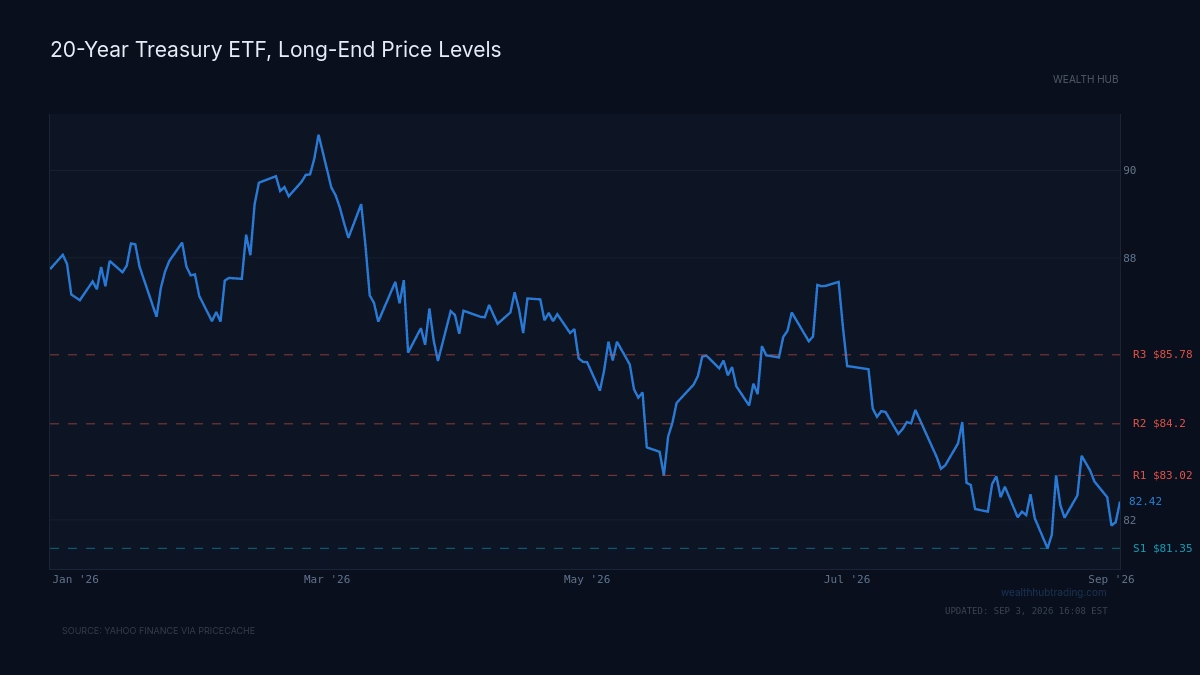
The United States enjoys the extraordinary privilege of issuing the world's reserve currency, which insulates it from much of the risk premium that punishes ordinary borrowers. Yet even there, the Treasury recently found long-term yields high enough that it leaned on shorter maturities to keep its interest bill down, refinancing into the front of the curve rather than paying up at the back. That is a tacit admission that the market is charging more for long duration than the issuer thinks is fair.
A government that quietly shortens the maturity of its debt to dodge the long end is doing the sovereign equivalent of rolling a mortgage onto a teaser rate. It works while it works. It concentrates rollover risk into a shorter window, and it leaves the borrower exposed if front-end rates rise or if appetite for the paper thins. Greece did a version of this in 2011. The parallel is uncomfortable precisely because the mechanism is identical, only the reserve-currency buffer differs in degree.
The UK Is Not Insulated
The reserve-currency shield is what makes the American numbers a floor, not a ceiling, for everyone else. The United Kingdom has no such shield. There is accumulating evidence that bond investors now demand a rising risk premium from heavily indebted sovereigns, and a country outside the reserve-currency club feels that premium in full.
The most striking illustration is that the UK has, on some measures, come to be treated by markets more like Italy than like a core issuer, a repricing set in motion by an episode of unfunded deficit spending under a previous government. The instructive detail is the political direction of that episode: it came from the right, not the left. Economic illiteracy on fiscal financing is bipartisan. The bond market does not read manifestos. It reads funding.
So while the Fed's four-basis-point estimate is a clean measurement for the US, the elasticity for a non-reserve issuer is plausibly steeper, because the term-premium component, the volatile part, is where a country without the dollar's privilege pays extra. This is the genuinely unverified link in the chain: no recent published study puts a precise number on the sensitivity of Gilt yields to UK deficit expectations the way the Fed paper does for Treasuries. The direction is well established; the magnitude for the UK is an inference, not a measured coefficient.
The Honest Counterargument
The strongest case against all of this is that the relationship is not mechanical and not always binding. Japan has run debt-to-GDP well above 200 percent for years while ten-year yields sat near zero, held down by a captive domestic investor base and central-bank purchases. The United States absorbed enormous deficits after 2008 and again in 2020 with yields falling, not rising, because the demand for safe assets overwhelmed the supply. The bond market, in other words, does not price fiscal expansion in isolation. It prices it against the demand for the paper, the credibility of the monetary regime, and the availability of alternatives.
That is a real qualification, and it is why "we are all in hock to the bond market" is a statement about elasticity, not about an ever-present cliff edge. The constraint tightens and slackens with confidence. The danger is not that the market punishes every deficit immediately. It is that the punishment, when it comes, is non-linear and arrives without warning, as the UK discovered in the space of days rather than quarters.
What Would Change the View
The view breaks if the term-premium channel stops responding to expected debt paths, if a sustained wave of safe-asset demand compresses yields even as issuance climbs, the way it did through the 2010s. That would signal the constraint has gone dormant again.
Until that shows up in the data, the cleaner reading holds. The observable condition to watch is duration behaviour: when a Treasury or a Debt Management Office starts systematically shortening the maturity of new issuance to suppress its reported interest bill, the market has already told the government its long-term borrowing is too expensive. The government is simply choosing not to say so out loud. That is the moment the "ignore the bond market" argument becomes most tempting to politicians and most dangerous to citizens, because the bill has not shrunk. It has only been moved somewhere harder to see.