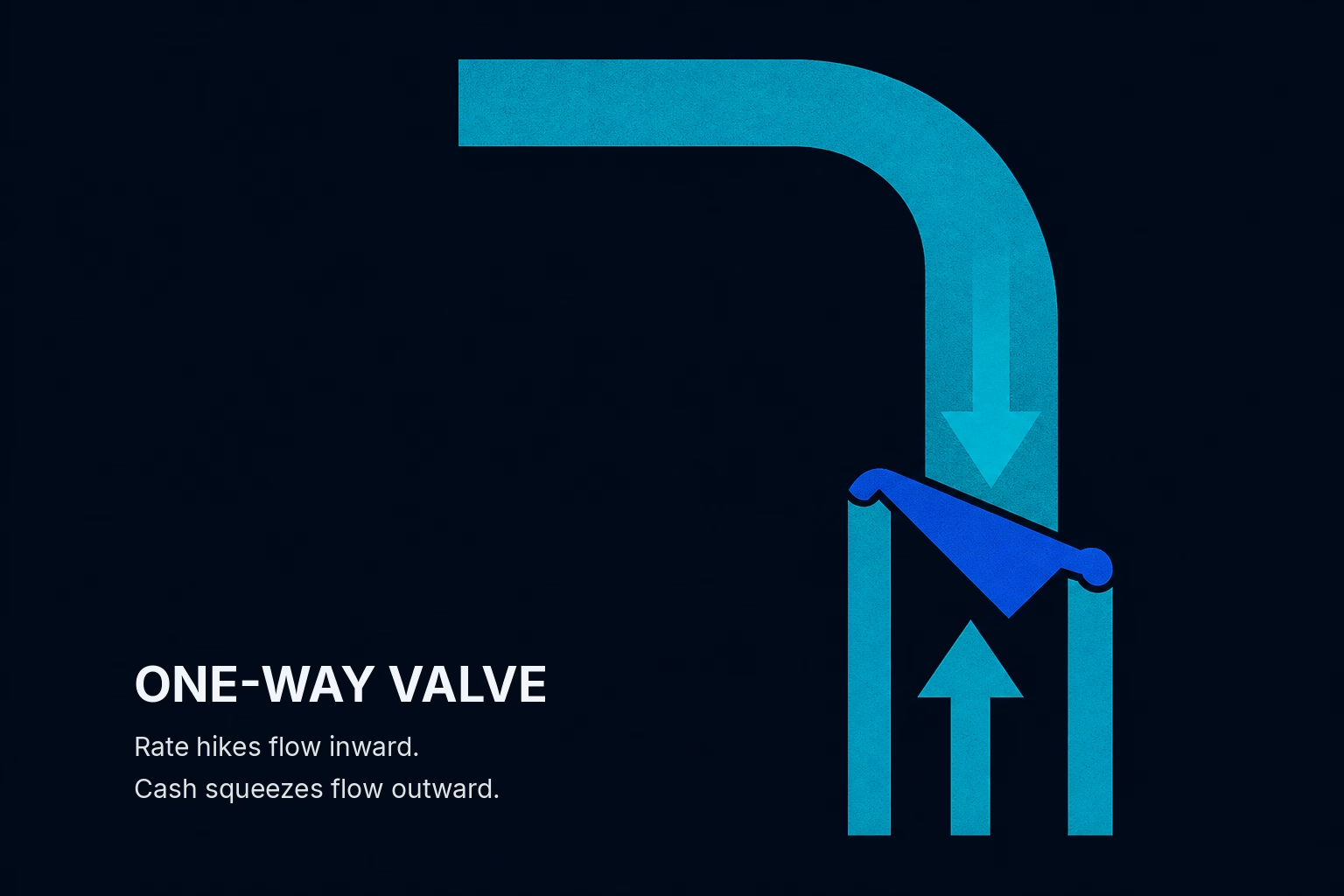
In September 2019, the fed funds rate did something it was not supposed to do. Overnight repo rates, the cost of borrowing cash against Treasury collateral, spiked from around 2% to nearly 10% intraday. The effective fed funds rate itself drifted above the top of the Fed's target range. For a few days, the plumbing of American short-term funding seized, and the New York Fed had to inject tens of billions of dollars to force rates back into line.
What made the episode so instructive was not the spike. It was how little the printed fed funds rate revealed until the pressure had already broken through. The rate looked calm right up until it did not. To understand why, you have to understand that the fed funds market most people imagine, banks lending each other reserves overnight, has largely stopped existing.
The market that used to clear itself
For most of the postwar era, the fed funds market was exactly what the textbooks described: an interbank market where banks with surplus reserves, meaning deposits held at the Federal Reserve, lent them overnight to banks that were short. Reserves were scarce and valuable. A bank ending the day below its required level had to borrow, and it paid a market-clearing price to do so.
That price was the fed funds rate, and it genuinely cleared supply against demand. When reserves were tight across the system, the rate rose. When they were plentiful, it fell. The Fed steered this rate by adjusting the total quantity of reserves, adding or draining small amounts through open-market operations to nudge the price toward its target. The rate was informative precisely because it was a real price set by real scarcity.
The practical implication then was straightforward: a rising fed funds rate told you funding was getting tight before the tightness showed up anywhere else.
Why the mechanism broke
Why did this stop working? Because after 2008, the Fed flooded the system with reserves and never fully drained them.
Through successive rounds of quantitative easing, the Fed bought bonds and paid for them by crediting banks with new reserves. Reserves went from scarce to superabundant, rising from roughly $10 billion before the crisis to several trillion dollars. When a resource is that abundant, its overnight price collapses toward zero, and no bank needs to borrow from another to meet a requirement it now clears by a wide margin.
This is the ample-reserves regime, and it forced the Fed to change how it sets rates entirely. Instead of adjusting the quantity of reserves to move a market price, the Fed now sets the price directly using administered rates, rates the Fed simply declares rather than discovers through trading.
Two administered rates do the work. Interest on reserve balances (IORB) is what the Fed pays banks on the reserves they hold. The overnight reverse repo rate (ON RRP) is what the Fed pays a broader set of institutions, including money market funds, to park cash with it overnight. Together they form a floor: no bank will lend reserves to another institution for less than the Fed itself will pay risk-free.
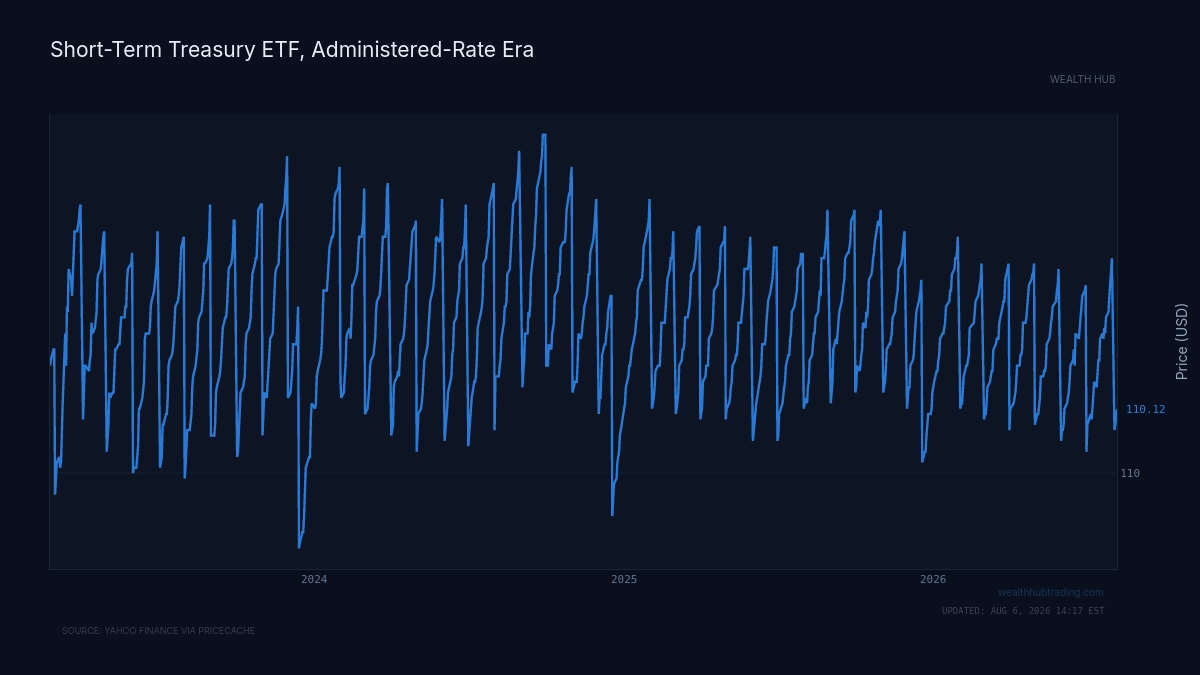
The practical implication is that the fed funds rate is now pinned inside a corridor the Fed defines, not discovered by banks trading with each other.
What actually clears in the fed funds market today
So what is left of the market? A small arbitrage corner, and understanding who trades in it explains why the printed rate has gone quiet.
The main lenders in today's fed funds market are not banks at all. They are the Federal Home Loan Banks (FHLBs), government-sponsored institutions that hold cash but are not eligible to earn IORB. Because they cannot collect the Fed's reserve rate directly, they lend their cash into the fed funds market instead, at a rate slightly below IORB. The main borrowers are commercial banks, often foreign bank branches, that take that cash and simply redeposit it at the Fed to earn IORB.
The trade is close to riskless. A bank borrows fed funds at, say, IORB minus a few basis points, deposits the same cash at the Fed, and pockets the tiny spread. The effective fed funds rate that gets printed each day is essentially the clearing price of this arbitrage, which is why it sits a hair below IORB and moves only when that spread moves.
Here is the part intuition gets wrong. Because this rate is set by an arbitrage against an administered floor rather than by banks scrambling for scarce reserves, it no longer rises when funding gets tight elsewhere. The stress in 2019 did not appear in fed funds first. It appeared in the repo market, where the actual scarcity was, and only bled into fed funds after the pressure had built for days. The fed funds rate was not measuring stress. It was measuring an arbitrage spread that the stress had not yet reached.
The practical implication is that watching the fed funds rate for signs of funding trouble is watching the wrong gauge.
Where the real signal now lives
If the printed rate says little, where does funding stress actually show up? In the collateralized markets, and in one Fed facility built to catch exactly this.
The Secured Overnight Financing Rate (SOFR) measures the cost of borrowing cash against Treasury collateral in the repo market. This is where the largest volume of overnight funding actually trades, and it is where scarcity of cash, or of specific collateral, pushes rates up first. When SOFR jumps relative to the administered rates, real funding pressure is building. That is the number that spiked in September 2019 while fed funds stayed calm.
The Fed responded to that episode by building the Standing Repo Facility (SRF), which lets eligible institutions borrow cash from the Fed against Treasuries at a fixed rate whenever they want. The SRF is designed to cap repo spikes by giving the market a reliable backstop lender. The telling signal is not the SRF's rate, which is fixed, but its usage. When institutions start drawing on it in size, they are telling you private repo funding has gotten expensive enough that borrowing from the Fed is now the cheaper option.
There is a mirror image on the other side. Heavy use of the ON RRP facility means institutions have more cash than they can profitably deploy, so they are parking it at the Fed rather than lending it out. Falling ON RRP balances, by contrast, mean that surplus cash is draining out of the system and reserves are tightening back toward scarcity, the condition under which a fed funds rate might one day mean something again.
The practical implication is concrete: to read overnight funding conditions, watch the SOFR spread over IORB, SRF usage, and ON RRP balances, not the fed funds print that headlines still quote.
The one thing to carry away
The fed funds rate survived as a headline number long after the market that gave it meaning dissolved into a small arbitrage against the Fed's own administered floor, which is why it now reports policy intent rather than funding stress. If you want to know whether the plumbing is under pressure, the honest gauges are the collateralized markets and the Fed's facility usage, because that is where scarcity now clears, and scarcity is the only thing a price can truly measure.