Anthropic's S-1 does not describe a company whose compute bill is driven by customers. It describes a research lab funded by a small, highly profitable serving business. According to Note 8 on page F-39, cost of revenue, which management calls "substantially all" compute serving paying customers, was just 27% of the compute bill in the first half of 2026. That share was 44% in 1H'25 and 35% in 2H'25. Over the same eighteen months, revenue per dollar of serving compute rose from $0.51 in 2024 to $1.65 in 2025, then to $6.84 in 1H'26.
The common intuition says inference is the compute sink and training is a one-off cost. The filing shows the reverse. Serving produced almost all of the revenue growth while consuming a shrinking share of the fleet. The roughly 73% of compute that does not serve paying customers goes to research, training and the free tier. That share is the real underwriting variable for an IPO priced between $1.5 and $2 trillion.
Note 8 and the Fleet That Doesn't Serve Customers
Note 8 recasts costs by function, and the figures that matter come in pairs. In 1H'26, revenue grew about 14x year over year, while the compute serving that revenue grew only about 2.3x. Inference margins at this scale are very high. A small fraction of new capacity carried the whole top line.
The MBI Deep Dives model, built around a single question, cuts its 2030 serving-share assumption because of this. The question is what has to be true for an IPO buyer at $1.5 trillion to earn a 10% IRR if Anthropic is valued in 2030 like today's hyperscalers. The model's author had planned for the serving share to rise to 45% by 2030. After reading the S-1, the assumption is 38%, and the author wonders openly whether even that is too high. Working backwards, the 10% hurdle requires about $92 billion of GAAP operating income in 2030 after dilution.
The fleet behind that number is large. The S-1 discloses about $800 billion of compute commitments. Matched against partner announcements, that implies roughly 15 gigawatts by the end of 2028. If 62% or more of those watts are pointed at research, the investment case depends less on how fast customers adopt Claude and more on what the research watts produce. The open question is whether that research spend is optional.
Revenue With a Six-Month Shelf Life
The S-1 answers part of that question, though not where readers would look first. One sentence matters more than anything in the risk factors: model versions released in the six months ended September 30, 2026 accounted for over 80% of revenue in the September quarter.
The implication is that Anthropic's product works more like inventory with a short shelf life than like a software franchise. The revenue base largely turns over every two quarters. Each new release is how the company keeps it. Training is the cost of restocking, not an R&D line management could trim in a weak year without hurting revenue.
The pricing disclosures support this reading. When Claude Fable 5.1 launched in September 2026, the company cut the cost of typical workloads by about 25% versus Fable 5, and by up to 45% on complex coding and agentic tasks. Opus 5.5, released the same month, cut cost per task by about 40% versus Opus 5. Management says these cuts mixed lower prices with efficiency gains and that margins held. The new model is the cost reduction. A lab that stopped training would not get to keep its old prices. Competitors would ship the next generation, and the deflation would land on someone else's terms.
This is also why distillation worries the frontier labs. If tens of billions of cumulative research spend can be copied cheaply by labs further behind, then the six-month shelf life is the only real protection. The protection lasts only as long as the restocking continues.
Who Pays for the Frontier
The mechanism reaches the financials through a split between token share and revenue share. In the model, like-for-like token prices fall nearly a quarter per year. That rate is anchored to public price lists: Gemini 4 Argon at $4/$20 against the $10/$50 that Fable 5.1 and GPT-6 Astra share, Meta's Muse Wonder priced at Opus parity, and open-weight Kimi K3 at $3/$15. Opus and Sonnet prices fall about 25% a year, on the expectation that sub-frontier models will handle most of today's coding and knowledge work by 2030.
The frontier tiers, meaning Fable and a Mythos-class successor, end up with only about a sixth of tokens by 2030. Because they are priced at roughly 2.5x Opus, that sixth produces close to half of revenue: about $77 billion in 2028 and about $200 billion in 2030. By 2030, that frontier revenue exceeds the research compute budget. A narrow slice of traffic, bought by customers who pay to be at the frontier, funds the next training run.
This is the weakest link in the chain, and the model's author says so. The S-1 does not disclose tokens, prices or revenue by model, so the frontier-tier split is an outside estimate, not a reported figure. The buyer base is also uncertain. Concentration is falling: 79% of 3Q'26 revenue came from outside the top five customers, up from 64% in 1Q'26. But the source analysis is fairly confident that Meta was the largest customer. Meta is also building its own frontier model, and it is unlikely to keep paying for both through 2030. The likely current frontier buyers are hyperscalers embedding Claude in their products and labs benchmarking against it. Both groups are expected to leave.
By construction, $200 billion of 2030 frontier revenue must come from work the tier below cannot do. That could mean longer-running autonomous agents. It could mean discovery work in medicine, which per-token pricing does not capture well. The model assumes this demand appears, but nobody can yet name the product. Read that way, a forecast that looks conservative on revenue per gigawatt is aggressive on demand composition. Blended revenue per serving gigawatt falls from about $65 billion to about $48 billion. That fall requires a whole new category of work to absorb the frontier tier.
The subscription business adds a second layer of uncertainty. Subscriptions were 20% of 1H'26 revenue. Outside estimates have them using about 40% of serving compute, which implies roughly $34 billion of revenue per gigawatt-year for subscriptions versus $84 billion for the API. That subsidy seems to be shrinking. Anthropic did not raise Fable limits after its last price cut, and outside models put Fable subscriptions near 80% gross margin versus about 6% for Opus.
Four Ways the Hyperscalers Get Paid
The cost side has its own counterintuitive result. Owning compute is not cheaper than renting it within the forecast window. The $161 billion of Broadcom rent works out to about $36 billion of hardware per gigawatt. Amortized over five-year leases, plus facility, power and interest, an Anthropic Direct gigawatt-year costs about $10.5 billion. Partner clouds (Trainium, TPUs, Azure) cost about $8 to $9 billion. SpaceX's Colossus 1 runs about $50 billion per gigawatt-year based on that company's own prospectus. Most hyperscaler capacity was locked in between November 2025 and April 2026, before the shortage pushed Anthropic to pay six times that rate for capacity available immediately.
The low cloud rates are not a discount. They are one of four revenue streams the hyperscalers take from the same customer:
- Training: minimum commitments of $110 billion to Amazon, $114.5 billion to Google and $44.9 billion to Microsoft, payable "regardless of actual usage."
- Serving: 48% of 1H'26 revenue was billed through Bedrock, Google's agent platform and Foundry, on compute bought from those same clouds.
- Distribution: a marketplace fee booked in sales and marketing, now about 35% of marketplace revenue, up from about 16% in 2025.
- Equity: Amazon's convertible notes carried $6.2 billion of principal at a $108.6 billion fair value at end-June. Their revaluation drove most of the $72.4 billion fair-value loss in 1H'26. Google can own up to 14.99% and holds an option to buy another $10 billion of stock at the IPO price.
The largest line item in Anthropic's income statement this year is a gain for Amazon. Anthropic Direct makes more sense as an effort to reduce dependence on the hyperscalers than as a cost play. Its savings show up only against expensive spot capacity, and after the leases are paid off, which is after 2030.
Timing matters for margins as well. Compute is contracted 12 to 18 months ahead and expensed when it arrives. In 2027, Anthropic pays for both SpaceX capacity and the first roughly $96 billion of Direct hardware before the matching revenue arrives. Management's MD&A warns that margins will "fluctuate from period to period, at times meaningfully." The model shows Anthropic profitable on an adjusted basis in 2026 and loss-making in 2027. It then reaches 25% to 27% adjusted operating margins, or 20% to 22% after stock compensation, which is how it gets to about $92 billion of GAAP operating income in 2030.
The Borrowed Multiple and the Case Against
The exit assumption is about 25x trailing operating income, taken from Meta, Alphabet, Microsoft and Amazon, which trade between roughly 18x and 30x. Three of those four earn operating margins well above the 20% to 22% GAAP margin modeled for Anthropic. Their multiples also reflect businesses that do not need to replace most of their revenue every six months.
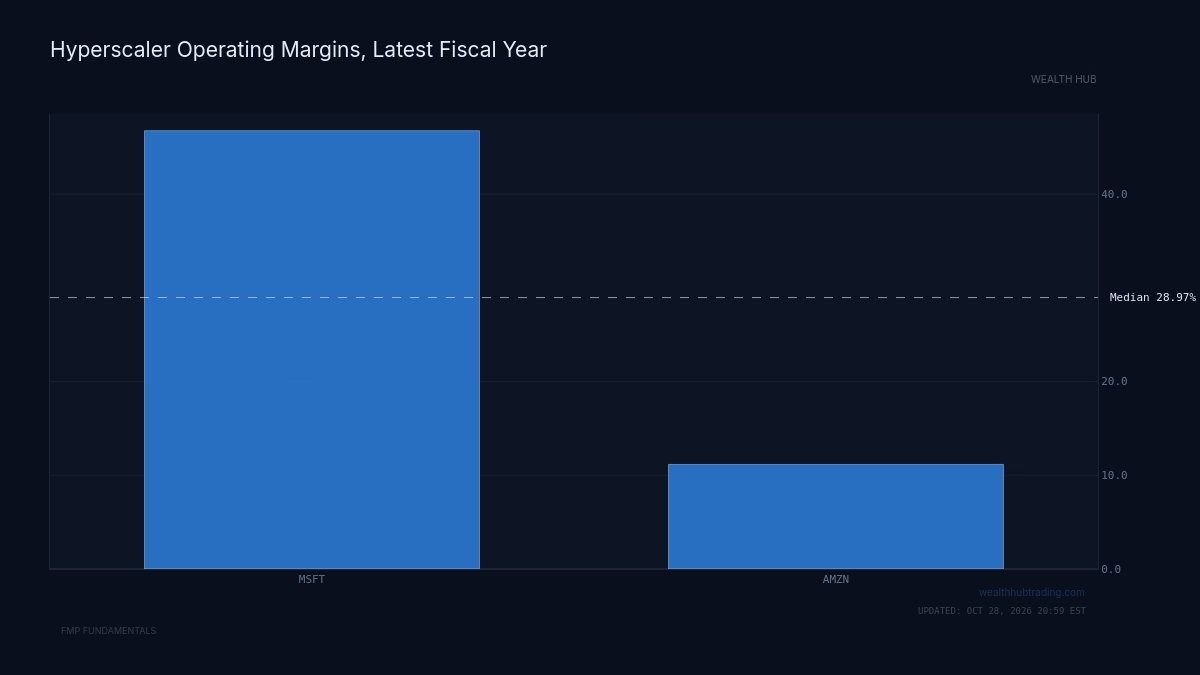
The strongest counterargument says this framing is too cautious. In the flywheel view, the research fleet is the core investment, not a cost of staying in the race. Each generation makes every existing unit of compute more productive. The lab that earns the highest return per watt can outbid rivals for the next watt, which widens its lead. The S-1 gives this view real support: cost per task falls 25% to 40% per release with margins intact, and serving productivity rose roughly fourfold in a year. If the loop holds, 25x is too low, because a compounding cost advantage deserves a higher multiple than a hyperscaler cohort with slowing growth.
The flywheel has a structural weakness. It works for one lab. If OpenAI, Alphabet and Meta each need a similar amount of frontier revenue to justify their own research fleets, then the $200 billion question becomes several hundred billion dollars of frontier demand, unless Anthropic holds a near-monopoly at the frontier. That outcome also depends on distillation failing, which is far from certain.
What Would Settle Race, Choice or Flywheel
The three readings make different predictions, and the coming filings can test them.
If research is a choice, the paid serving share should stabilize or rise once Direct capacity arrives, and margins after 2027 should beat the model. There would be a large lever to pull, and roughly $420 billion of non-serving compute through 2030 would be discretionary spending.
If it is a race, frontier pricing should converge toward the $4/$20 tier that Gemini 4 Argon is pushing. The frontier share of revenue would shrink, and the research fleet would become a defensive cost with poor returns on capital.
If it is a flywheel, frontier-tier revenue should grow faster than the research budget well before 2030. Customer concentration should keep falling even as hyperscaler and lab buyers move to their own models.
The disclosure to watch each quarter is the Note 8 ratio together with the top-five customer share. A serving share that keeps falling while revenue concentration also falls points to the flywheel. A serving share that keeps falling while concentration stalls points to a race financed by public shareholders. At $1.5 trillion, the IPO price assumes the flywheel without having verified it.