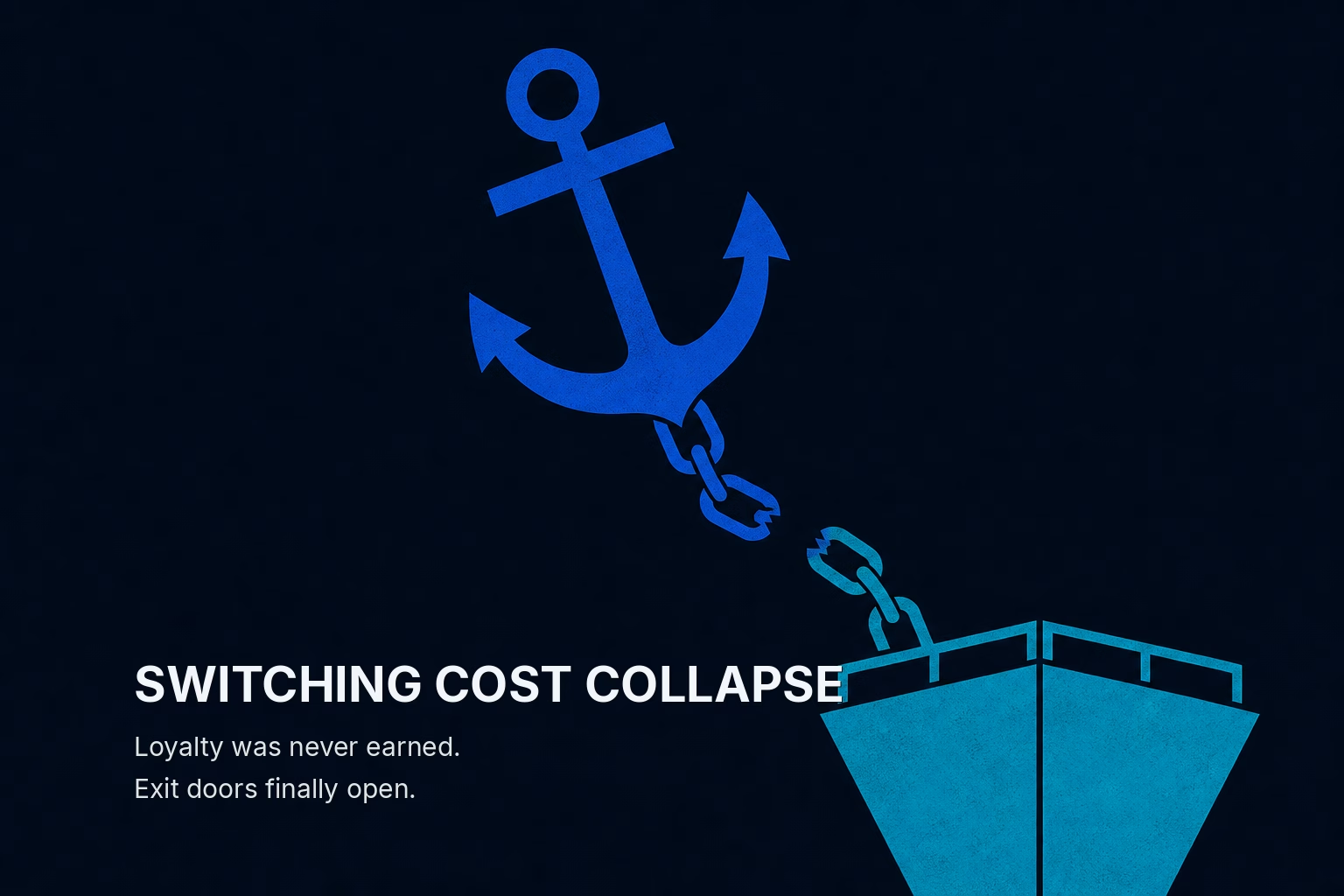
The market is treating Expedia's early embrace of consumer agents as a smart partnership. The more accurate reading is that it is the first defection in a prisoner's dilemma, and its likely endpoint is the scenario a 15x earnings multiple does not price: the online travel agencies losing control of the customer while still doing the work of serving them. The three threads that keep resurfacing in hands-on use of these agents look like separate issues. They are one mechanism. Agents with looser guardrails make blocking futile. Futile blocking pushes merchants to cooperate. Cooperation hands the consumer relationship to the agent. Online travel is where that chain is shortest and where valuations show the least concern.
The evidence comes from the field rather than from filings. Yet Another Value Blog, which has been testing Muse and Claude Cowork daily, describes a practical gap between the two that most model-benchmark coverage misses. That gap matters for the OTA debate.
Guardrails Are a Pricing Decision
Claude refuses to click through "confirm you're human" checks. It also resisted summarizing a paid Substack the user subscribed to, citing copyright, and gave in only after an argument. Muse either attempts the CAPTCHA automatically or asks whether it should try to get past the website. Asked to compile the same Substack timeline, it simply did the task.
Commentators tend to treat this as a story about lab culture. For the businesses on the receiving end, it works more like a pricing decision. A lab that relaxes its guardrails gains share because its product completes more tasks. By the blogger's account, Muse is winning users on ease of use and willingness to try anything, not on model quality. Once that becomes a visible route to share, every lab competing for an existential prize faces the same pressure. If one lab loosens its standards, the others have to follow or accept losing users.
The second-order effect is the one that matters for equities. A merchant's ability to keep agents out depends on the agents respecting the barriers. An agent that offers to take over the user's browser and act as the user cannot be reliably shut out. The source reports that Muse increasingly responds to a blocked site by offering exactly that. The ethics race between labs therefore sets the terms of a second game between merchants.
Why Blocking Agents Fails as a Strategy
Amazon banned Muse almost immediately after launch, and the blogger has the impression that more sites are following. That impression is self-reported and unquantified, so it should be treated as directional only. The reasoning behind the bans is sound: an agent that searches the whole web and buys from the cheapest seller turns a destination retailer into an anonymous supplier.
The trap is structural. If every competitor in a category blocks agents, then any single competitor can capture outsized short-term volume by becoming the agent's preferred partner. Macy's is the clearest retail case. An agent shopping for undershirts has no reason to stop at macys.com, so cooperating speeds up a decline that is already underway. If every other department store holds the line, though, the first one to open its doors gets a final windfall. Each player is better off defecting, and once enough defect, all of them end up worse off.
Two forces push toward the same outcome. Agents may simply get around the blocks, which the guardrail race makes more likely. A competitor may defect deliberately. In either case the long-run equilibrium is cooperation on the agent's terms. Blocking buys time. It does not secure a future.
Expedia Took the Deal
Online travel has already played out the theory. Expedia has integrated with Muse. Over the past month, as consumer agents gained traction, EXPE outperformed BKNG by a wide margin, according to the blogger's fiscal.ai comparison. One month of relative performance between two stocks proves very little about causation. It is, however, the pattern you would expect if the market were paying the defector its short-term reward.
That reward is real and is worth stating plainly. An OTA that becomes the default booking engine for a fast-growing agent picks up incremental room nights it would not otherwise get, possibly at the expense of Booking. Over a few quarters that can show up as share gains, and a stock that rises on share gains is behaving rationally.
What the market appears to be skipping is what the integration does to the shape of the business. Inside an agent, Expedia stops being the place the traveler starts. It becomes a fulfillment layer that the agent queries, compares and can replace. The agent sees every alternative price and has no brand loyalty to any of them. Expedia's integration resembles the cable bundle licensing content to Netflix: it earns license revenue today and gives up the customer relationship that set the pricing of that revenue. The blogger cites Starz and the cable networks as the case study. Content kept its value. Control of the subscriber moved to Netflix, and the economics followed.
What Fifteen Times Earnings Assumes
Both Booking and Expedia trade at roughly 15x earnings, and Expedia's stock is about flat for the year. For a business growing in the mid-to-high single digits, the blogger estimates that around 80% of discounted cash flow value comes after year five. The figure depends heavily on assumptions about growth, reinvestment and discount rate, and he presents it as a ballpark rather than a precise result. The ballpark is sufficient for the argument. At this multiple the investor is not paying for 2026 earnings. The investor is paying for whether 2031 and later look like today.
Set that against what the agent builders say publicly. In podcast interviews with the Muse and Instinct teams, the first use cases mentioned are cutting subscriptions and booking travel. Travel is not a niche application for these products. It is the flagship demo, backed by companies spending billions on development. The OTA multiple implies terminal cash flows that last and hold their margins. The agent roadmap is aimed squarely at those cash flows.
Two things cannot both hold for long: an industry whose most-funded new entrant names it as the first target, and stocks that show no sign of a shortened duration. A multiple in the mid-teens is not distressed. It is also far from the multiple of a business whose terminal value is in question.

The Bull Case Worth Respecting
The long case is not naive, and its strongest point is not the one OTA bulls usually make first.
The familiar arguments hold some weight. Booking in particular has spent years building relationships with a long tail of independent European hotels, and agents cannot easily replicate that supply. Booking habits are sticky. OTAs keep only a modest share of the value they create. Google Flights and many other meta-search challengers never broke the OTA position. Today, booking a simple trip through an agent takes more back-and-forth than booking it directly on Expedia.
The more serious point is data. Booking and Expedia hold billions of historical interactions on what travelers search for, abandon and pay. If AI turns that history into a better recommendation and pricing engine, the disruption could become a moat. The supply-side version is also plausible. Agents may need an aggregated, contracted inventory layer and may end up as the OTAs' best distribution channel.
This is the fact that could break the short thesis. If agents depend on OTA inventory, and the dependence is strong enough that OTAs keep their take rates, then the integration is a distribution win and Expedia's outperformance is the correct read.
The weakness in that rebuttal is who sets the price. An inventory layer serving an agent that compares Booking, Expedia, hotel direct sites and anything else it can access is a wholesale business. Wholesale suppliers sometimes earn good returns, but they rarely earn the returns of the company that owns the customer. The bull case explains why OTAs survive. It does not explain why they keep their current economics, and at 15x the asymmetry favors the downside. The blogger's broader footnote supports this: taken to its end, agents that constantly compare and negotiate are deflationary for almost every consumer-facing margin. Travel just has the shortest path.
The Disclosure That Settles It
The read changes if Booking also integrates with the major agents and take rates hold through the following quarters. That would show the inventory layer has pricing power and that defection does not erode margins. The read is confirmed if the gain from Expedia's integration shows up in volume while revenue per booking or marketing efficiency weakens, meaning the business is buying share at wholesale prices.
The most useful data point is one neither company currently reports: the share of bookings that originate in third-party agents rather than in OTA apps and direct traffic. Once management starts disclosing it, or an analyst forces the question on an earnings call, the market will have to price the shift in customer control instead of looking past it. Until then, a sector named as the first target of a well-funded new channel, trading on cash flows that are mostly five years out, is the clearest mispricing in the consumer agent debate. The short is obvious, and the market has not yet acted on it.