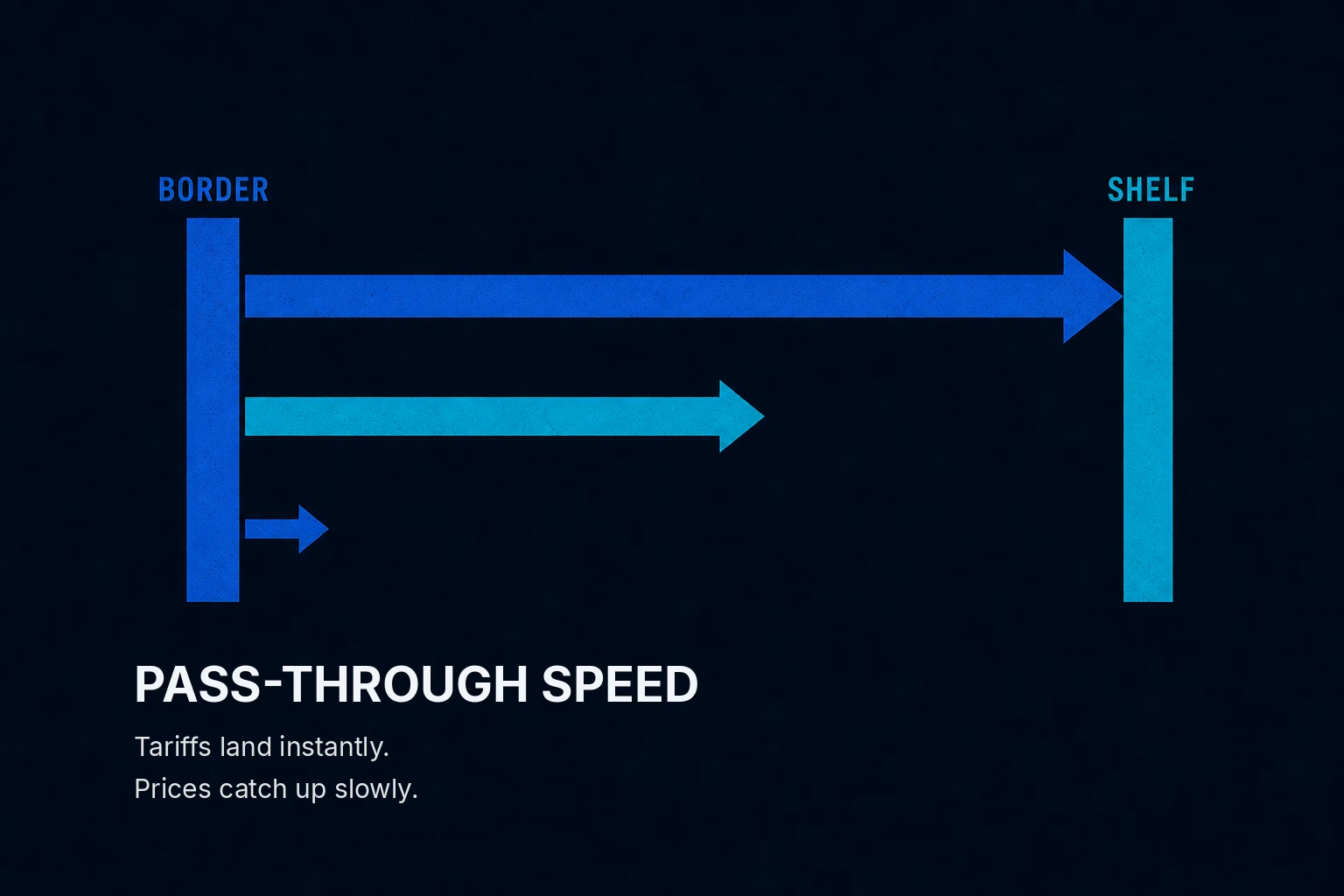
The tariff inflation impulse is already over, but the tariff price level is not, and the part that lingers longest sits on goods made in the United States. New research from Mary Amiti and Sebastian Heise of the New York Fed and David Weinstein of Columbia finds that the contribution of the 2025-26 tariffs to twelve-month consumer goods inflation peaked at 2.9 percentage points in February 2026. Their forecast has that contribution near zero by August 2026 and negative after that. The mechanism behind the timing matters more than the headline. Import prices move within a month. Domestic producer prices take six to twelve months. When tariffs are cut, the fast channel unwinds first and the slow channel stays put. Tariff relief therefore leaves domestic producers' price increases largely in place while it unwinds the import-price increases quickly.
Ninety Percent at the Border, a Quarter at the Register
The two most quoted tariff numbers seem to contradict each other. Earlier work by the same authors, confirmed here with data through February 2026, found that roughly 90 percent of the 2025 tariffs passed through to U.S. import prices. Foreign exporters barely cut their prices. The result holds after accounting for the dollar's depreciation over the period, which raised import prices on its own. Yet the paper's summary figure is that each percentage point of average tariff raises consumer goods prices by only about a quarter of a percent after a year.
Both numbers are correct. They measure different points in the chain. The 90 percent describes what happens at the dock: an importer pays almost the full tariff, and pays it immediately, with import prices rising nearly one for one in the first month after a tariff increase. The quarter describes what the consumer sees once three filters have been applied.
The first filter is that only part of the consumer goods basket is imported. The second is that the retail price contains far more than the border price. The third is time. In the authors' scenario of a 10 percent tariff on all imports, consumer goods prices end up 2.6 percent higher after twelve months. Two-thirds of that comes directly from pricier imported consumer goods. The remaining third comes from domestic goods.
A common misreading takes the 90 percent figure and assumes the shelf price follows one for one. That overstates the consumer effect by roughly a factor of four. The opposite misreading takes the quarter and concludes foreigners are paying most of the tariff. That gets the incidence backwards. Americans are paying nearly all of it. The rest of the gap comes from the size of the domestic distribution margin and from the share of goods that are not imported.
The Distribution Margin as a Shock Absorber
The step that most readers skip is the one between the factory gate and the register. Distribution costs, meaning transportation, wholesaling and retailing, account for about half of what consumers pay for goods. The authors estimate that a 10 percent tariff-driven increase in import and producer prices raises retail prices by 5.6 percent.
Their worked example makes the arithmetic plain. A good retails for $100, with $50 for the border or factory price and $50 for distribution. A 10 percent rise in the upstream price takes it to $55. If the distribution margin stays at $50 in dollar terms, the retail price becomes $105, a 5 percent increase. The measured 5.6 percent is slightly above that benchmark, which suggests distributors add a little on top rather than absorbing any of the cost.
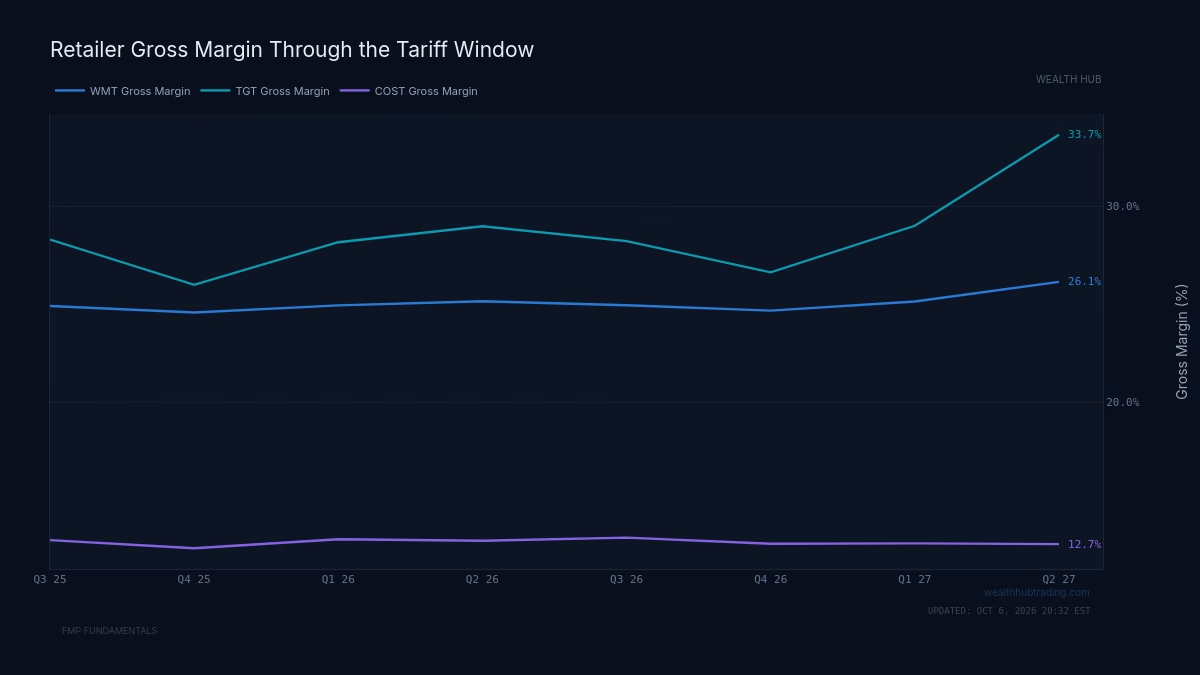
This is the useful insight for anyone reading retailer results. The pass-through estimate implies that retailers roughly preserve their dollar markup and pass the tariff on. In accounting terms, a constant dollar margin on a higher cost base means the gross margin percentage compresses mechanically even when the retailer has absorbed nothing. Margin-percentage slippage during a tariff episode is therefore weak evidence that retailers are "eating" tariffs. The 5.6 percent figure points the other way. The chart below lets the reader check that implication against reported gross margins at large U.S. general merchandisers. We do not cite specific margin values here, and company-level margins move for many reasons besides tariffs, so the comparison is a test of consistency rather than proof.
Retailer timing also matters. The authors find that about half of the direct effect reaches consumer prices after three months and all of it by six months, as retailers take a few months to reprice. The border reacts in a month. The shelf takes a quarter to two quarters.
The Untaxed Third
The less intuitive finding is that tariffs raise the prices of goods that are not tariffed at all. Domestic producers raise factory-gate prices through two channels. The marginal cost channel works through imported inputs: a steel tariff raises the cost of building a car in Ohio. The strategic complementarity channel works through competition: when imported substitutes get more expensive, U.S. producers face less pressure to hold their own prices down, so they widen markups. The authors find both channels operate, and the cost channel is the larger one.
These channels are slow. U.S. producer prices rise only a little in the first six months after a tariff increase, then roughly double over the following six. At the retail level, the indirect effect more than doubles between month six and month twelve. By February 2026, the indirect channels made up about 30 percent of the total tariff effect on consumer goods prices.
This changes how the tariff should be understood as a policy instrument. A third of the consumer cost does not show up as customs revenue. It shows up as higher revenue for domestic producers, part of it covering higher input costs and part of it widened markups. A household buying a domestically assembled appliance pays a tariff-related premium that never reaches the Treasury.
Why Tariff Relief Arrives Lopsided
The difference in speed between the two channels creates an asymmetry in the forecast. In early 2026, a Supreme Court ruling ended the tariffs imposed under emergency powers, and a lower 10 percent surcharge replaced them. The authors project the tariff effect on the goods price level easing from its peak near 3 percent to about 2 percent by August 2026.
Nearly all of that decline comes from the direct channel. Import prices fell back about as fast as they had risen. The indirect effect proved far more persistent, because domestic producer prices adjust slowly in both directions. A factory that raised prices in response to higher steel costs, or that widened its markup when foreign rivals became more expensive, has little reason to rush a price cut. The cost relief comes through its own slow supply chain, and the competitive pressure comes back only gradually.
From there the level edges up again. About half of the rise reflects tariffs already in effect, mainly the August 2026 tariffs on Canadian goods, which are still passing through. The other half reflects the tariff increase on Canadian cars, trucks and auto parts announced for January 2027. The auto sector is a natural test case for the slow channel, because North American vehicle production runs on cross-border parts flows. The forecast attributes the late-2026 increase to these specific measures. Our reading that autos will show the indirect channel most clearly is an inference, not something the paper quantifies by sector.
The broader lesson: a tariff episode that is partly reversed can leave domestic prices higher than a simple reading of the tariff schedule implies. Partial reversals sometimes leave the slow channel in place long after the headline rate has come down. This is a pattern to test in this episode, not a rule.
Where the Estimate Could Mislead
The strongest objection concerns what the method can and cannot see. The estimates come from comparing 67 non-oil consumer goods categories with more tariff exposure against those with less. That design separates tariff effects from common price movements. It cannot measure how tariffs affected the common movements themselves: exchange rates, wages, demand and monetary policy are held fixed. If tariffs weakened the dollar, the 2.9 point figure leaves out part of the true effect. If tariffs dampened demand or prompted tighter policy, the true net effect could be smaller. The authors say this directly, and the uncertainty runs in both directions.
The sample also excludes services, which make up about two-thirds of the consumer basket. The 2.9 point peak applies to non-oil consumer goods, not headline inflation. A rough scaling by basket weight suggests a much smaller headline contribution. That is our arithmetic, and it ignores any tariff effects on services inputs.
Finally, the counterfactual is striking: without tariffs, the authors estimate goods prices would have fallen slightly by February 2026, consistent with the mildly negative pre-COVID norm for goods inflation. Goods inflation had started to edge up in late 2024, before the new tariffs. The method attributes the 2025 acceleration to tariffs, but the late-2024 upturn shows that other forces were also at work, and a cross-sectional design is not built to separate them fully.
Reading the Base Effect Into 2027
The forecast's most practical implication is that goods inflation will soon give a misleading signal. As the large 2025 increases drop out of the twelve-month comparison, the tariff contribution turns negative in late 2026, before turning slightly positive by mid-2027 as the Canadian measures pass through. A soft goods inflation reading over that period is in part an arithmetic effect of the year-over-year comparison. It should not be read on its own as weakening demand or as tariffs being reversed.
Meanwhile the price level remains about 2 percent higher than it would otherwise be, with the persistent part concentrated in domestically produced goods. The variable that would change this view is domestic producer prices for tariff-exposed categories. If they fall back as quickly as import prices did after the 2026 cut, the slow channel is less persistent than the model assumes. If they hold firm while import prices retreat, the untaxed third is doing what this research says it does: keeping prices high after the tariffs that caused them have been reduced.