The finance industry's most durable asset is not its balance sheet. It is customer inertia, and an AI agent that shops your car insurance while you slee...
That is the read worth holding onto here, and it matters more now precisely because of where rates sit. When the 10-year yields 5.18% and the 2s10s curve is positive at +0.31%, the cost of NOT switching a deposit, a policy, or a loan is the highest it has been in a generation. Automating the switch turns a latent cost into a realized one, at scale, without the human friction that has always saved incumbents from their own pricing.
Meta's Muse and the smaller Spear Street Instinct are not the story. What they expose is the story: a rate environment that has widened the gap between the price a loyal customer pays and the price a shopping customer could get, at the exact moment the friction of shopping collapses toward zero.
Why the Rate Backdrop Turns Inertia Into a Liability
Start with the arithmetic that incumbents would rather you not run. With the 2Y at 4.87% and the 10Y at 5.18%, money-market and high-yield savings rates are elevated, while the average retail deposit still earns a fraction of that. That spread, the difference between what a bank pays a sticky depositor and what it could pay if that depositor moved, is the single largest source of net interest margin at a consumer bank. It exists because moving money is annoying, and most people don't.
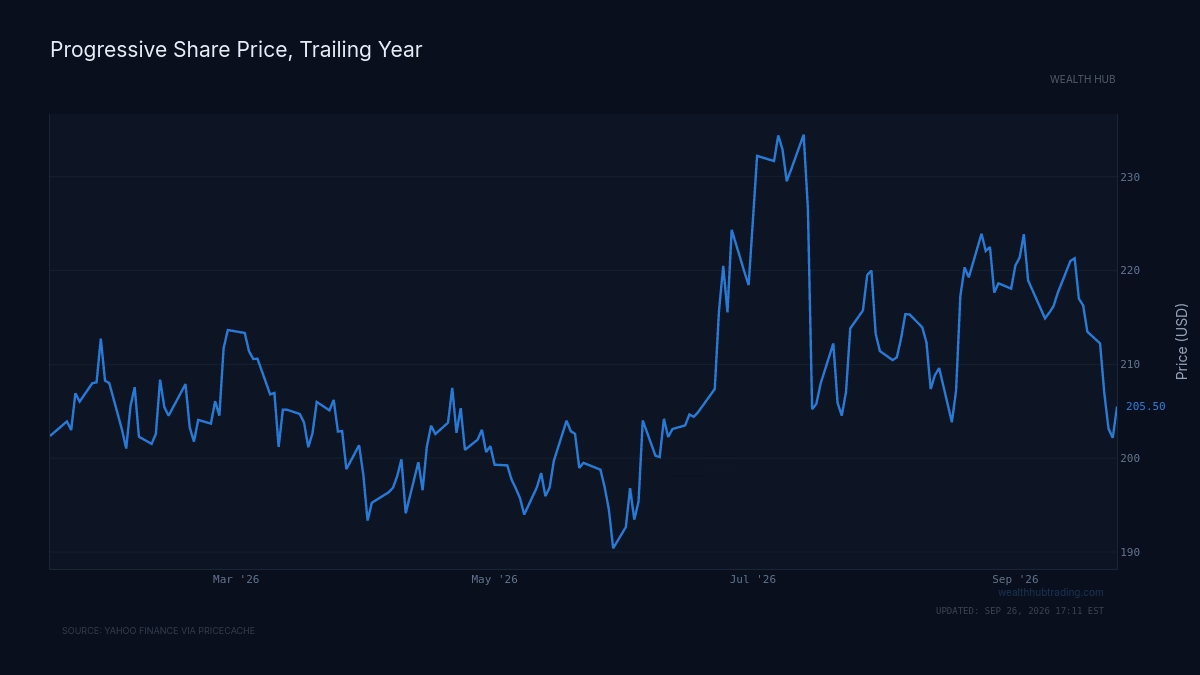
Insurance runs the same play in a different currency. The renewal premium is set on the assumption you won't re-shop. One driver reported saving $3,500 a year by having an agent gather quotes and execute a switch from Liberty Mutual to Progressive; the new policy matched the old terms, so the only thing that changed was the price he was willing to tolerate. Aggregators could always have surfaced that quote. What they couldn't do was carry the customer through the friction of actually leaving. An agent that fills the forms, calls the carriers, and automates the cancellation does exactly that.
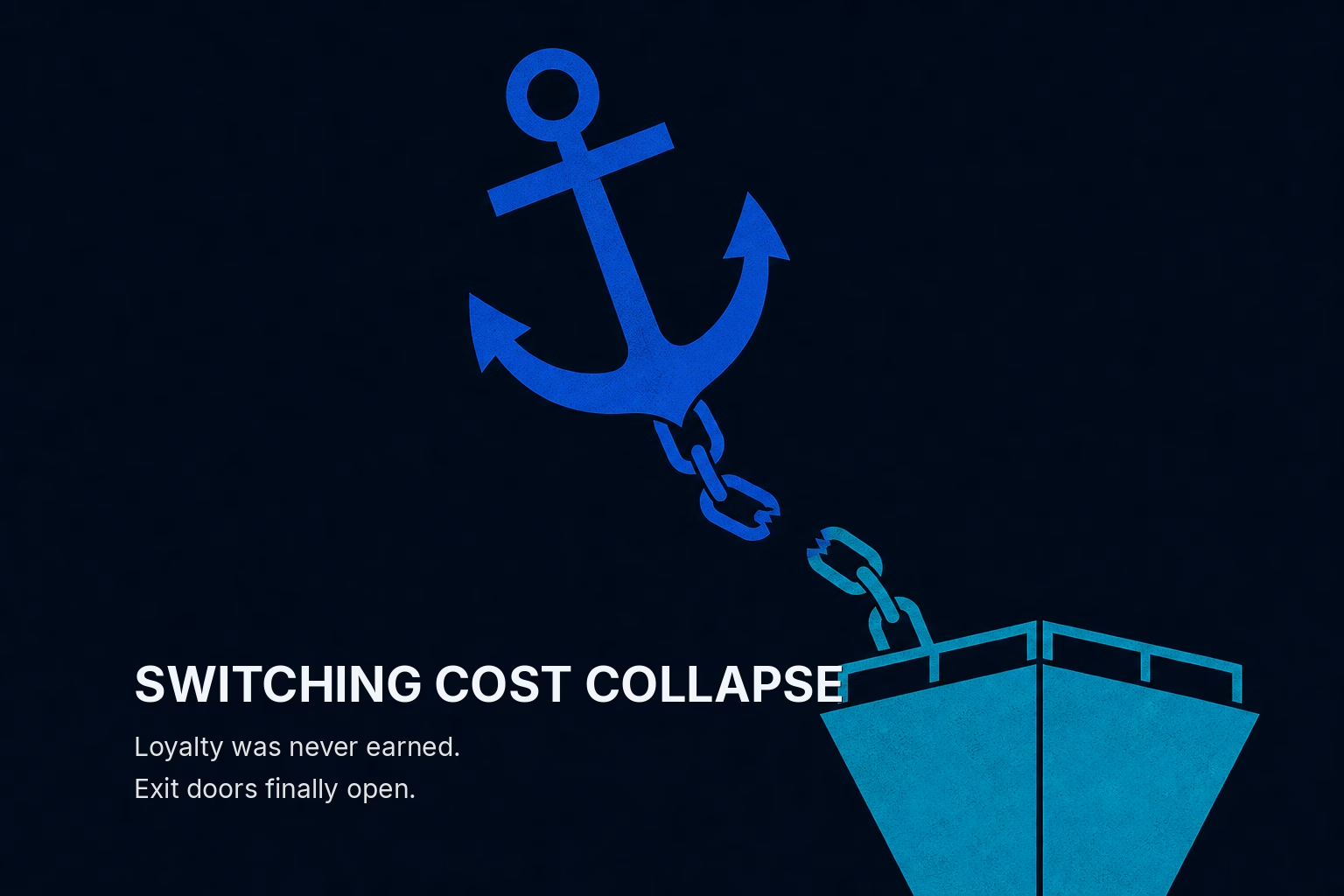
The mechanism is straightforward: high rates raise the dollar value of every switch, and agents drive the cost of switching toward zero. Those two lines were never supposed to cross. When they do, the margin that lived in the gap between them starts to leak.
Where the Damage Concentrates First
Not every financial business is equally exposed, and the lens here is which balance-sheet lines are propped up by friction rather than by a real advantage.
The most exposed are the businesses whose profitability is a direct tax on inaction. Auto and home insurance carriers who lean on renewal complacency sit at the front. So do consumer banks running large low-yield deposit books, where the whole model assumes depositors won't chase the money-market rate that a 5%-plus front end now dangles in front of them. Retail brokerage cash sweeps, credit-card balances that persist because refinancing is a chore, and standard-term personal loans all belong on the same list.
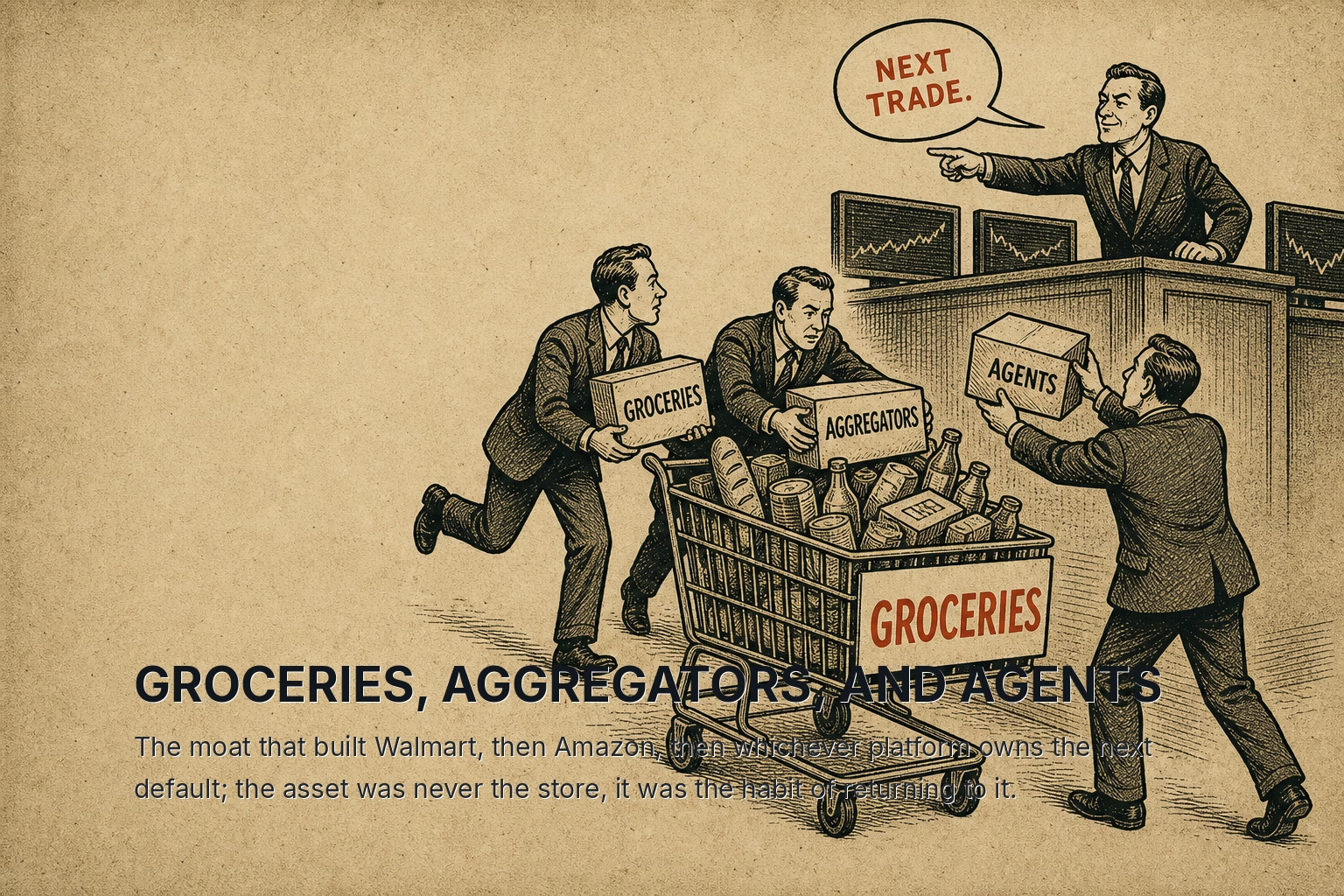
The businesses that gain are the ones an agent routes toward: the low-cost carrier, the direct bank paying near the market rate, the lender whose only edge was price and who never got the volume because nobody could be bothered to find them. Progressive winning a switch from Liberty Mutual is the retail version of this; at scale it is a re-rating of the whole distribution layer. The agent becomes the new aggregator, and it is a far more effective one because it doesn't stop at showing you the option. It takes the action.
There is a second-order recipient too. Whoever owns the agent owns the routing decision, and the routing decision is where the value migrates. That is why Andreessen Horowitz's Angela Strange framed this as something insurers and banks "should be TERRIFIED about." Inertia and information asymmetry, she argues, will no longer be enough to keep customers. The point is not that the technology is novel. It is that the technology attacks the specific thing the incumbent margin was built on.
The Adoption Curve Is Faster Than the Defenses
The uncomfortable detail for incumbents is speed. Muse recorded 2.8 million downloads in two weeks, topping both the US App Store and Google Play, a faster start than ChatGPT managed. Spear Street's valuation rose fourfold in under a month. These are not the numbers of a niche experiment; they are the numbers of a behavior changing.
Instinct's design tells you why adoption is easy. It lives inside WhatsApp and uses the chat window as its interface, while a virtual desktop behind the scenes navigates websites and reaches into email and calendar. There is nothing to learn. You ask it to find cheaper car insurance the way you'd ask a friend, and it works the problem while you're asleep. The friction that protected incumbents was never really about information; it was about effort. Removing the effort is the whole product.
What Would Break This Read
The thesis has a real counterargument, and it deserves to be stated plainly rather than waved away.
Zuckerberg has come for finance before and lost. In 2019 he unveiled Libra, a currency meant to rethink financial infrastructure "if you started it today rather than fifty years ago on a lot of outdated systems." The industry, and its regulators, refused, and he backed down. The lesson incumbents will draw is that they have a defense agents lack: the regulatory and compliance perimeter around moving money, binding a policy, and opening an account. An agent that mis-sells a policy, or that automates a switch the customer didn't fully understand, is a liability event waiting to happen. Consumer-protection rules, KYC requirements, and the simple legal question of who is liable when an autonomous agent signs on your behalf could slow this to a crawl, exactly as they slowed Libra.
Incumbents also have a pricing lever inertia never gave them a reason to pull. If agents commoditize shopping, the rational response is to compete on price for the customers who now shop, which is precisely the margin compression the thesis predicts, but it is a managed decline rather than a rout. And rates will not stay at 5.18% forever; if the front end falls, the dollar value of switching shrinks, and some of the urgency drains out of the whole dynamic.
The read breaks if the regulatory perimeter hardens around autonomous financial actions faster than adoption spreads, because then the agent can advise but not execute, and execution is the entire threat. Libra died at exactly that boundary.
The Condition to Watch
The signal that this is real, and not another Libra, is narrow and specific: watch whether agents are permitted to complete the transaction, not just recommend it. A recommendation engine is an aggregator with better manners; incumbents have survived those for years. An engine that executes the switch, binds the policy, moves the deposit, is the thing that converts high rates from an incumbent's tailwind into their bill.
If that execution capability spreads before the compliance perimeter closes around it, the businesses whose margin is a friction tax will discover that their most reliable asset has quietly stopped showing up. The customers who never switched are about to be handed something that switches for them, and it does its best work while they sleep.