The surprise in Brookfield's late entry to the Nvidia consortium was reading it as a private-equity story at all. Huang spent months lining up Goldman, ...
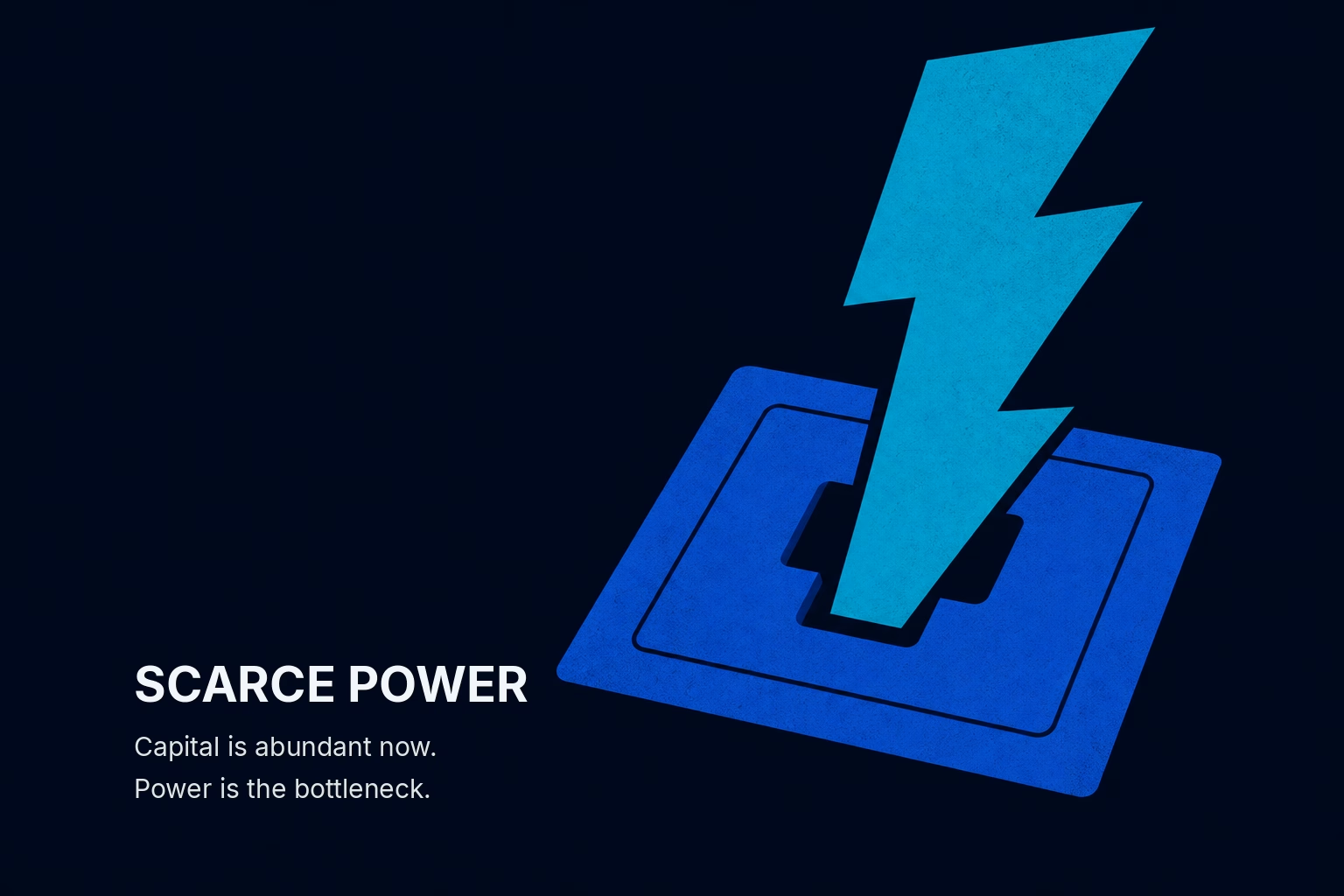
The instinct is to file this under "another mega-fund muscles into the AI trade." That instinct gets the mechanism backwards. Brookfield was not brought in to write cheques against compute. It was brought in because it owns the input that the compute cannot function without: power, and the physical rights, land and grid interconnections that turn power into a data centre. In an AI buildout where capital is abundant and electrons are not, the asset owner sits closer to the bottleneck than the financier.
Why Power, Not Capital, Was the Ticket
Flatt said it plainly standing next to Huang: the firm started with "enormous amounts of power, solar, wind, gas," moved to data centres, and then to compute. That is not a pitch about balance-sheet size. It is a description of a supply chain read from the scarce end.
The scarce end matters because everyone in that consortium can supply money. Goldman, Blackstone, Apollo, KKR, BlackRock, all of them can mobilize tens of billions on short notice. Capital is the commodity in this deal. What is not commoditized is a portfolio of operating generation assets, signed grid interconnection queues, and the development muscle to build hyperscale campuses next to power that already exists. Data centre developers are quoting multi-year waits for grid connections in the constrained US and European markets. A firm that already controls generation and already sits in those queues is not offering the same product as a credit fund. It is offering the thing the credit fund's money cannot buy quickly.
This is the mechanism the "PE firm joins AI deal" framing misses. Brookfield's edge is not that it can finance the build. It is that it shortens the timeline from committed capital to energized megawatt, and in an AI arms race, timeline is the whole competition.
The Machine Underneath the Consortium Headline
Brookfield manages $1.3 trillion, some its own and some its clients', across more than 5,800 professionals in 50 countries. The activity in a single recent week, buying an Australian plumbing manufacturer, recapitalizing a UK holiday-park operator held since 2015, taking a minority stake in a US real estate partnership, launching a Canada-focused fund, is the tell that this is not a thematic AI bet. It is a permanent-capital compounding engine that happens to own the input AI needs most.
The evolution is the point. Brookfield rebuffed a merger with Apollo, then instead of building one integrated giant it acquired Oaktree to deepen credit, transitioned from a conglomerate into an asset manager, and pivoted into insurance the way several peers did. The insurance pivot is the quiet engine here. Insurance liabilities are long-dated and cheap relative to third-party fund capital, and they need to be matched against long-dated assets. Power plants and data centres are long-dated assets. The structure lets Brookfield fund infrastructure with its own permanent balance sheet and earn management fees on the third-party capital it deploys alongside, twice on the same asset.
Flatt has doubled assets under management over five years and says he can do it again. The AI infrastructure wave is not the reason to believe him; it is one channel through which an already-working machine gets a larger opportunity set.
Where the Bull Case Actually Lives
Bill Ackman's Pershing Square holds a roughly $2.5 billion stake in Brookfield Corporation and calls it "high-quality, asset-rich, rapidly growing" with a long track record of capital allocation. His specific claim is that Brookfield benefits from the multi-trillion-dollar AI infrastructure wave. Note what Ackman is buying: not a compute play, an owner-operator of the physical layer positioned to capture spread on capital it allocates into that layer. That is the same mechanism read, expressed as a position rather than a thesis.
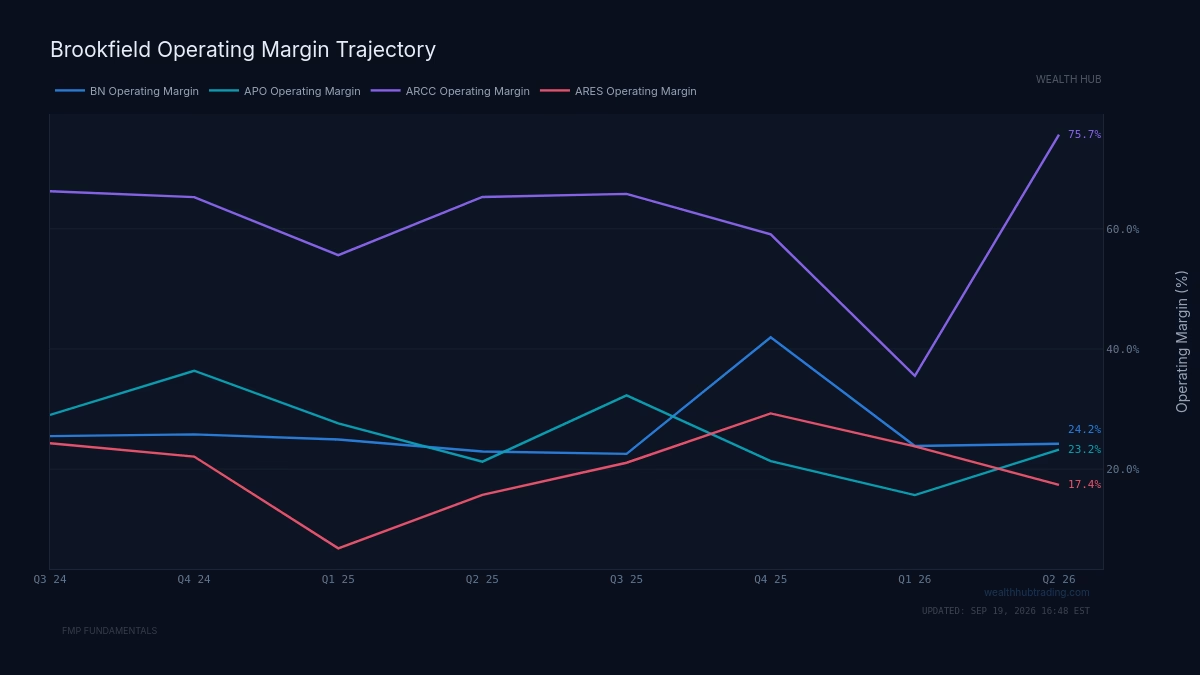
The bull case is coherent because the fee-plus-balance-sheet structure means Brookfield does not need any single AI campus to be a home run. It needs the aggregate flow of infrastructure capital to keep rising and its cost of matching liabilities to stay below the yield on the assets it builds. Both conditions currently hold.
The Countercase Worth Taking Seriously
Apollo's founder is scathing, and his critique is not noise. He argues Brookfield has built "a second-tier private equity business, a second-tier credit operation," and now "a second-tier insurance business," and called the Oaktree route "imbecilic." Strip out the rivalry and there is a real question underneath: does Brookfield's evolving structure create value, or does it obscure it?
That is the fact that could break the thesis. The mechanism I have described, permanent insurance capital funding long-dated infrastructure while third-party fees stack on top, only creates value if the returns on the assets clear the cost of the liabilities and the fee stream is durable. A sprawling structure that spans real estate, credit, insurance, private equity and infrastructure across 50 countries is also a structure in which mediocre segment returns can hide behind headline asset-under-management growth. Doubling AUM is not the same as doubling economic value if each new dollar earns a thinner spread. The insurance pivot in particular converts a fee business into a spread business, and spread businesses are only as good as the gap they earn and the credit they take to earn it.
So the Apollo critique and the Ackman endorsement are arguing about the same structural fact from opposite sides. One says the breadth is a moat around a scarce input. The other says the breadth is where second-tier returns go to hide.
What Resolves It
The thesis breaks if the spread between what Brookfield earns on the infrastructure and power assets it builds and what it pays to fund them, through insurance liabilities and third-party capital, compresses toward zero while headline AUM keeps climbing. That is the observable condition: watch the realized returns and fee-related earnings per unit of AUM, not the AUM total itself. If the power-and-data-centre assets deliver the yield the structure needs and the fee stream holds, Brookfield's consortium seat was earned on the one input capital can't manufacture. If segment economics thin out as the balance sheet grows, Apollo's founder will have been describing the machine accurately, and the AI wave will have made a large business larger without making it better.
Until the segment returns say otherwise, the cleaner reading is that Nvidia added Brookfield for what its money buys that other money cannot: control of the electron, and the years of grid access that stand between a funded plan and a running rack.