Pirelli's post-invasion guidance and Pirelli's post-invasion filings tell two different stories, and the filings are the ones that carry legal and reput...
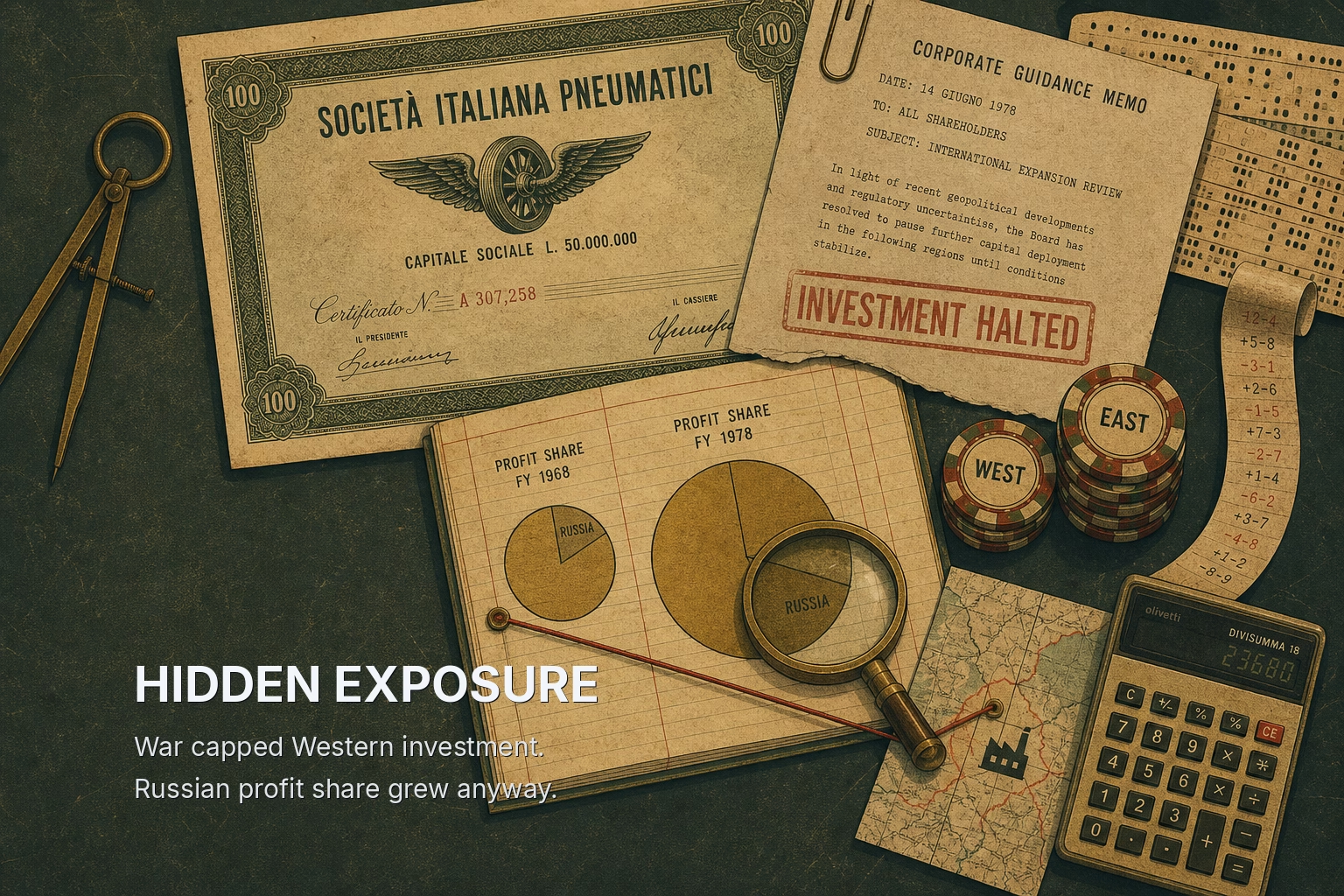
Management told investors it would halt Russian investment "except for spending linked to security" after February 2022. Russian corporate filings obtained by the short report describe a business that has not shrunk into run-off but has grown its contribution to the group, with roughly 10% of profit now sourced from operations every Western competitor exited. The distance between the guidance verb ("halt") and the disclosed outcome (a larger profit share than pre-war) is the disclosure the market is anchored away from.
For an equity built on a premium, F1-branded, Western-governance narrative, that gap is not a rounding error. It is the difference between a tire maker whose Russian exposure is a legacy tail and one whose Russian exposure is a growing, sanctions-adjacent core the income statement quietly depends on.
The Profit Share Nobody Guided To
The headline number to interrogate is not revenue, it is profit mix. A company can shrink a business on the top line while it grows on the bottom line if local pricing, currency effects, and a competitor-free market let margins expand. That is precisely the pattern the Russian filings describe: peers gone, demand intact, and Pirelli left as the only Western manufacturer able to serve it.
If about a tenth of group profit now originates in Russia, the reported consolidated earnings that the equity trades on are partly a function of an operation management framed as being in wind-down. That is a disclosure-quality problem before it is a geopolitics problem. The guidance language shaped consensus expectations toward "Russia is being managed down." The filings, if accurate, describe the opposite direction of travel. When guidance language and filing substance diverge, the filing is the document that governs liability, and it is the one the market has not repriced.
Two facts sharpen the exposure. Pirelli sank about €470 million into Russia, and Russian law would let it recover only a fraction on exit. So the choice is not clean: stay and absorb the escalating sanctions and reputational risk, or leave and crystallize a large, near-total write-down. Every competitor chose the write-down.
Why the Competitor Set Is the Cleanest Evidence
The most damaging comparison in this case is not to Pirelli's guidance, it is to Nokian, Michelin, Continental, Goodyear, and Bridgestone. All five sold their Russian operations after the invasion and took the impairments and share reactions that came with it. Pirelli is the last Western tire maker still manufacturing in the country.
That uniformity matters analytically because it removes the "everyone is stuck" defense. When one company diverges from a five-name peer set that all made the same costly decision, the divergence is a choice, and choices invite scrutiny that a shared industry constraint would not. The peer exits establish that a clean exit was operationally available; they took the write-downs precisely because staying carried a cost they judged higher. Pirelli's retention implies either a different risk assessment or a different set of constraints on its freedom to leave, and the ownership structure described in the report points toward the latter.
The Ownership Overhang Behind the Guidance
The report's harder allegations concern control, not just presence. A Russian state entity holds a 25% stake in Pirelli's two Russian factories. The Kirov plant sits inside the same industrial complex as a state-owned tire factory that produces tires for Russian military platforms, including, per Russian local-government publications cited in the report, the RS-24 Yars nuclear-warhead launcher. The claim that the adjacent military plant relies on Pirelli's infrastructure to operate, and the claim that the second minority holder, JSC Panaland, shares an address and email domain with the state-linked research institute and has principals tied to Rostec, are the load-bearing accusations. They are sourced to an adversarial investigation and Russian filings, and a reader should hold them as allegations pending Pirelli's response and independent verification rather than as settled fact.
But even discounting the technology-transfer and sanctions-breach specifics, the structural point survives: a 25% minority state holder plus Russian exit law equals a business Pirelli may not be able to leave on commercial terms even if it wanted to. That is the mechanism that reconciles the guidance and the filings. "Halt investment except for security spending" may be less a strategic posture than the language available to a company whose Russian assets are effectively captive.
The prior relationships thicken the picture. Igor Sechin bought 13% of Pirelli in May 2014, two months after the Crimea annexation, with documents signed in Putin's presence. The 2017 Pirelli calendar, a genuine cultural asset for the brand, featured the stepdaughter of Rostec's chief, and EU officials later cited that appearance as supporting evidence against lifting her sanctions. None of that is dispositive of current wrongdoing. It is context that raises the prior that the Russian entanglement is deep rather than incidental.
What Would Confirm or Break the Read
The thesis here is narrow and testable: Pirelli's Russian business is larger in profit terms and more encumbered in control terms than its guidance implied, and the equity is not pricing the disclosure, sanctions, and forced-write-down risk that follows.
It breaks on a specific rebuttal. If Pirelli discloses audited Russian profit contribution materially below the ~10% figure, documents that the Kirov complex has no operational dependency on the adjacent military plant, and shows that the Donetsk dealer listing and the non-public military-order email were errors already remediated, then the case collapses to a reputational skirmish rather than a re-rating catalyst. The burden of that rebuttal sits with the company, and the market has not yet demanded it.
It confirms on escalation. A formal EU or member-state sanctions inquiry into the Donetsk dealer, an auditor qualification on the Russian segment, or a peer-style write-down announcement would each convert an allegation into a P&L event. The valuation risk is asymmetric because a premium, ESG-screened, F1-branded equity carries a governance premium that a sanctions-and-military-supply narrative directly attacks. The multiple, not just the earnings, is what is exposed.
The One Number That Settles the Direction
For the peer set that actually exited, the write-down was the price of a clean story, and their subsequent disclosures are unencumbered by a captive Russian minority holder. Pirelli's refusal to pay that price is the anomaly the market is treating as immaterial. It may not stay immaterial.
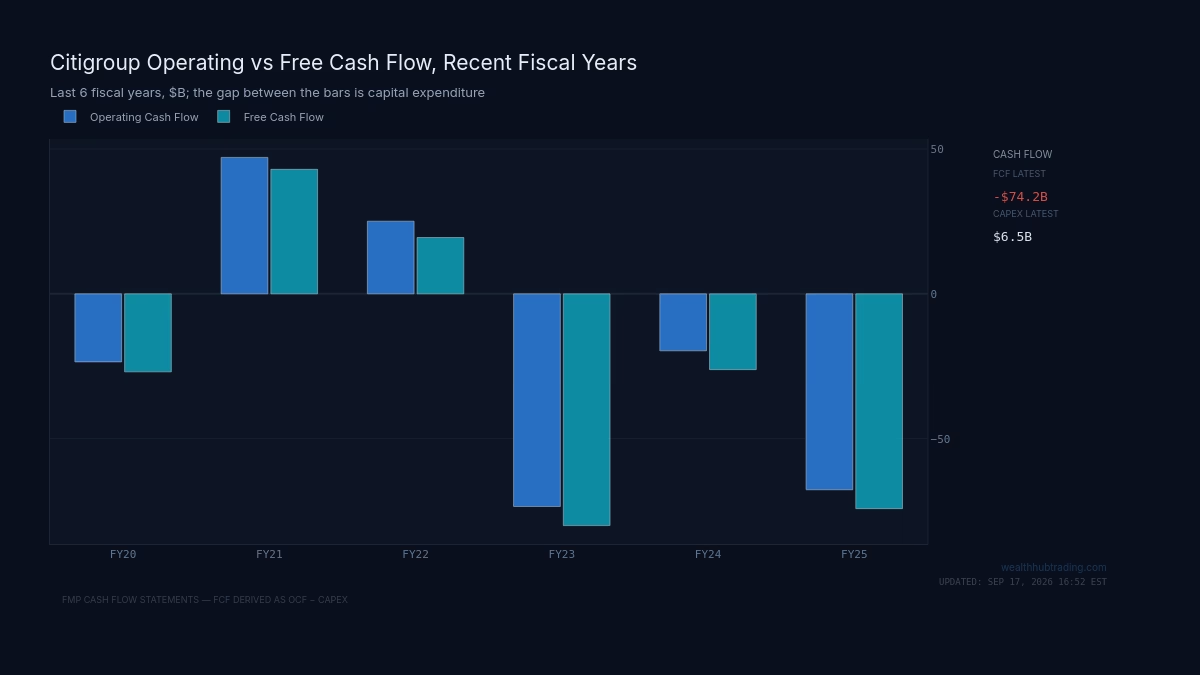
The single observable that resolves this is the audited Russian segment disclosure in Pirelli's own reporting. Until Pirelli publishes a Russia profit-contribution figure that either confirms or refutes the ~10% claim and addresses the control and sanctions allegations directly, the guidance language should be treated as the weaker evidence and the filings as the stronger. The chart below is not Pirelli, which does not trade with resolvable US-listed history here; it anchors the governance-premium mechanism to a large-cap financial whose own filings show how far a headline number can sit from the cash-flow reality beneath it.