The interesting thing about robotics right now is not when the stock charts move. It is that the entire sector is gated behind a single unresolved techn...
The Curtain, Not the Chart
The interesting thing about robotics right now is not when the stock charts move. It is that the entire sector is gated behind a single unresolved technical question, and almost every "ChatGPT moment" claim quietly assumes that question is already answered. It isn't.
The pitch you hear in a San Francisco dive bar backyard, over local IPAs and cheap lagers, is real enthusiasm. Young engineers slicing US-sourced magnet slabs, building electric motors for military drones, machining actuators for robots Made in America. The energy is not the problem. The problem is that the most impressive robots today live behind a shroud, running tele-operated demos in controlled environments, optimizing for a clean click rather than durability in the wild. You can talk to ChatGPT from your couch. Almost no one has watched an AI-enabled robot fold laundry, pack a mixed pallet, or hold a conversation with a pedestrian without a human quietly steering it.
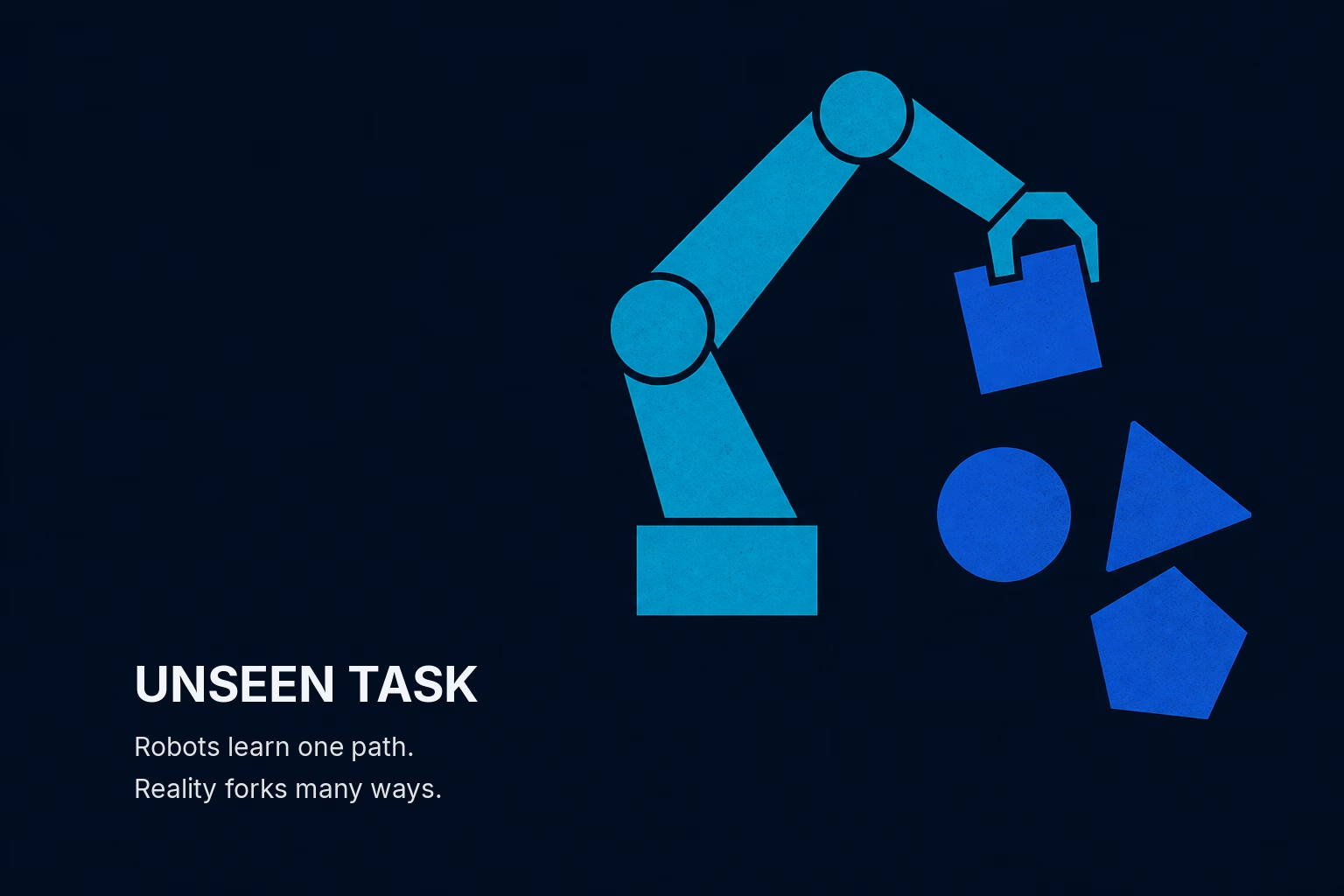
So the field trip question is narrower than the branding. Under the new label of "Physical AI," the mechanism that would take robotics from Bay Area backwaters to a genuine renaissance is generalization: can a robot handle a task it was never explicitly trained on? Everything downstream, the commercialization timeline, the addressable market, the trade, hangs on that.
What GEN-1.5 Actually Claimed
The reason this matters became concrete in August. GeneralistAI announced GEN-1.5, a "one-shot" learner, to significant fanfare. The demo showed a bot completing simple manipulation tasks from instructions, with no task-specific training beforehand. That is the whole ballgame if it holds. It is what the field calls in-context learning: the robot appears to carry a broad enough model of the physical world, what objects are, how they move, that it does not need mountains of task-specific data brute-forced into it for each new job.
Here is where intuition gets it wrong. The instinct, reading a one-shot demo, is to treat it as a general-purpose brain that has crossed a threshold. But a demo proves the model can do the task in the demo. It does not prove the task sits outside the distribution of what the model already saw in pretraining.
That distinction is the entire argument. Technical detractors raised it immediately: is this true generalization, or is the demonstrated task simply close enough to the pretraining distribution that the model is interpolating rather than reasoning? If the pretraining data already contained many near-neighbors of the demo task, a "one-shot" success is impressive engineering but not a new capability. It is the same brute force, hidden one layer up. The robot has not learned to handle the unseen; it has been shown a great deal that only looks unseen to the audience.
This is why the "ChatGPT moment" framing is doing more work than the people using it realize. A true ChatGPT moment is not a chart going up. It is universal recognition of a broadly applicable, highly disruptive capability. OpenAI's own engineers did not need the public launch to know what they held. The tell that robotics has arrived will not be a product announcement; it will be the moment insiders stop debating whether the generalization is real.
Why the Demo Environment Is the Variable
The mechanism to watch is the gap between the demo and the deployment, and it is a wider gap in robotics than in language models for a physical reason.
A language model that hallucinates produces a wrong sentence, which is cheap. A robot that misjudges an object it was not trained for drops it, jams a line, or injures someone, which is expensive and irreversible. That asymmetry is why early real-world deployments look like pilots rather than obvious return-on-investment installations. The economics do not clear until the robot is reliable on tasks nobody scripted, because the value of a general robot is precisely in the long tail of jobs too varied to pre-program. A robot that only performs its demo tasks is a very expensive single-purpose machine, and single-purpose automation already exists and is cheaper.
So the commercialization timeline is not a function of how good the demos get. It is a function of how far outside the training distribution the robots can operate before reliability collapses. That is a different variable, and it is the one the enthusiasm tends to skip.
The hardware layer complicates the read further. The reindustrialize story, magnets, actuators, roller-screws, electric motors, is a genuine industrial buildout with its own supply chain and its own investment case, some of it aimed at drones and defense rather than humanoids at all. It is tempting to treat the hardware buildout as confirmation that the software has arrived. It is not. The actuators get built and sold whether or not the neural networks generalize; the two theses ride on the same trend but resolve on different evidence.
The Case That This Is Already Working
The honest counterargument is that the distribution objection can be raised forever and eventually stops being fair. Every capable system was, at some point, dismissed as mere interpolation over a large enough dataset. Language models were called stochastic parrots by serious researchers right up until the parrot started doing things parrots cannot do. If the pretraining distribution is broad enough, "interpolation" and "generalization" become a distinction without a practical difference, because the world's tasks also cluster near their neighbors. A robot that has effectively seen enough of the physical world may not need to reason from first principles any more than a skilled human does.
There is also a serious institutional read on the other side. Nvidia's Jensen Huang has called Physical AI the next frontier of intelligence; Goldman Sachs has called humanoids the next leg of the robotics trade. Those are not naive voices, and the capital following them will fund exactly the scaling that could turn interpolation into something indistinguishable from generalization. Capital can manufacture the breadth that closes the gap.
That is the real tension. The bull case and the bear case do not disagree about the demos. They disagree about whether breadth of pretraining is a shortcut to generalization or a substitute masquerading as one. That is an empirical question, and it will be answered by deployment data, not by argument.
Where This Resolves
The thesis breaks, in the constructive direction, the moment a leading lab lets a robot run unsupervised on tasks demonstrably outside its training set, in an uncontrolled environment, at a failure rate low enough to underwrite. Not a curated demo. Not a tele-operated pilot with a human on the loop. An unsupervised deployment where the interesting failures, the genuinely novel objects and situations, get handled at production reliability.
Until that specific condition appears, the correct reading is that robotics is in a capability-development phase priced increasingly as if it were in a commercialization phase, and the gap between those two is the generalization question. The hardware buildout is real and can be underwritten on its own industrial merits. The software renaissance is a wager on one unresolved technical claim, and the tell will come from inside the labs before it ever shows up on a chart.
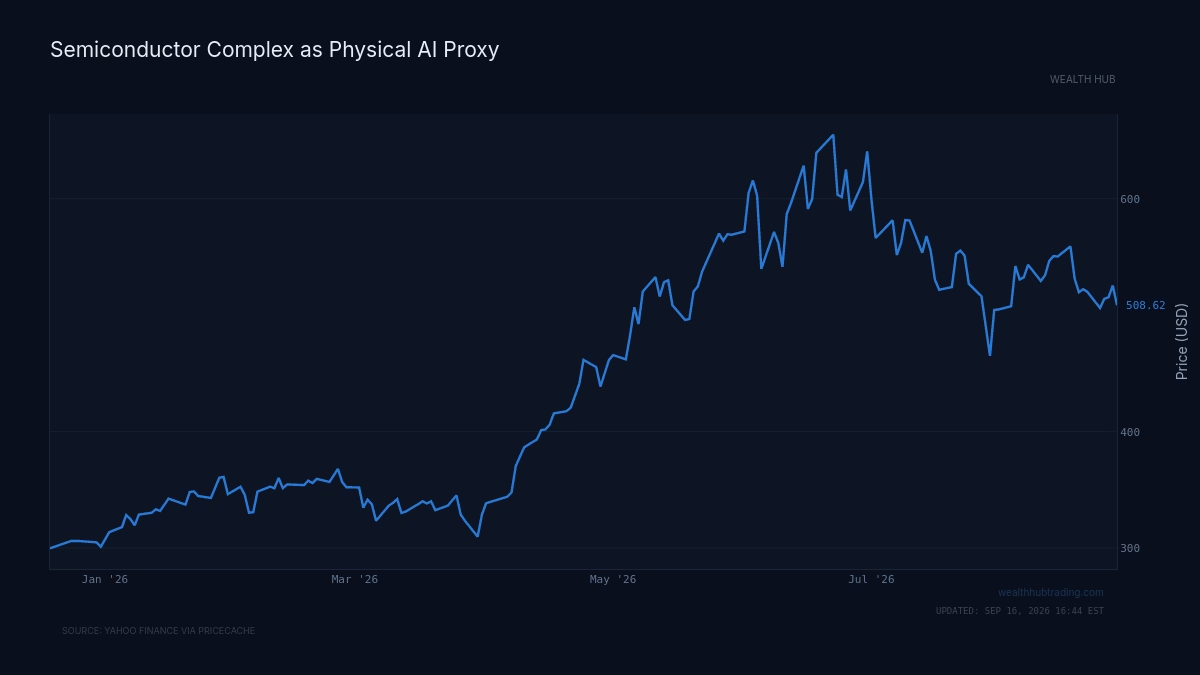
The public markets offer no clean pure-play on the specific question that matters, which is itself informative: the semiconductor complex that supplies the compute is the closest liquid proxy for the theme, and it carries far more than robotics inside it.