The oil market keeps pricing the Strait of Hormuz as a light switch, on or off, closed or open. That framing is the mistake. A field trip to the fifty-f...
The oil market keeps pricing the Strait of Hormuz as a light switch, on or off, closed or open. That framing is the mistake. A field trip to the fifty-four-mile passage between Iran and Oman reveals something the tanker-transit binary cannot capture: the relevant risk is not a closure event but a slow rewrite of the rules governing who is permitted to pass, written in real time by the Iranian Revolutionary Guard. The mechanism that matters is discretionary transit control, not blockade. Those are different trades with different tails.
Why "Open or Closed" Is the Wrong Model
Roughly a fifth of the world's seaborne oil moves through Hormuz. Every risk desk knows the headline number, and every risk desk has run the same scenario: Iran mines the channel, sinks a tanker, the price of Brent gaps double digits, and the world scrambles. That scenario is real but low-probability, and precisely because it is the obvious one, it is the one the market is best prepared to price and least likely to be surprised by.
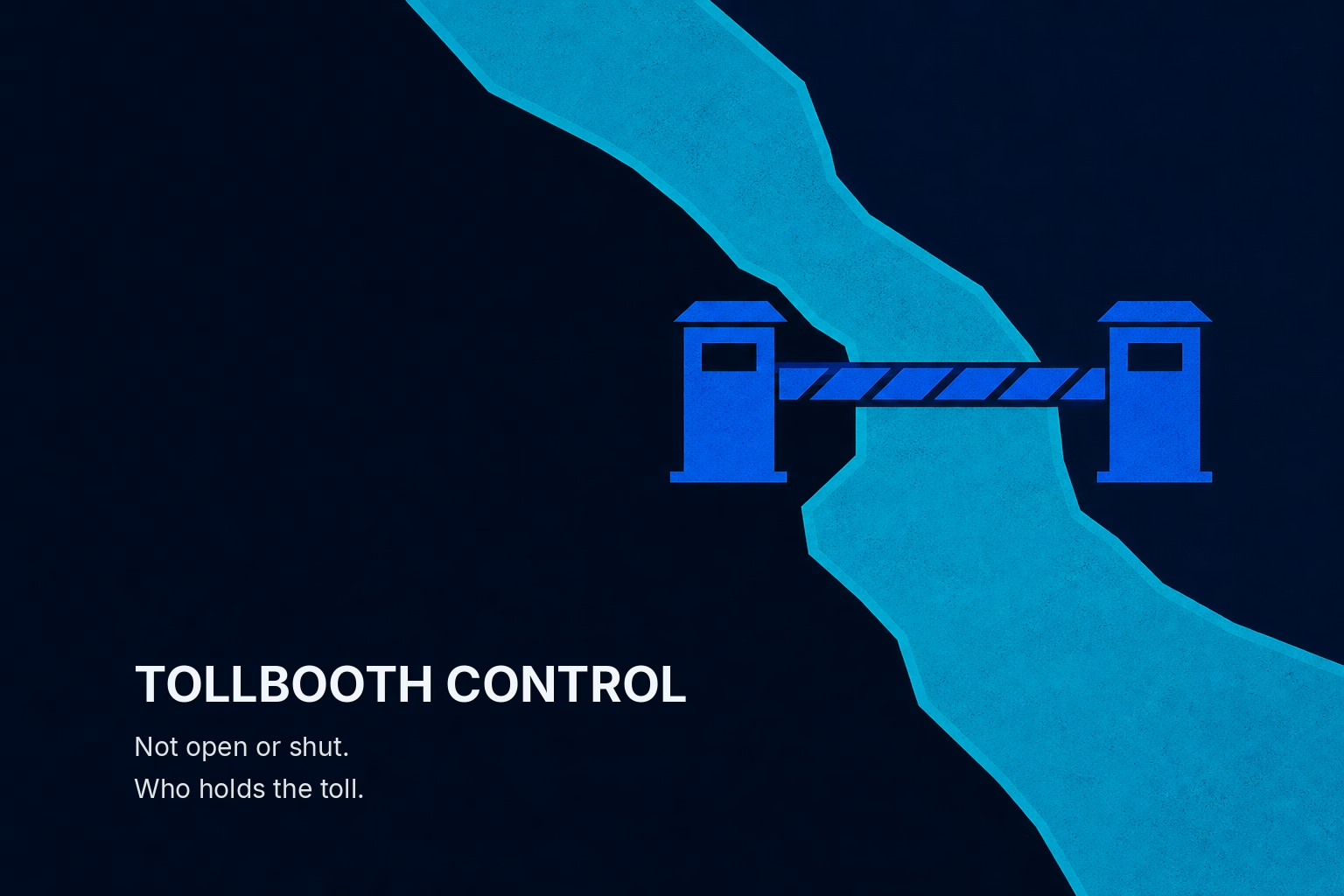
The binary model assumes Iran's only lever is total denial. It isn't. A total closure invites the response that ends the regime's ability to project any power at all, which is exactly why it has never happened despite decades of threats. The lever that gets used is the one that stops short of that: selective friction. Delay a hull here, wave through a tanker there, demand documentation, escort some vessels and shadow others. This is the difference between a wall and a tollbooth, and a tollbooth is far more useful to the operator because it can be adjusted without triggering the nuclear option of a naval war.
The observation from the water is that the drones, the patrol boats running patterns, the discretion at the point of passage are all instruments of graduated control, not preparation for a single closing act. Shahed drones overhead and Guard vessels working the channel are the visible edge of a regime that is deciding, case by case, who moves.
The Mechanism: Discretion as the Asset
Here is where intuition breaks. The market treats Hormuz risk as a probability distribution over a closure date. The better model treats it as a pricing power problem. If the Revolutionary Guard can impose conditions on transit, the flags a tanker flies, the cargo it carries, the insurance it holds, the destination it declares, then the Guard has effectively become a variable cost inserted into every barrel that crosses. That cost does not show up as a spike. It shows up as a widening, persistent risk premium and a bifurcation in who pays it.
Selective transit control does three things a closure does not. It preserves Iran's own export capacity and its relationships with the buyers it favors, chiefly to the east. It extracts leverage over the vessels it chooses to slow. And it keeps the option of escalation alive without spending it. A closed strait is a used bullet. A discretionary strait is a loaded gun pointed indefinitely.
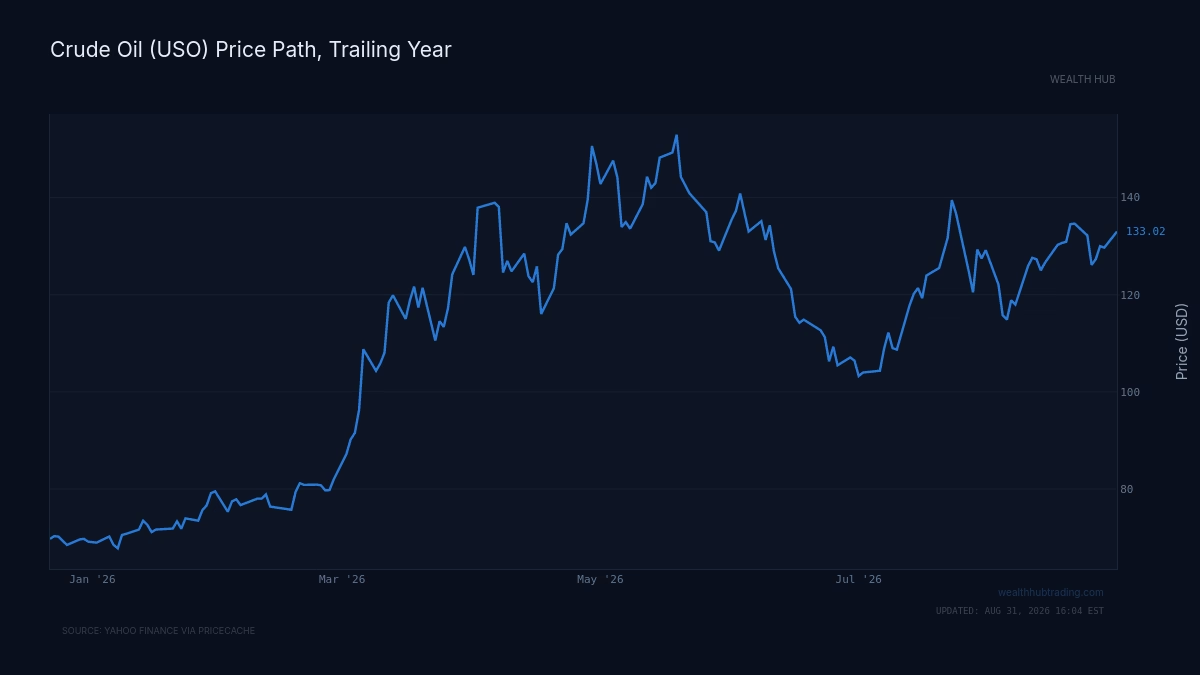
The consequence for markets is that the premium migrates from the flat price into the term structure and into freight. Tanker rates, war-risk insurance premiums, and the spread between crude that can move freely and crude that cannot, these are the surfaces where discretionary friction registers first. A flat-price trader watching Brent for the gap is looking at the wrong instrument. The friction lives in the cost of moving the barrel, not yet in the barrel itself.
Who Bears the Cost, and Who Escapes It
The multipolar frame is not decoration here; it is the distributional core of the trade. If passage is discretionary, then discretion is exercised along political lines. Buyers aligned with the transit authority move at one cost; buyers on the other side of the ledger move at another, or wait. That is a redirection of trade flows, not a suppression of them. Barrels do not disappear; they reroute, and the reroute has a price and a beneficiary.
This is the part the closure model cannot represent at all. A closure is indiscriminate, it taxes everyone equally and briefly. Discretionary control is selective, it taxes some parties durably and exempts others. The durable, selective version is the one that reshapes freight routes, insurance markets, and the relative competitiveness of refiners depending on where they sit and whom they buy from. The winners are the counterparties the gatekeeper wants to reward. The losers are the ones who assumed the channel was a public good.
The Counterargument That Would Break This Read
The thesis fails if the Guard's discretion turns out to be theater rather than a durable, enforced regime. If the "new rules" are episodic harassment that international naval escorts neutralize within weeks, then the tollbooth collapses back into the old binary and the risk premium bleeds out. Sustained selective control requires that the operator can actually enforce conditions against a determined, escorted flow, and history is full of chokepoint operators whose leverage evaporated the moment a serious navy showed up. Sometimes a coercive chokepoint regime holds for years; sometimes it dissolves in a single freedom-of-navigation deployment. Which of those this becomes is not yet settled.
There is also the honest limitation of the evidence. A single field observation, however vivid, is one draw from a noisy process. Patrol patterns and drone flights are consistent with graduated control, but they are also consistent with ordinary wartime posturing that signals nothing durable about transit rules. The stronger version of the bear case is simply that nothing structural has changed and the market's occasional binary spikes are the correct, if crude, way to price an occasional binary risk.
What Would Confirm the Read
The tell is in the term structure and in freight, not in the flat price. If discretionary control is becoming the operating regime, it should register as a persistent premium in war-risk insurance and tanker rates that does not decay when the news cycle moves on, and as a widening divergence in the cost of moving cargo depending on flag, destination, and buyer. A closure scare produces a spike and a reversion. A discretionary regime produces a level shift that holds.
Watch for the premium that refuses to fade. That is the signature of a tollbooth being built. The moment freight and war-risk pricing settle into a higher plateau while flat-price Brent stays comparatively calm is the moment the market has quietly conceded that Hormuz is no longer a switch, and has become a variable cost with a name attached to it.