The most revealing number in HNI's post-Steelcase story is not the synergy target management keeps repeating. It is the operating margin: 8.5% on $2.8 b...
The most revealing number in HNI's post-Steelcase story is not the synergy target management keeps repeating. It is the operating margin: 8.5% on $2.8 billion of revenue in the FY2025 filing, against a debt load of $1.6 billion. That is the real constraint. A furnishings rollup with a single-digit operating margin does not have much room to absorb integration friction, and it just absorbed its largest and most complex acquisition to date. The guidance narrative is about growth and synergies. The disclosed financials are about how little slack sits between the two.
What Management Repeats and What the Filing Shows
HNI's investor communications lean hard on a familiar template: Steelcase is a conservatively underwritten, low-execution-risk merger arriving as the cycle turns, and management hopes to repeat the playbook that made the 2023 Kimball International deal work. The synergy figure has already been nudged up from the original $120 million forecast, and the Q2 commentary reads as if integration is running ahead of plan.
Set that language beside the scale of what was bought. Kimball cost $483 million. Steelcase cost roughly $2.2 billion for a business with about four times the revenue. Complexity in a furniture integration does not scale linearly with revenue, it scales with plants, brands, dealer networks, and overlapping product lines. Repeating a $483 million playbook on a $2.2 billion target is not the same exercise, and the repetition of the Kimball comparison on call after call is doing rhetorical work that the numbers do not obviously support.
The synergy raise is the tell worth sitting with. Raising a synergy target nine months into an integration, before most of the hard network-optimization and footprint decisions have been executed, is a confidence signal management chooses to send. It is not a realized result. The distinction matters because the guided narrative asks the market to price the raise as evidence of execution, when at this stage it is still a forecast layered on a forecast.
The Margin Is the Constraint, Not the Multiple
The bull case, fairly stated, is coherent: HNI is the most complete platform in commercial furnishings, it has delivered four consecutive years of double-digit non-GAAP EPS growth, leverage is trending down, free cash flow is real, and the stock trades at a discount to peers on both earnings and sales. If the office cycle recovers and synergies land, you get earnings outperformance and multiple expansion at the same time. That is a legitimate setup and it deserves to be taken seriously rather than waved away.
But the fundamentals reframe where the risk actually sits. The FY2025 cash flow statement shows $276.2 million of operating cash flow and $65.8 million of capex, leaving $210.4 million of free cash flow, with capex running at just 2.3% of revenue. That low capital intensity is a genuine strength; this is a business that converts operating income to cash without a heavy reinvestment drag. The problem is not cash generation. It is the margin the cash is generated from.
At an 8.5% operating margin, a two-point compression from integration disruption, dealer churn, or a slower-than-hoped office recovery is not a rounding error, it is roughly a quarter of the operating margin gone. Against $1.6 billion of total debt on $4.9 billion of total assets, that compression lands on a balance sheet that management describes as healthy and de-levering but that has materially less cushion than it did before it took on the Steelcase purchase. The synergy math and the margin math are the same math viewed from opposite ends: the synergies are what has to arrive to keep the margin from being the thing that breaks.
Where the Peer Set Actually Helps
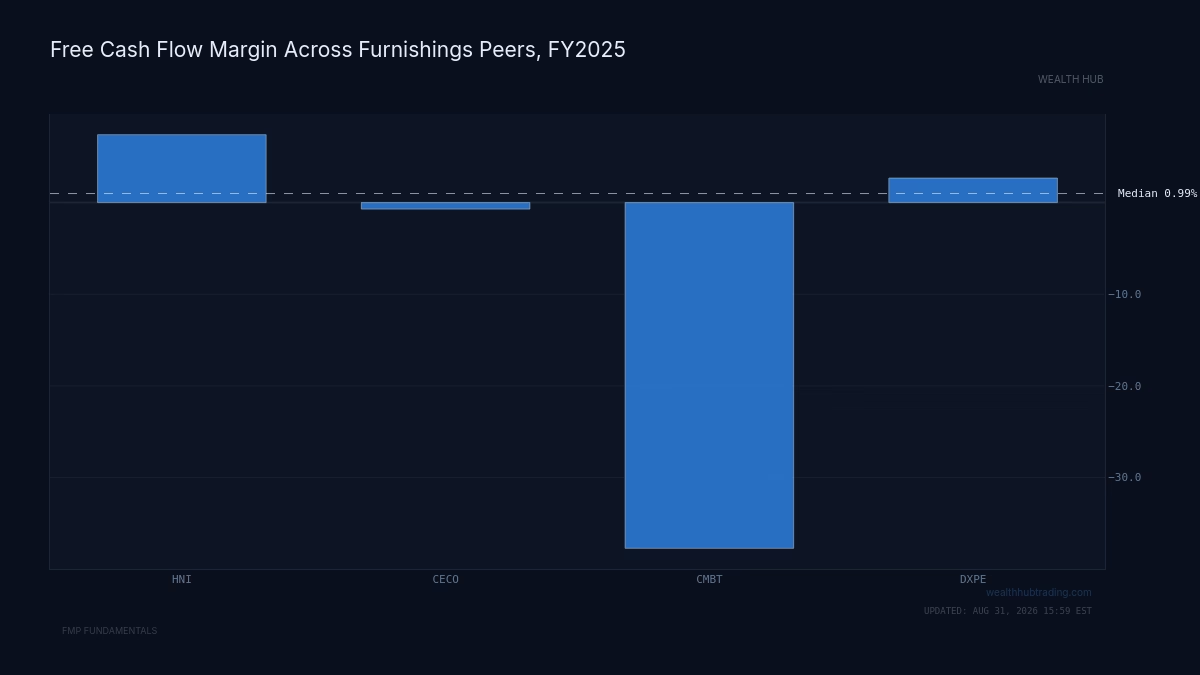
The peer comparison is where the story turns genuinely favorable, and it should not be dismissed just because the guidance language is doing too much. Among the comparable names in the filings, HNI is the one throwing off clean free cash flow at low capital intensity. HNI generated $210.4 million of free cash flow in FY2025. CECO produced negative free cash flow of $5.5 million on capex that consumed nearly all of its operating cash. DXPE managed $54.0 million of free cash flow at a similar 8.8% operating margin but a fraction of HNI's cash conversion.
The instructive contrast is with a name that carries a headline margin more than double HNI's, at 22.2% operating margin, but posted negative free cash flow of $628.3 million because capex ran at 64.3% of revenue. That is the point the margin obsession usually misses: a lower operating margin that converts to cash without a reinvestment sink is worth more to an owner than a fat margin that gets eaten by capital spending. HNI's 2.3% capex-to-revenue ratio is the underappreciated asset here, and it is the thing that gives the integration room to be imperfect and still fund the dividend and buyback.
So the fundamentals cut both ways against the narrative. They weaken the growth-and-synergy framing by exposing how thin the margin cushion is. They strengthen the ownership case by showing that the cash conversion is real and the capital intensity is genuinely low. Both readings come from the same filing.
The Fact That Would Break the Read
Here is the honest counterweight. If office demand recovers on the timeline management implies and the Steelcase synergies land near the raised target, the thin margin becomes the setup for operating leverage rather than a vulnerability. On flat-to-rising revenue, synergy capture flows straight to operating income, the margin expands off a low base, and the discount to peers closes. In that world, buying a low-margin, high-cash-conversion platform at a discount just before the cycle turns is exactly the trade, and the repeated Kimball comparison ends up justified rather than overstretched.
That is why the argument does not resolve into a short thesis on the language alone. Evasion-flagged calls and a well-worn acquisition script are reasons for skepticism, not a verdict. The verdict lives in the next few filings.
The read breaks if operating margin holds or expands through the next two to three quarters of Steelcase integration while free cash flow stays near the FY2025 $210 million level. Margin resilience under integration load would confirm the synergies are real cost, not forecast. The read is confirmed if operating margin slips below 8% while the synergy figure keeps getting raised in the commentary, because a rising synergy target alongside a falling margin is the specific signature of a narrative outrunning the filing. Watch the margin line, not the synergy slide. That is where the guidance language and the disclosed numbers will finally have to agree or diverge.