Meta's settlement is not a penalty; it is a competitive weapon dressed as one. The company agreed to pay 52 attorneys general a cumulative $18 billion o...
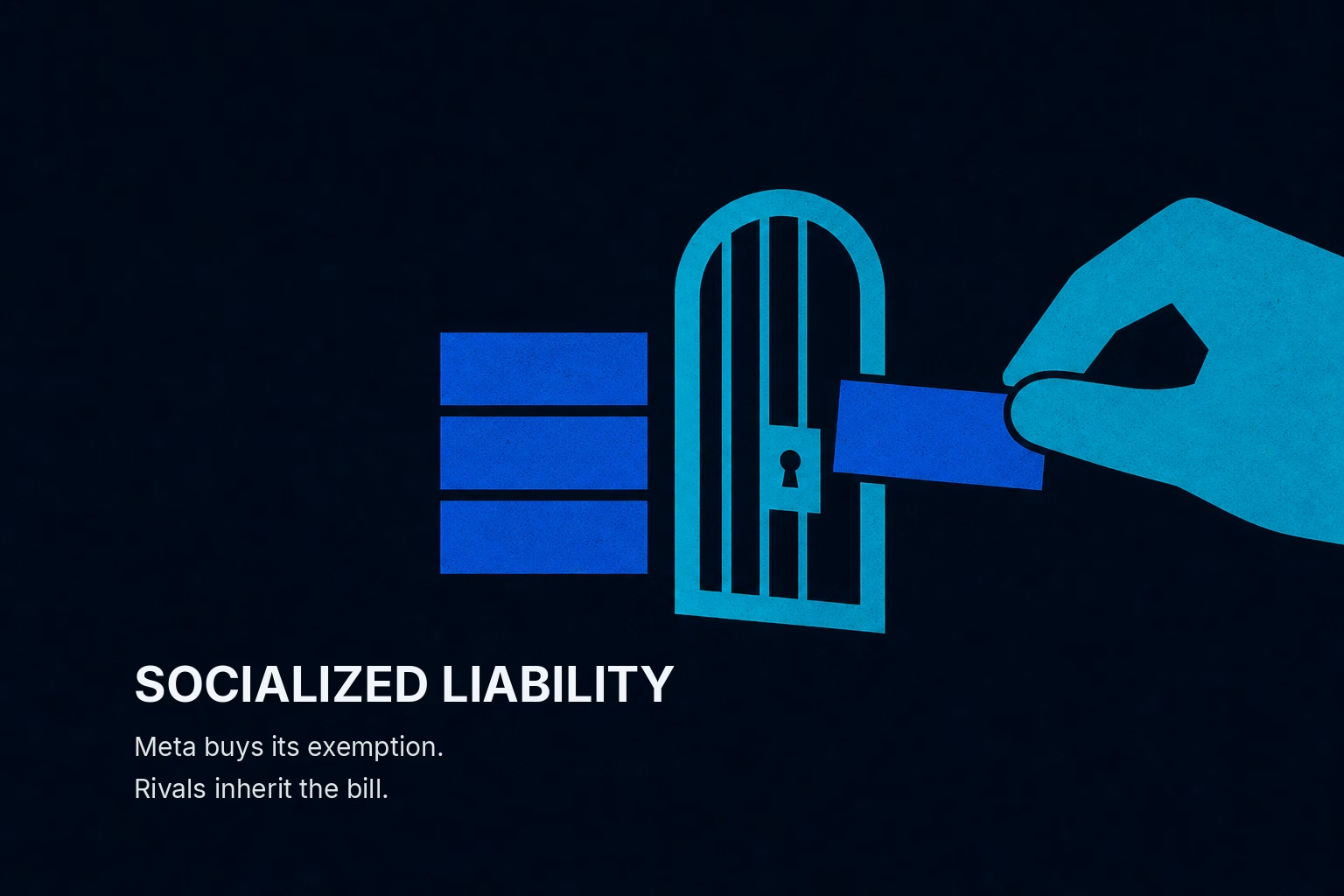
Meta's settlement is not a penalty; it is a competitive weapon dressed as one. The company agreed to pay 52 attorneys general a cumulative $18 billion over ten years to close the lawsuit alleging it engineered addictive platforms that damaged teenage mental health, but the structure of that payment tells you the deal was designed to bind competitors, not just to punish Meta. Nearly a third of the total, $5.3 billion, only becomes payable if YouTube and TikTok agree to adopt the same teen-usage restrictions Meta accepted, and if each of those rivals matches half the sum. Read that clause again. Meta wrote a term into its own settlement that pays out only when its two largest competitors are dragged into the same regulatory cage.
What the Contingent Clause Actually Does
The mechanism here is the part that intuition gets backwards. Most readers see a $5.3 billion contingent liability and treat it as a discount, money Meta might avoid paying. That framing misses the trade entirely.
Meta generates roughly 1% of its revenue from teenage users. On a pure revenue basis, ceding the teen market would barely register. So why fight so hard to keep it? Because in social networking the young cohort is not valued for the revenue it produces today; it is valued as the top of the funnel that becomes tomorrow's core user base. A competitor that captures a generation of teenagers on an engagement-optimized product is building a network that compounds against Meta for a decade. That is the asset Meta cannot willingly surrender.
The competitive market makes unilateral restraint irrational. If Meta alone makes its apps boring for minors while TikTok and YouTube keep the engagement loops running, Meta has handed rivals a structural recruiting advantage. The only way for restraint to be safe is for it to be universal. The contingent clause converts that logic into contract language: Meta accepts the usage limits, but the deal is only fully consummated when its rivals accept them too. The regulatory constraint that would have been a competitive wound in isolation becomes a moat when it is applied to everyone.
This is why the full-page newspaper advertisements, and the promoted posts on Facebook and Instagram, are not a public-relations afterthought. They are pressure. Meta is spending to manufacture the public expectation that these measures should be an industry standard, which is precisely the condition under which the $5.3 billion tranche triggers and, more importantly, under which Meta's teen franchise stops being a liability and starts being a fortified position.
The Collateral Precedent
The sharper read is that the companies most exposed to this settlement are not the ones named in it.
The deal establishes a precedent that "excessive" usage of any consumer app can be construed as a long-term legal risk for the operator. Once that principle is in the water, it does not stay confined to Meta, YouTube, and TikTok. It becomes a template that any state attorney general, or any plaintiff's firm assembling a class action, can lift and reuse.
The company that fits that template most uncomfortably is Roblox. Its daily active user base skews heavily toward minors, and the platform itself reports an average of roughly three hours of time spent per daily active user. Averages flatten the tail. If the top cohort of users, the ones most likely to drive the bulk of platform bookings, spend materially more than three hours a day, then Roblox is running exactly the engagement profile that Meta just paid $18 billion to declare a legal hazard. A wave of parent-led litigation demanding that Roblox implement the same time limits, school modes, and night modes Meta accepted would land far harder on a business whose entire value proposition is deep, sustained minor engagement than it did on a business that earns 1% of revenue from teens.
I want to be precise about the boundary of this claim. There is no filed litigation forcing Roblox into these terms today, and the read that the precedent migrates to Roblox is an inference about legal contagion, not an observed event. What is observable is the structural setup: a company whose reported usage metrics sit directly in the crosshairs of the standard Meta just helped normalize. 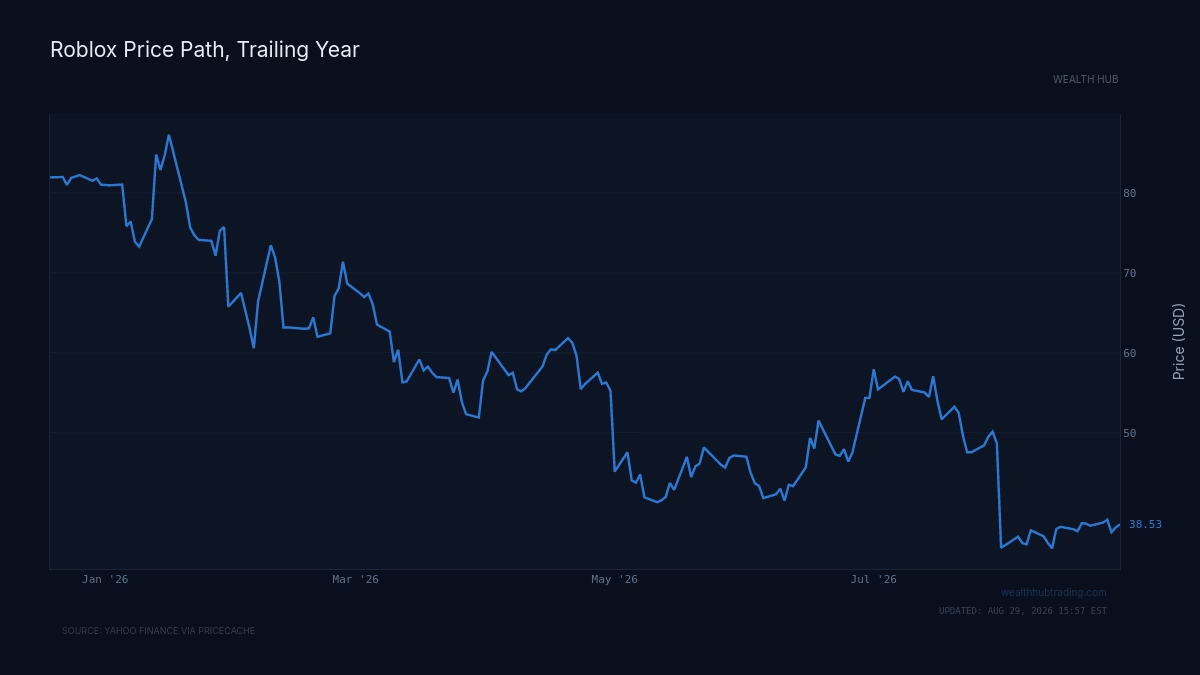
Why the Settlement Reads as a Win, Not a Wrist-Slap for Everyone Else
The countercase is that this was too soft to matter, and there is real evidence for it.
Every state except New Mexico and Florida joined the agreement, which takes the most draconian penalty scenarios off the table for Meta. New Mexico had already taken Meta to trial in state court and prevailed, a judgment Meta is now appealing, so it had no incentive to fold into a broader settlement. Florida walked away for the opposite reason: it judged the terms too lenient to sign. When a state refuses to settle because the deal is too generous to the defendant, that is a data point about how favorable the terms were.
The exclusions reinforce the point. Direct messaging sits outside the time-limit, school-mode, and night-mode restrictions Meta agreed to, which carves a substantial channel of teen engagement out of the constraint entirely. If you take at face value the underlying allegation, that these platforms were knowingly designed to harm adolescent mental health, then a settlement that leaves direct messaging untouched and spreads $18 billion across a decade looks less like accountability and more like a manageable cost of doing business.
But leniency toward Meta and lethality toward the precedent are not contradictory; they are the same outcome viewed from two angles. A settlement soft enough that Meta can absorb it, yet broad enough to establish that minor-usage intensity is a legal liability, is exactly the design a company would want if the real objective were to convert its own exposure into a rule that constrains everyone in the category. The wrist-slap and the weapon are the same instrument.
The Distaste Is Misplaced
Some observers found it unseemly that Meta used its settlement to pressure rivals. That reaction inverts the actual logic of the problem.
If the concern is genuinely the effect of these apps on teenagers, then a fragmented outcome, where Meta alone accepts usage limits while teens migrate freely to unconstrained competitors, achieves nothing except redistributing the harm. The measures only work if they are universal. Meta insisting that YouTube and TikTok play by the same rules is, on the merits of the stated public-health concern, the only structure under which the remedy is coherent. That Meta's commercial self-interest and the public-health logic point in the same direction is not a scandal; it is the reason the deal was achievable at all.
The Condition That Confirms or Breaks the Read
The thesis is that Meta bought regulatory certainty and a competitive moat for a price it can comfortably carry, while seeding a precedent whose damage falls disproportionately on minor-heavy platforms outside the room.
The read is confirmed if YouTube and TikTok are pulled into equivalent restrictions, triggering the contingent tranche and validating the "industry standard" strategy, and if litigation or attorney-general attention begins to migrate toward platforms like Roblox on the same theory. It is weakened if the contingent conditions never trigger, leaving Meta having paid $18 billion for a rule that binds no one but itself, or if courts and regulators treat the Meta settlement as sui generis rather than as a template. The specific thing to watch is not Meta's stock reaction to the headline number. It is whether the standard travels, because the entire value of what Meta bought depends on it becoming the price of admission for everyone else.