
When Basel III's binding minimums hit U.S. depository institutions in January 2015, the interesting response was not the banks that raised capital.
When Basel III's binding minimums hit U.S. depository institutions in January 2015, the interesting response was not the banks that raised capital. It was the banks that didn't have to. A holding company sitting on equity-rich nonbank affiliates faced a regulatory shortfall the same way a household with money in the wrong account faces a bounced check: the problem was a plumbing problem, not a wealth problem. Cetorelli and Kundu's work traces exactly this maneuver, and the finding reframes what a capital requirement actually does to an organizationally complex firm. It does not compel new equity. It redistributes existing equity toward the entity the regulator can see.
That distinction is the whole game, and it is precisely the part the market treated as procedural noise in 2015.
The Tell Is the Null Result, Not the Positive One
The headline estimate is small and easy to skim past: banks in holding companies headquartered in states that deregulated interstate banking one year earlier accumulated roughly three-quarters of a percentage point more excess capital after 2015. Across the seven-year gap between early and late deregulators, that compounds to about five percentage points of extra bank-level capital.
The number that carries the argument is the one that sits at zero. At the consolidated holding-company level, the corresponding effect is essentially nil. Consolidated assets, lending, and leverage do not move. A large effect at the bank subsidiary paired with no effect at the consolidated parent is not a rounding artifact. It is a signature. New equity raised from outside investors would have lifted consolidated capital too, because issuance adds to the total. The total did not change. The capital already existed somewhere in the structure and was moved to where it counted.
This is why the identification strategy matters more than it looks. Using the timing of interstate banking deregulation across the 1970s, 1980s, and early 1990s as a source of variation in organizational complexity is a way of isolating firms that built deep multi-subsidiary structures for reasons that have nothing to do with a capital rule three decades later. Early-deregulating states had more runway to assemble complex organizations before national harmonization in 1994. That head start predicts nonbank subsidiary share decades on, and it is hard to argue it also predicts Basel III behavior except through the channel of complexity itself.
Following the Equity Through the Parent's Own Books
The unconsolidated filings of the holding company are where the reallocation becomes visible, because they show equity moving between the parent and its subsidiaries rather than netting it all away. Among holding companies with meaningful nonbank operations, the pattern is clean. After 2015, parent equity investment in bank subsidiaries rises by 2.28 percentage points of total holding-company equity per year of deregulation exposure, while investment in the nonbank affiliates falls. The parent is not creating capital. It is draining one reservoir to fill another.
The issuance margin confirms the mechanism from the other direction. Holding companies with greater deregulation exposure significantly reduced external equity issuance after 2015. Faced with a tighter requirement, the complex firms tapped markets less, not more. That is only possible if the capital came from inside. A firm that had to meet the standard by issuing would show up as an issuer. These firms showed up as issuers who pulled back.
Put the two observations together and the story is not ambiguous. The regulator raised the required capital at the regulated entity. The firm satisfied the requirement by rearranging where its equity sat, avoided the cost of issuing into the market, and left its consolidated equity exactly where it had been. Every party to the transaction got what it measured. The regulator saw a better-capitalized bank. The firm saw an unchanged balance sheet.
What Would Break This Reading
The cleanest challenge to the reallocation story is the external-issuance story, and it deserves to be stated at full strength rather than waved off. If complex holding companies had simply been better positioned to raise fresh equity, one could reproduce a larger bank-level capital build without any internal shuffling. That version is real and worth taking seriously.
It fails on the consolidated null and the issuance decline together. Issuance lifts the consolidated total; the consolidated total is flat. Issuance makes a firm a net seller of equity; these firms became smaller sellers of equity after the rule bound. Both facts point away from the market and toward the internal ledger. The reading breaks only if someone can show a consolidated capital increase or a rise in external issuance among the exposed firms that the current estimates are missing. Absent that, the internal-reallocation channel is the more disciplined explanation of the same evidence.
There is a subtler caveat worth keeping honest. Deregulation timing predicts complexity, but it is an instrument, not a controlled experiment. If early-deregulating states differ systematically in some way that also shaped post-2015 capital behavior through a route other than complexity, the estimate absorbs that. The authors' point that early and late deregulators showed no divergence in nonbank activity before deregulation is the relevant defense: the gap opens only after the policy, which is what an instrument is supposed to look like.
Why the Second-Order Read Was Underpriced
The market underweights slow regulatory catalysts because they arrive as filings, not as events, and because the first-order effect looks benign. Basel III made banks safer at the entity level; that is true and it is what the compliance headline said. The second-order effect is where the information sits. A binding capital rule at the depository subsidiary does not necessarily strengthen the consolidated firm at all when that firm holds equity-rich nonbank affiliates it can draw down. Capital adequacy measured at the regulated ring can improve while the loss-absorbing capacity of the whole organization is unchanged.
That has a specific consequence for how a regulatory increase should be read going forward. The size of the bank-level capital response is not a measure of how much new equity a rule pulled into the system. For organizationally complex firms, it may be closer to a measure of how much equity they already had parked in nonbank subsidiaries and were willing to relocate. Two firms can post identical improvements in bank-level ratios while one raised real capital and the other moved existing capital across a wall inside the same house. Only the consolidated and unconsolidated detail separates them.
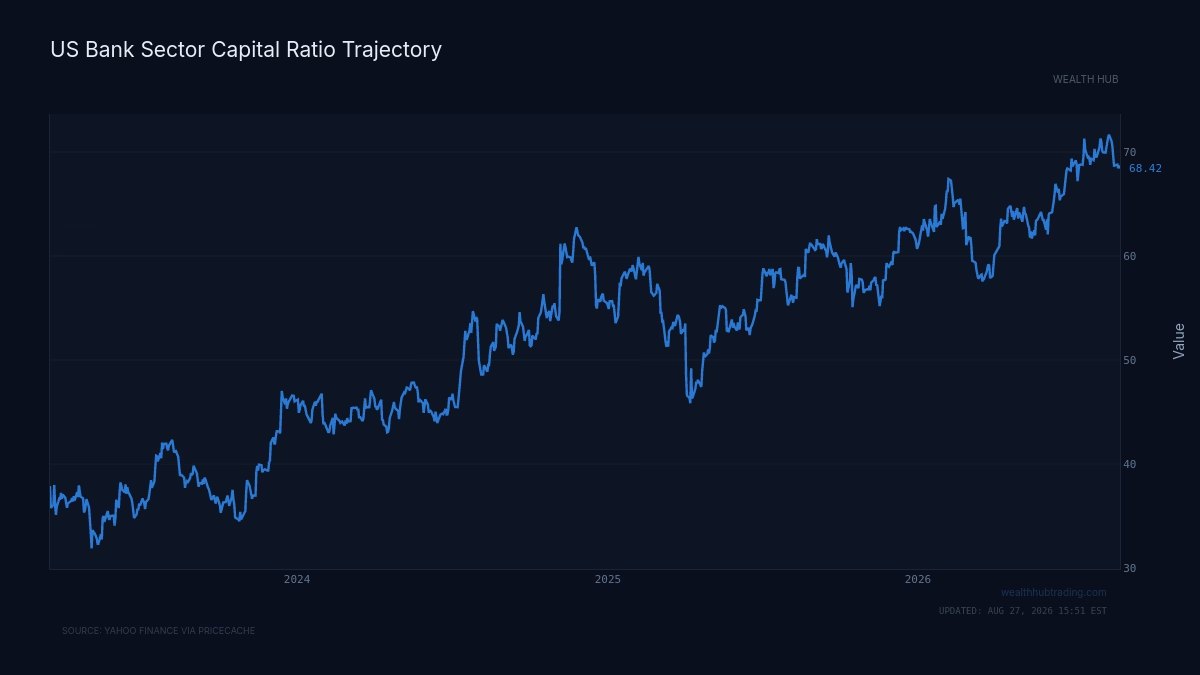
The observable that would sharpen or overturn this view is the behavior of consolidated capital and external issuance around the next binding requirement. If a future increase produces a bank-level build with a matching consolidated increase and rising issuance, the reallocation channel has narrowed and firms are genuinely adding equity. If it again produces a bank-level build with a flat consolidated total and falling issuance, the reservoir mechanism is operating exactly as it did in 2015, and the safety gain the headline reports is, at the consolidated level, mostly rearrangement.