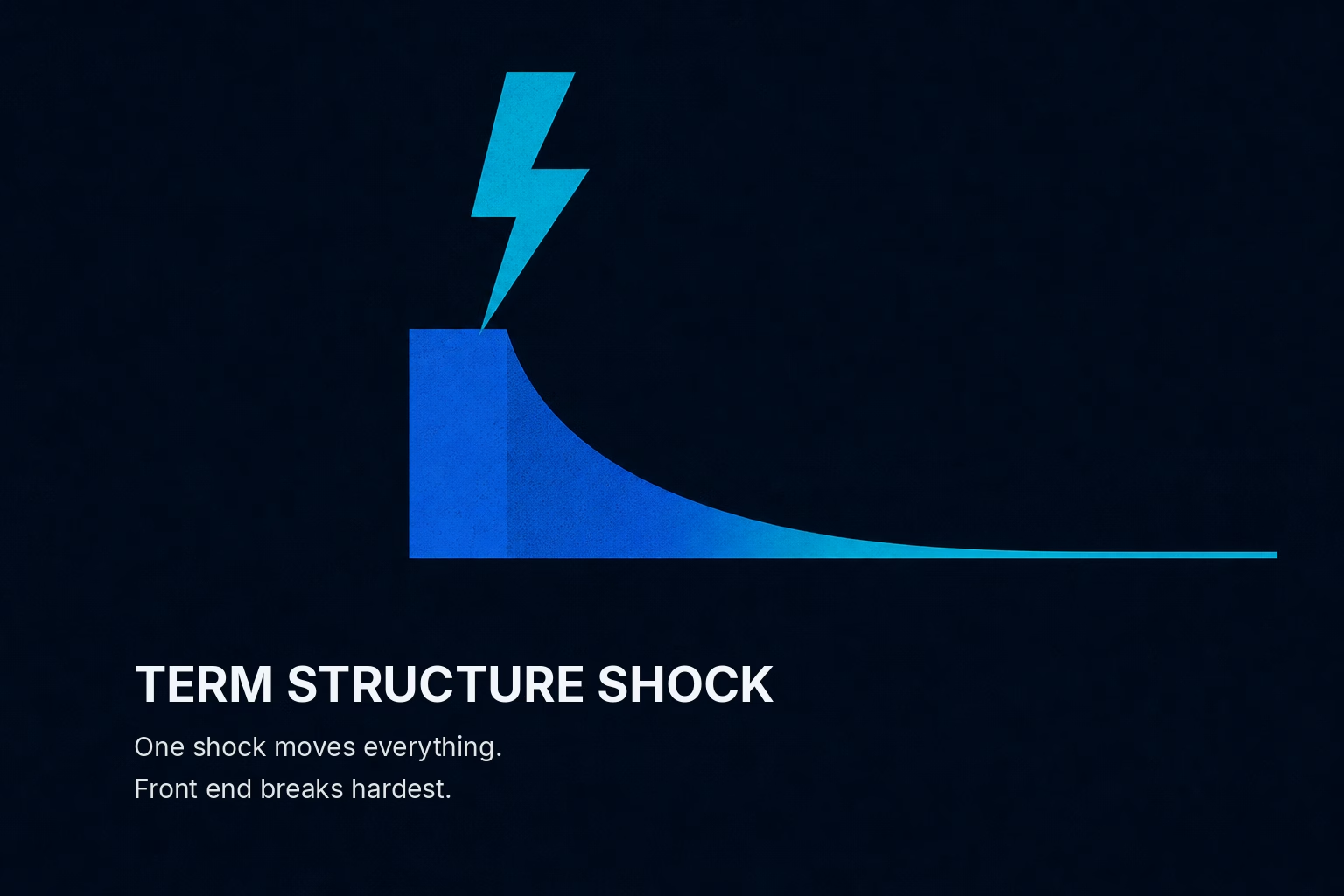
The interesting claim in Dyer and Jankauskas is not that Fed surprises move stocks. That has been settled since Bernanke and Kuttner counted roughly a 1 percent equity move per 25 basis points of unexpected tightening two decades ago. The interesting claim is where along the equity term structure the shock actually bites, and the answer disciplines a lot of loose thinking about "duration" in equities. A hawkish surprise does not repice the index uniformly. It concentrates on the short-maturity dividend strips and the near-term risk premium, the part of the present-value stack that ought, on paper, to be least sensitive to a discount-rate move.
Why the Front End Should Not Be Where the Damage Lands
Start with the arithmetic everyone agrees on. The value of an index is the sum of expected dividends discounted at maturity-matched rates. Push the whole discount curve up and, mechanically, the longest-dated cash flows lose the most, because a rate increase compounds over more periods. That is the entire logic behind calling growth stocks "long duration": their value sits far out on the maturity axis, so a rise in rates should hurt them disproportionately. It is the story the market tells itself every time the two-year yield jumps and the Nasdaq underperforms.
The equity term structure work built on Giglio, Kelly, and Kozak lets you test that story directly rather than assert it. Instead of treating the index as one blob with a single discount rate, it separates the discount rate at each maturity into a risk-free component and a maturity-matched equity risk premium, and it separately pins down the term structure of expected dividend growth. That decomposition matters because a Fed surprise can travel through at least three doors at once: it moves the risk-free curve, it moves the equity risk premium, and it moves growth expectations. Looking at the price alone, you cannot tell which door did the work.
What Actually Moves When the Fed Surprises
The mechanism that resolves the puzzle is that a hawkish monetary policy surprise does not behave like a clean, permanent, level shift in the risk-free curve. If it did, the long end would take the beating. It behaves like news about the near-term path, and the near-term risk premium responds hardest.
Two things happen when the MPS prints positive. First, near-dated expected dividend growth gets marked down, because the same surprise that signals tighter policy signals a weaker near-term demand and earnings path. Second, and this is the less obvious piece, the short-maturity risk premium rises: investors demand more compensation for holding the claims whose cash flows arrive before the policy fog clears. Both effects load on the front of the equity term structure. The long end, discounting cash flows that arrive after the current tightening cycle has plausibly reversed, moves comparatively little, because the surprise carries limited information about the risk-free rate and the risk premium a decade out.
The clean way to see this is the paper's own partition of the sample into hawkish MPS months, dovish MPS months, and no-FOMC months. That design isolates whether it is the directional news or the mere occurrence of a meeting that reprices the strips. The MPS series itself, built from high-frequency futures moves in a narrow window around announcements, averages near zero over the full sample, tilts slightly negative inside NBER recessions and slightly positive outside them. So this is not a proxy for the business cycle wearing a monetary hat; it is surprise relative to what was already priced, which is exactly the object you want when you are trying to attribute a repricing to policy rather than to macro drift.
The Duration Trade Is Half Right and Backward on the Other Half
This is where the second-order read for anyone actually positioning matters. The "long duration equals rate sensitive" heuristic gets the direction right and the location wrong. Growth stocks do sell off on hawkish surprises, but if the front of the equity term structure is where the risk premium and growth revisions concentrate, then the sell-off is being driven more by near-term earnings and near-term risk repricing than by the long-dated discounting story the label implies. A company valued on 2035 cash flows is being punished on a 2026 revision.
That distinction changes what a hedge should target. If you believed the pure duration story, you would hedge a hawkish surprise with something whose payoff scales with the long end of the curve. If the repricing is a front-end equity phenomenon, the cleaner expression is short-dated: near-term earnings-sensitive cyclicals, not the longest-duration secular growers, are where the first and largest mark happens. The market's instinct to sell the Nasdaq on a hot print is not wrong, but the reason it gives itself is often the wrong reason, and wrong reasons produce mispriced hedges.
The policy angle sharpens it further. A Fed surprise is a slow-moving, scheduled catalyst that the market treats as procedural until the window opens, then reprices in minutes. The names forced to absorb the cost are not evenly distributed across the duration spectrum; they cluster where near-term dividend growth and the short risk premium sit. That is a more specific claim than "rates up, stocks down," and it is the claim the term-structure lens is built to adjudicate.
Where the Read Could Break
The honest weakness is identification, and it is the weakness the authors are working against rather than around. High-frequency identification assumes the narrow window around the announcement captures only the policy news and nothing else. Bauer and Swanson's own contribution to this literature is the "Fed information effect" critique: some of what looks like a policy surprise is the Fed revealing its private read of the economy, which is a growth-expectations shock masquerading as a rate shock. If a chunk of the measured MPS is really information about the economy, then attributing the front-end dividend-growth revision to "monetary policy" overstates the policy channel and understates the endogenous macro news.
There is a second fragility. The equity term-structure estimates are model outputs, not traded prices. Dividend strips do trade, but the full maturity structure of risk premia and growth expectations is inferred through the Giglio-Kelly-Kozak framework, and a different decomposition could reassign the same price move between the risk-premium door and the growth door. The finding that the front end absorbs the shock is only as robust as the separation of those two channels, and that separation is exactly the hard part.
The thesis breaks cleanly if the front-end concentration disappears once the information-effect-purged surprise measure is used, or if the same repricing shows up when you partition by no-FOMC months, meaning the meeting itself rather than the directional surprise is doing the work. Until one of those shows up in the term-structure decomposition, the sharper reading holds: monetary policy surprises reprice equities from the front of the maturity curve inward, and the duration label most investors reach for describes the victims correctly while misnaming the weapon.